

Review: Push Industries Nine.One V2
Reading time: 13 minutes
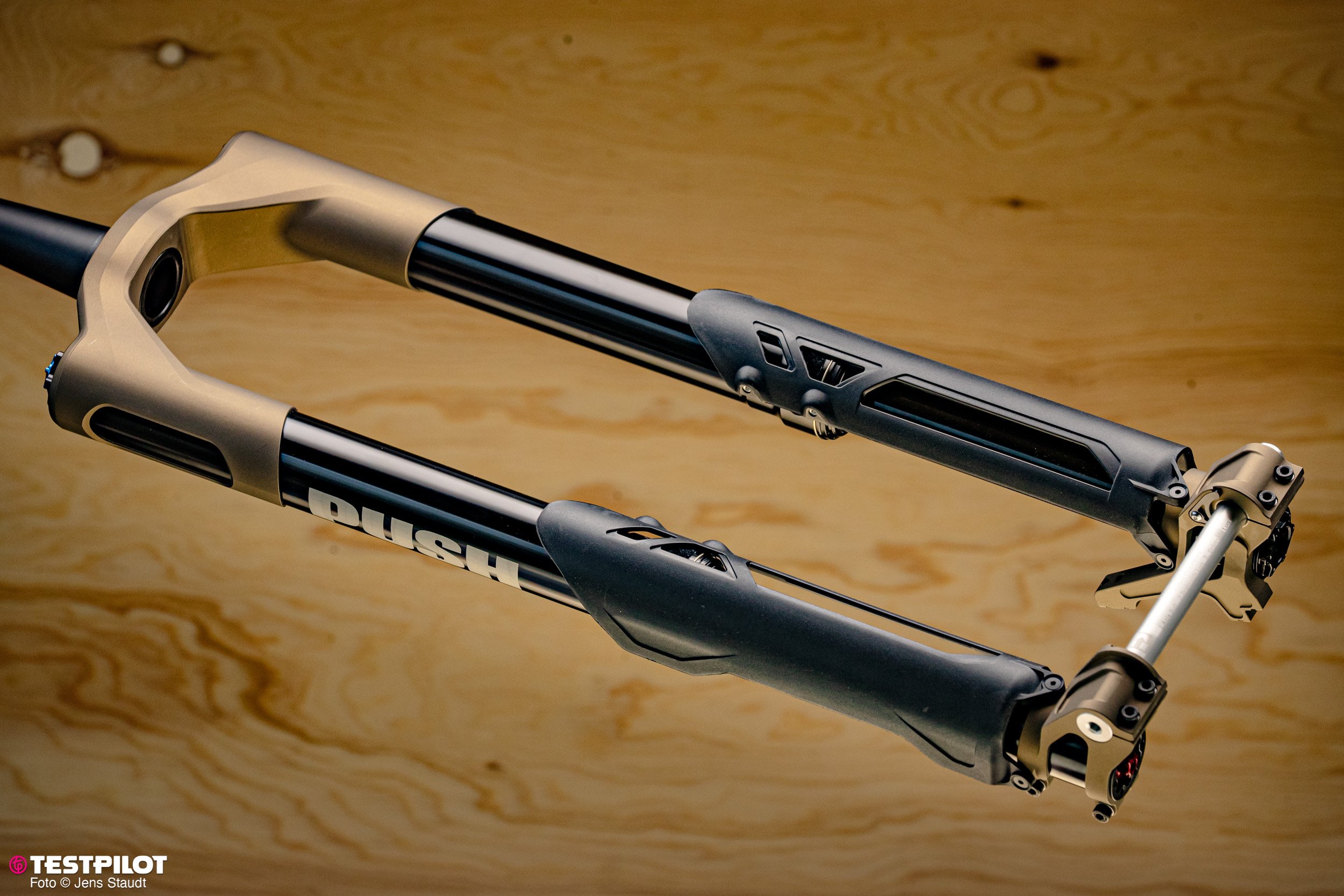
The name: Push Industries. A provider of suspension products. The approach: doing things a bit differently from everyone else. No mass production, but rather tailored to the individual customer. For the individual bike and the individual rider profile. The Nine.One V2 upside-down fork brings together not only the unique approach of a small company from Colorado but also an entirely different philosophy than what you typically see off-the-shelf from competitors. Steel spring, custom setup for each customer, and two ways to influence the spring curve…
We took the Push Nine.One V2 to the test and came out mind boggled. Different = better? Take a deep dive in the world of Push and how they do things different.
Technical info – Push Nine.One V2
| Application | Trail / Enduro / eMTB |
| ⌀ | 36 mm Stanchions / 44 mm Uppers |
| Travel | 140–170 mm |
| Settings | HSC & LSC, LSR, Sub Chamber, HBO |
| Suspension | Coil-Spring with Sub Chamber |
| Damping | NINEONE |
| Wheel sizes | 29″ / 27,5″ |
| Max. Tire Width | 2,6″ |
| Axle dimension | 15 x 110 mm Boost |
| Brake rotor | PM 180–203 mm (220–223 mm Adapter) |
| Offset | 44 mm (29″) / 37 mm (27,5″) |
| Axle-to-Crown | 551–581 mm (je nach Travel) |
| Steerer tube | 1,5–1 1/8″ |
| Casting | Aluminium |
| Wipers | Push ULF Seals |
| Fender | optional |
| Color | Black / Bronze |
| Weight | 2.941 g |
| Warranty | 2 years |
| Price (RRP) | ca. 2.399 € |
| Website | pushindustries.com |
Price-Performance-Ratio
At Testpilot, we have our own perspective on product pricing. At the end of the day, mountain biking is an (expensive) hobby—but back in the day, just like today, you could have an absolute blast in the woods on a rigid bike. Do we really need high-end suspension, premium carbon frames with motors, and bikes that cost $15,000? Not really. Still, it's difficult to draw a clear line on what constitutes a reasonable price. Is the manufacturing quality from brand X actually better? Do higher-grade materials always justify a premium markup? What about better service? Or the availability of replacement parts five years down the road?
With Push, however, it's easier to justify the investment. The Nine.One stands out from the crowd positively. Machined in Colorado, it doesn't roll off an assembly line in some massive Far East factory every few minutes. Choosing this product isn't as simple as just tossing it in your shopping cart. It involves a process where you actually communicate with the Push team and their partners (if you live outside the US).
Your body weight, bike type (e-bike or analog), and riding style are all considered—and this doesn't just ensure you get the right steel spring rate installed from the factory. Every parameter factors into the tuning of the damper cartridge as well. When the fork arrives at your door, all settings are dialed in and ready to go, specifically for you. Just mount the fork on your bike and go for a ride.
Still not satisfied? Their "60-Day Performance Guarantee" means they've got your back with advice and support—all to make sure the fork performs perfectly in the end.
Every time you send your Push suspension in for service, the one-year factory warranty gets extended by another year—essentially making it possible to have a lifetime warranty.
Push also offers a warranty reset program: if you buy a used Nine.One, warranty is transferred to your name.
So does the Push Nine.One V2 still cost a pretty penny? Yes. But you have to weigh the value they deliver against the rest of the market.
Tech bits Push Nine.One V2
In our field test, the Push Nine.One V2 is the second fork we've featured that uses an upside-down design. While Push Industries long focused exclusively on shocks and tuning kits for other manufacturers' forks, the V1 version of the Nine.One hit the market in 2024. However, it's still a rare sight in European regions.
This exclusivity can be explained partly by the price and partly by Push's presence primarily in the aftermarket. While the big players rely on mass production in the Far East, Push sticks to its own manufacturing facility in Colorado, with custom tuning directly on the customer level.
For the OEM business, this approach is simply too complex and costly. But that's precisely what makes the product so compelling—it's tailored specifically to the customer, giving you significantly more control over performance.

Push Nine.One V2 – Chassis
The chassis, which was FE-optimized at the headquarters, combines 44mm upper aluminum tubes with 36mm lower tubes. A CNC-machined, two-piece crown catches the eye. Thick black tubes adorned with machining marks are encased by a U-shaped CNC component—permanently bonded there with special adhesive, of course. The modular axle mounts complete the visually appealing overall picture. In the bronze finish, these components really pop as well.
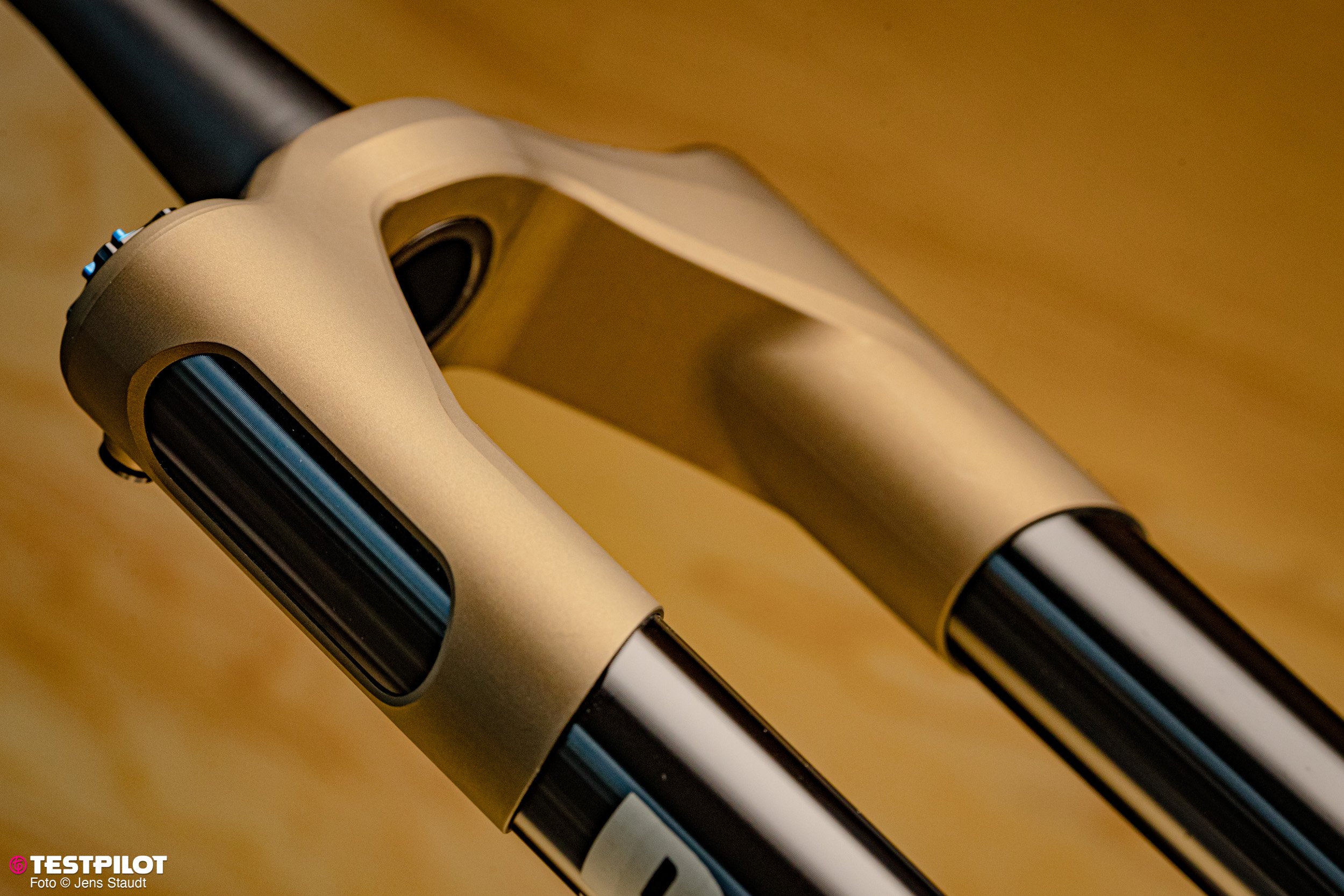
The 44 mm uppers get enclosed into a u-shaped part.

At the end of the 36 mm tubes you will find the exchangeable dropouts.ch wechselbare Achsaufnahmen.
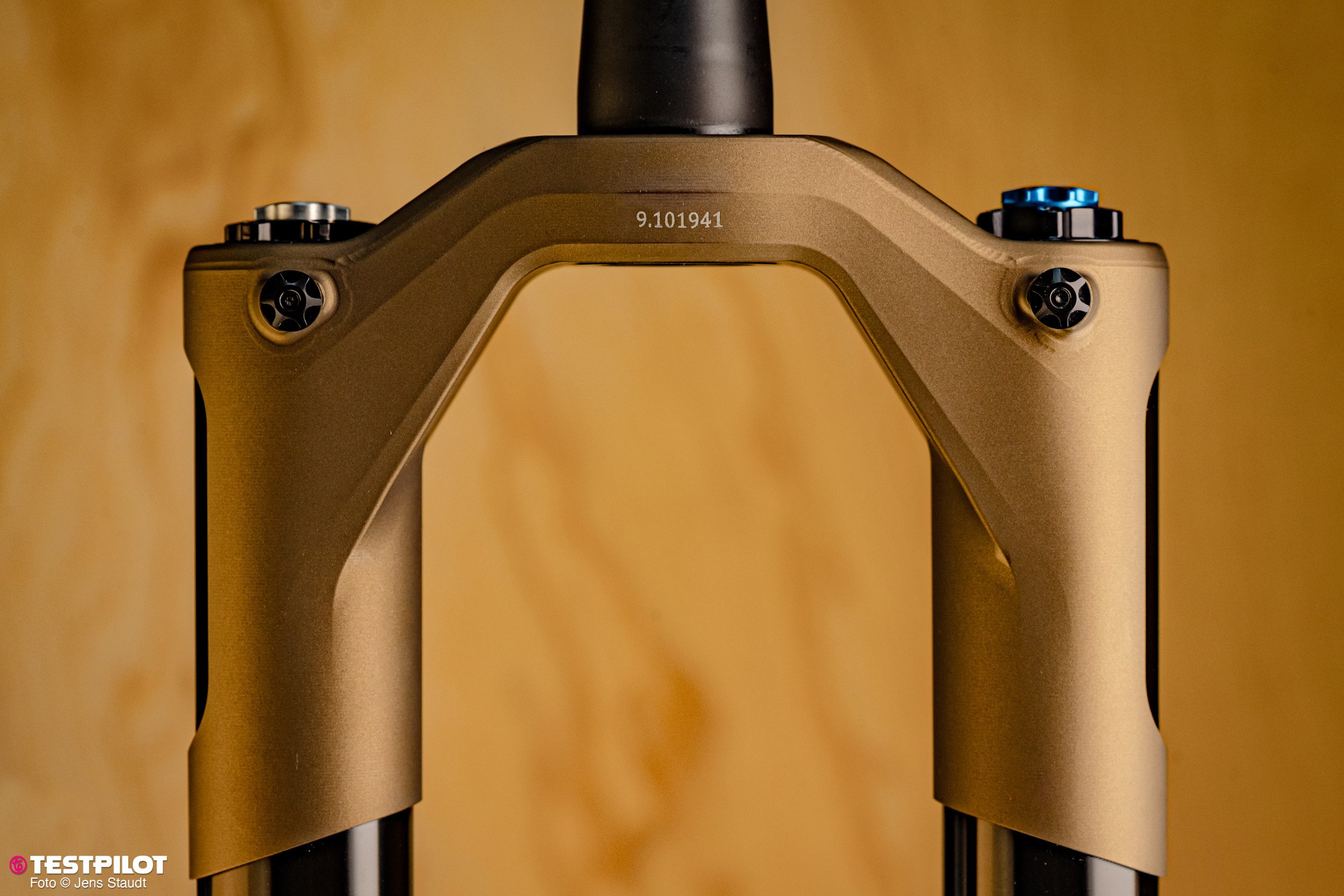
What are you fancy for? Bronze or plain black?
On the back of the crown, there is a bleed valve on each side with a pull-to-release design. Pulling the knobs allows excess air pressure to escape.
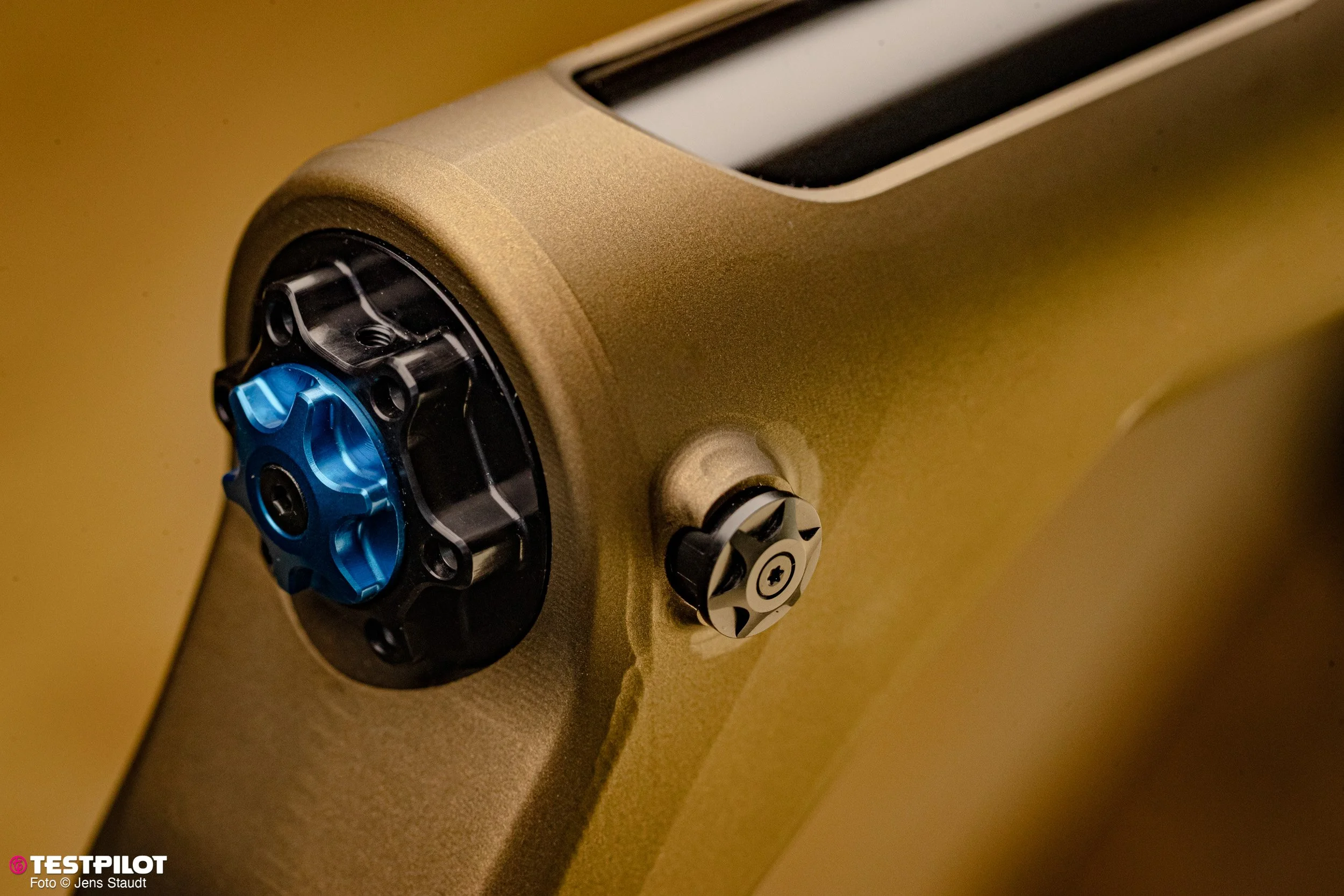
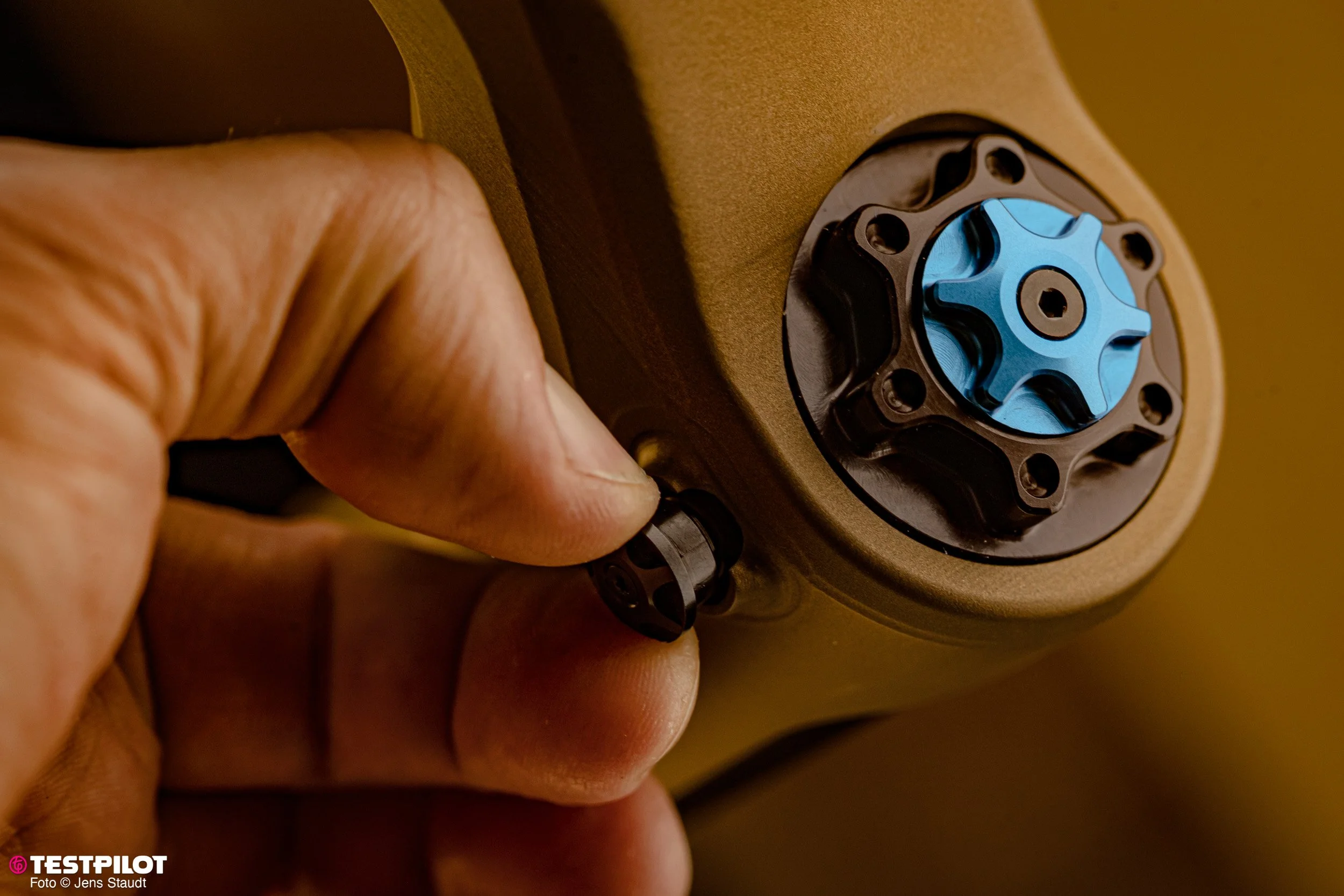
The axle mounts are modular, with individual lugs that can be easily attached or removed using two screws each—the different options allow you to change the offset or adapt the fork for a different wheel size (27.5" or 29"). With a clamping width of 38 mm, they're designed to provide plenty of stiffness at the lower end.
The fully integrated direct-mount brake caliper tab is located on the left lug—accommodating either 180mm or 203mm rotors. 220/223mm rotors are possible with an adapter. The fork guards also bolt directly to the lugs, allowing them to be replaced or carried over when swapping lugs.
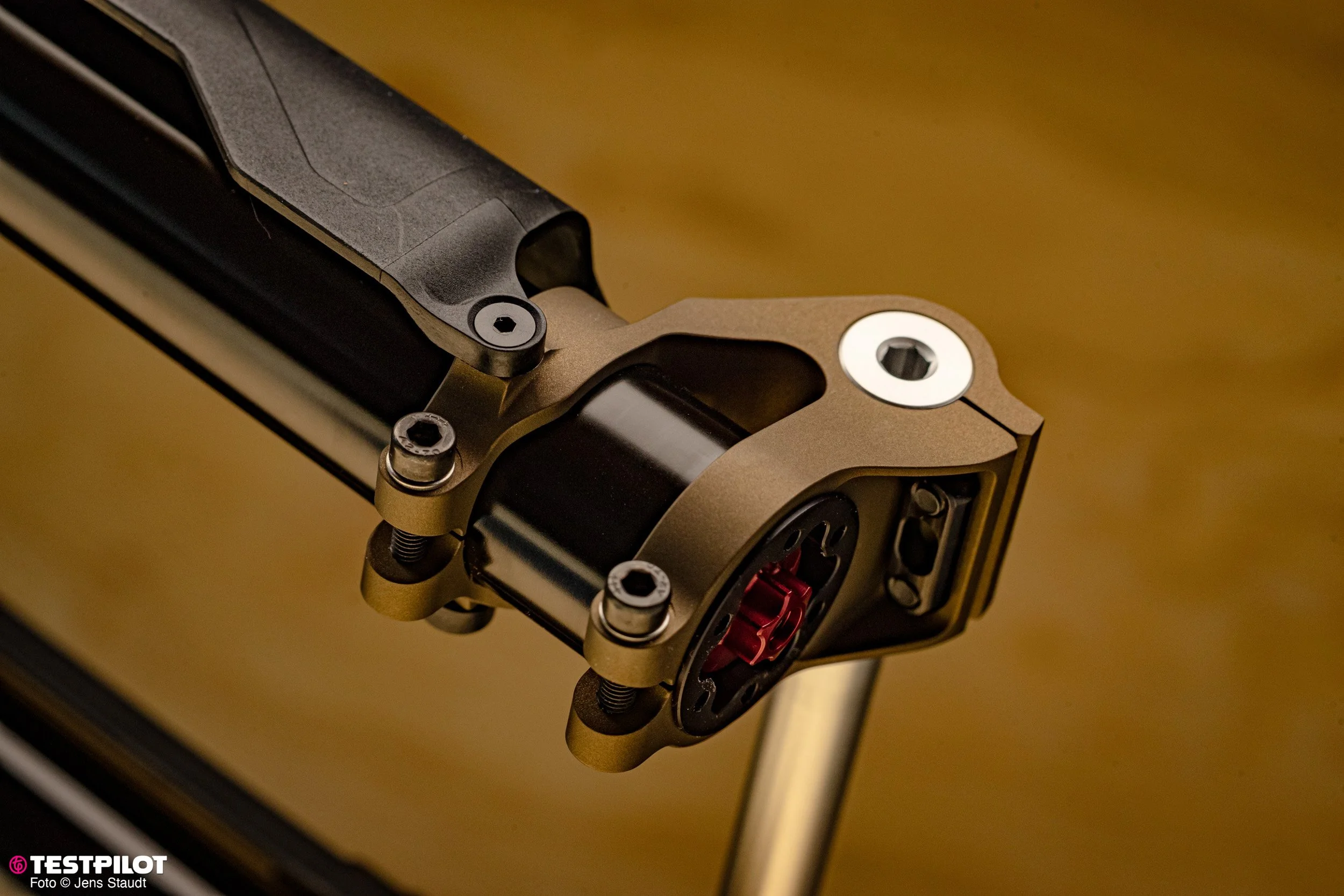
The modular lugs are secured to the stanchions using two clamping screws.
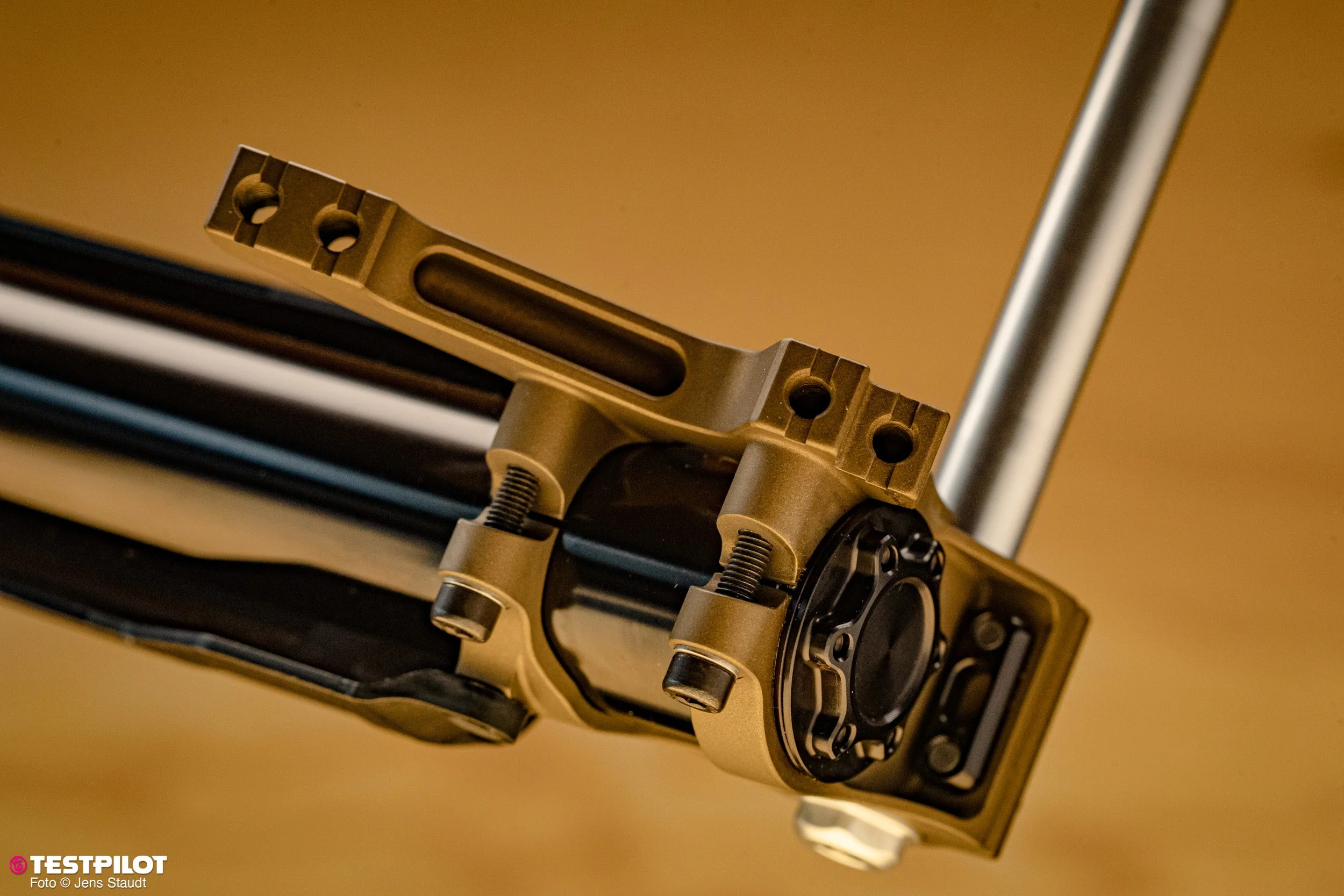
Both options are possible—the left lug features a direct brake caliper mount for either a 180mm or 203mm rotor.
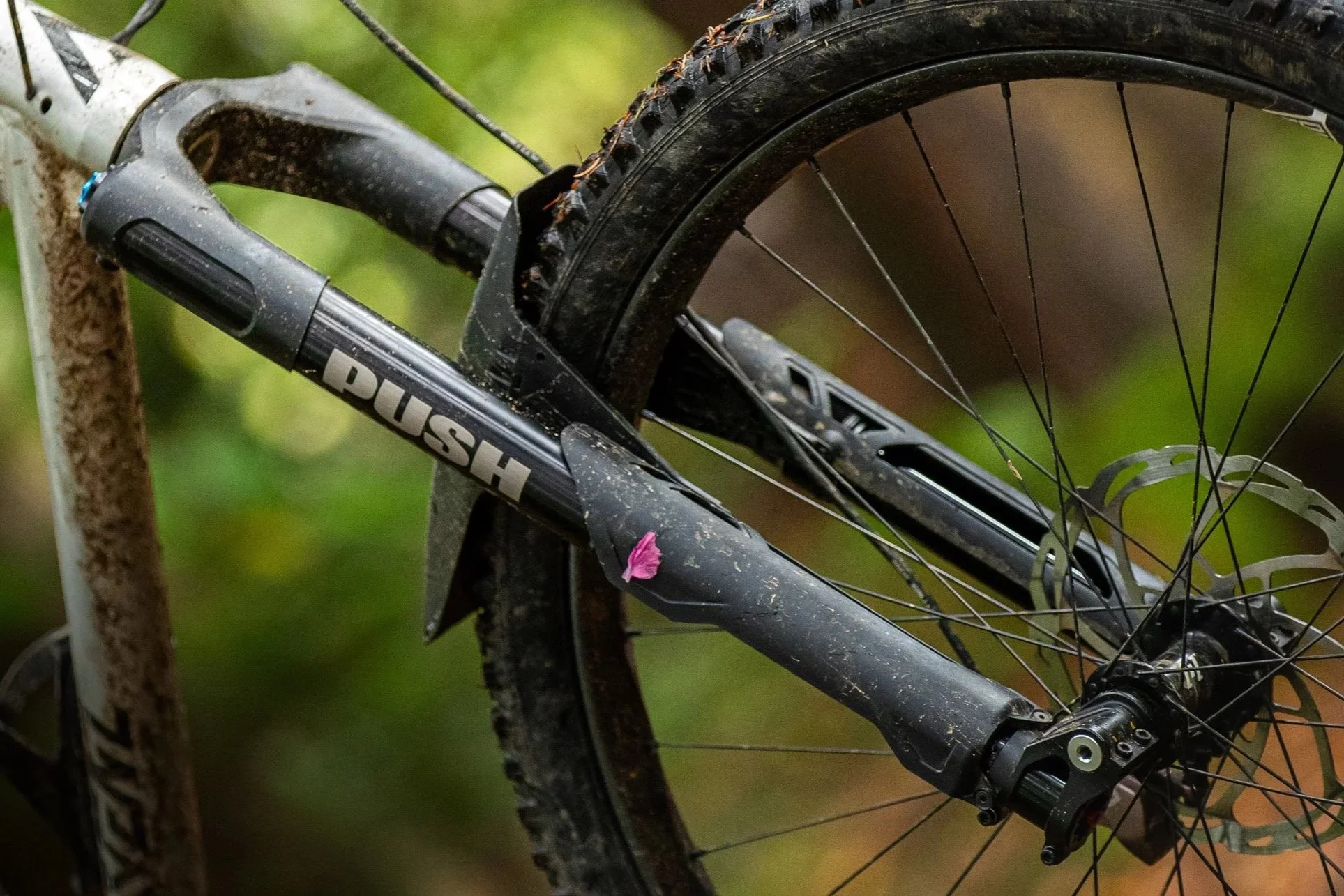
On the left stanchion guard, there is a mounting point for the brake hose or the optional fender. If you prefer to ride without the guards, you'll need to figure out how and where to keep the hose away from the front wheel. The fender cannot be mounted in that case either.
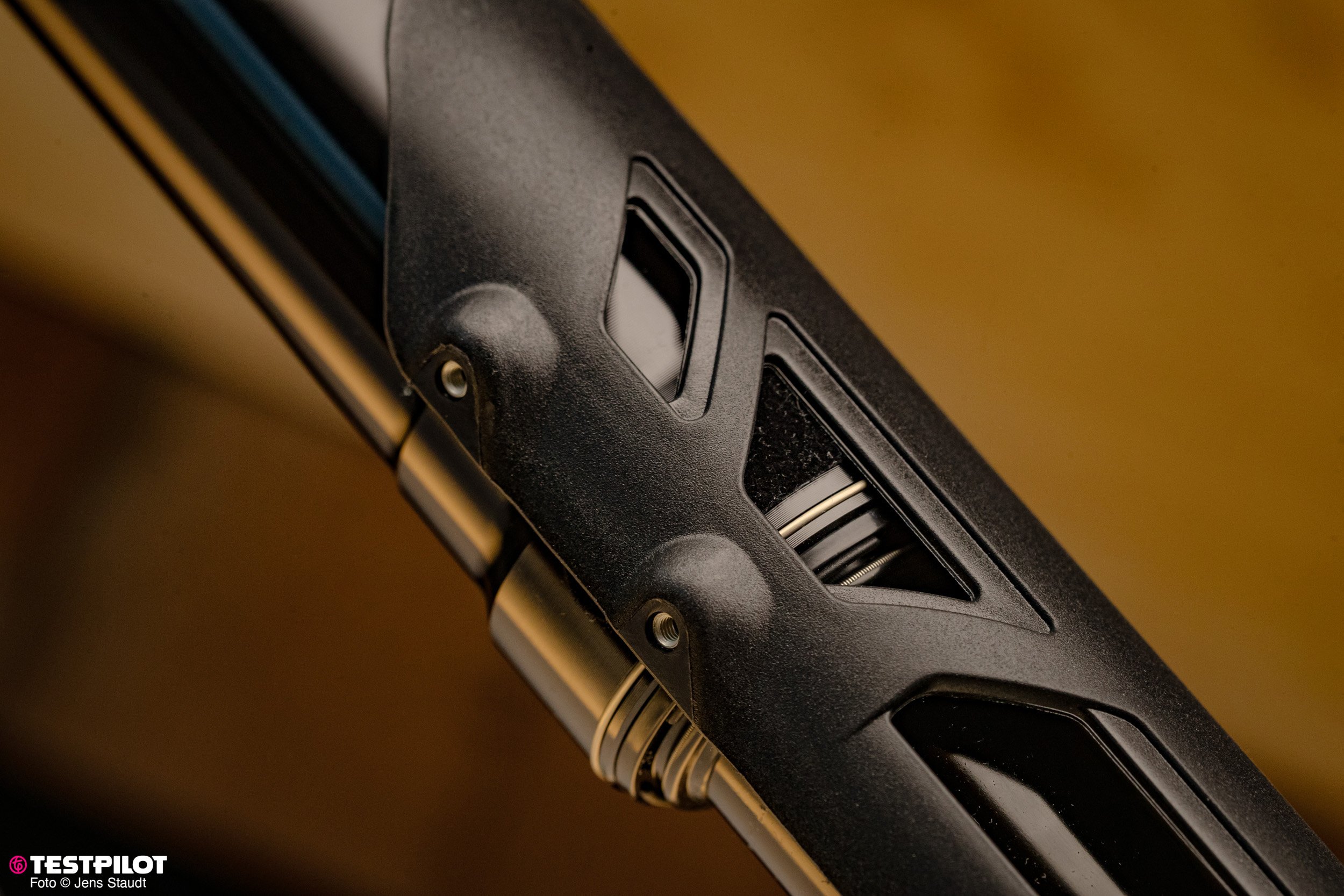
On the inside of the left fork guard, there are two small threaded holes…
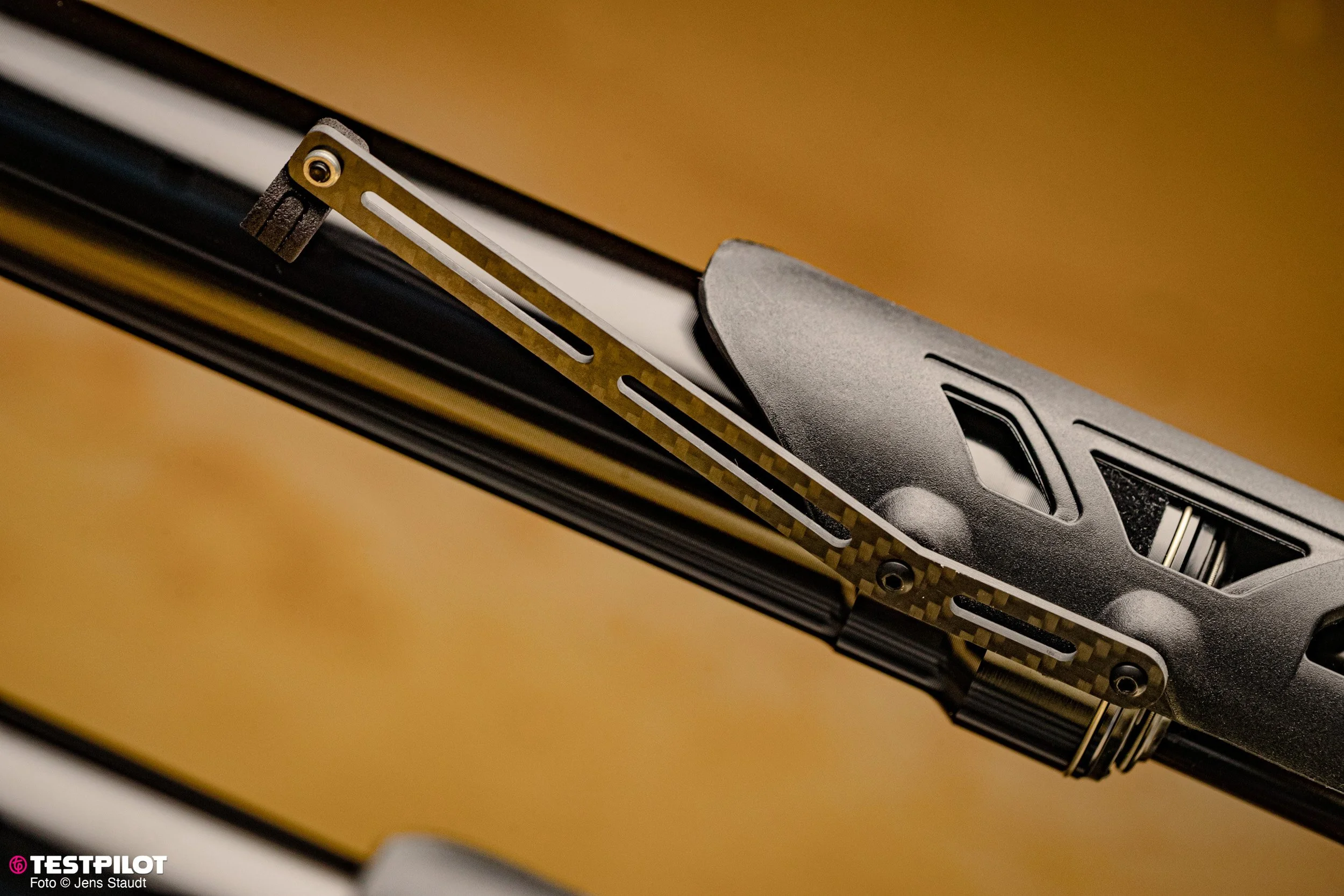
to which either a brake hose guide or…
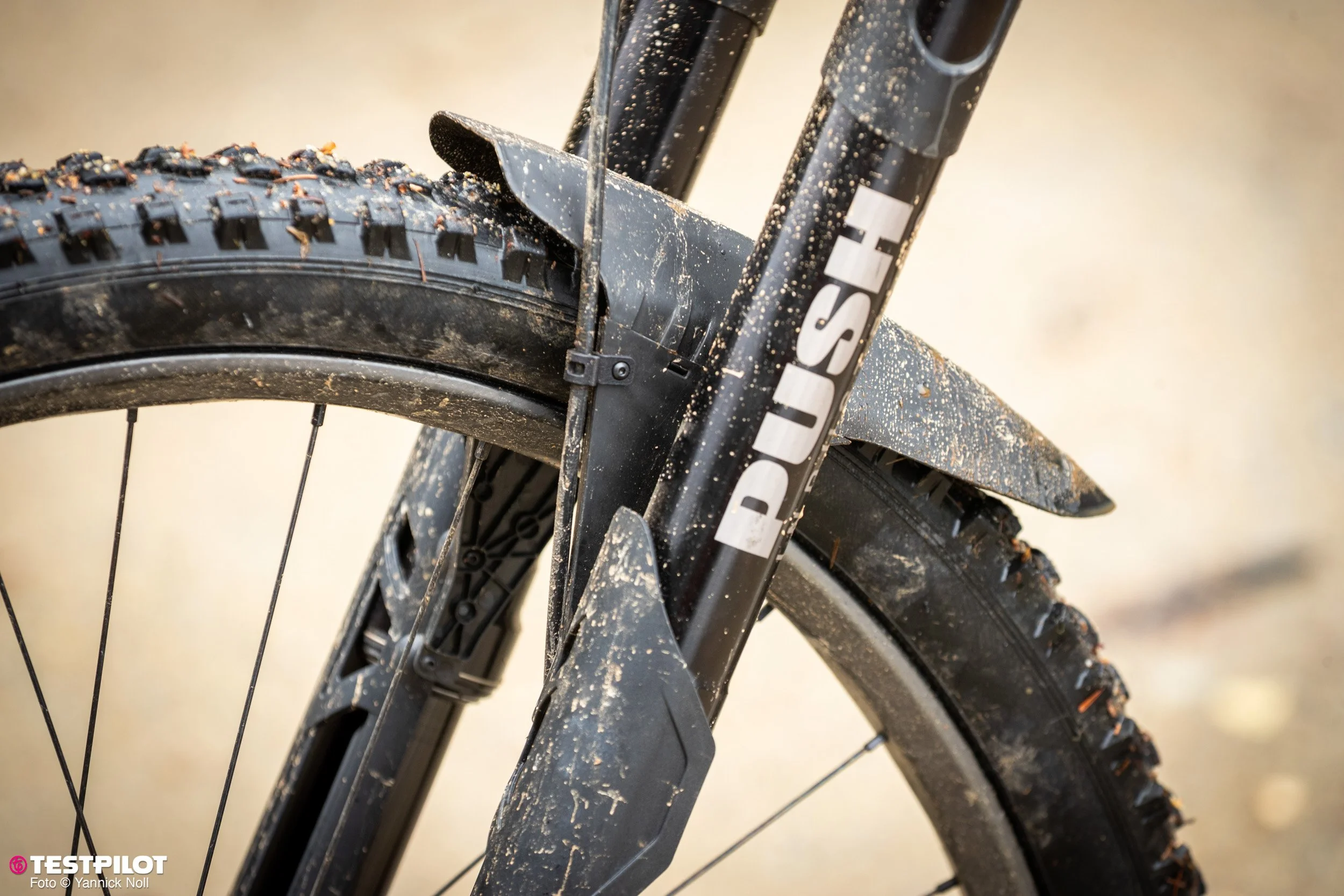
a fender can be mounted.
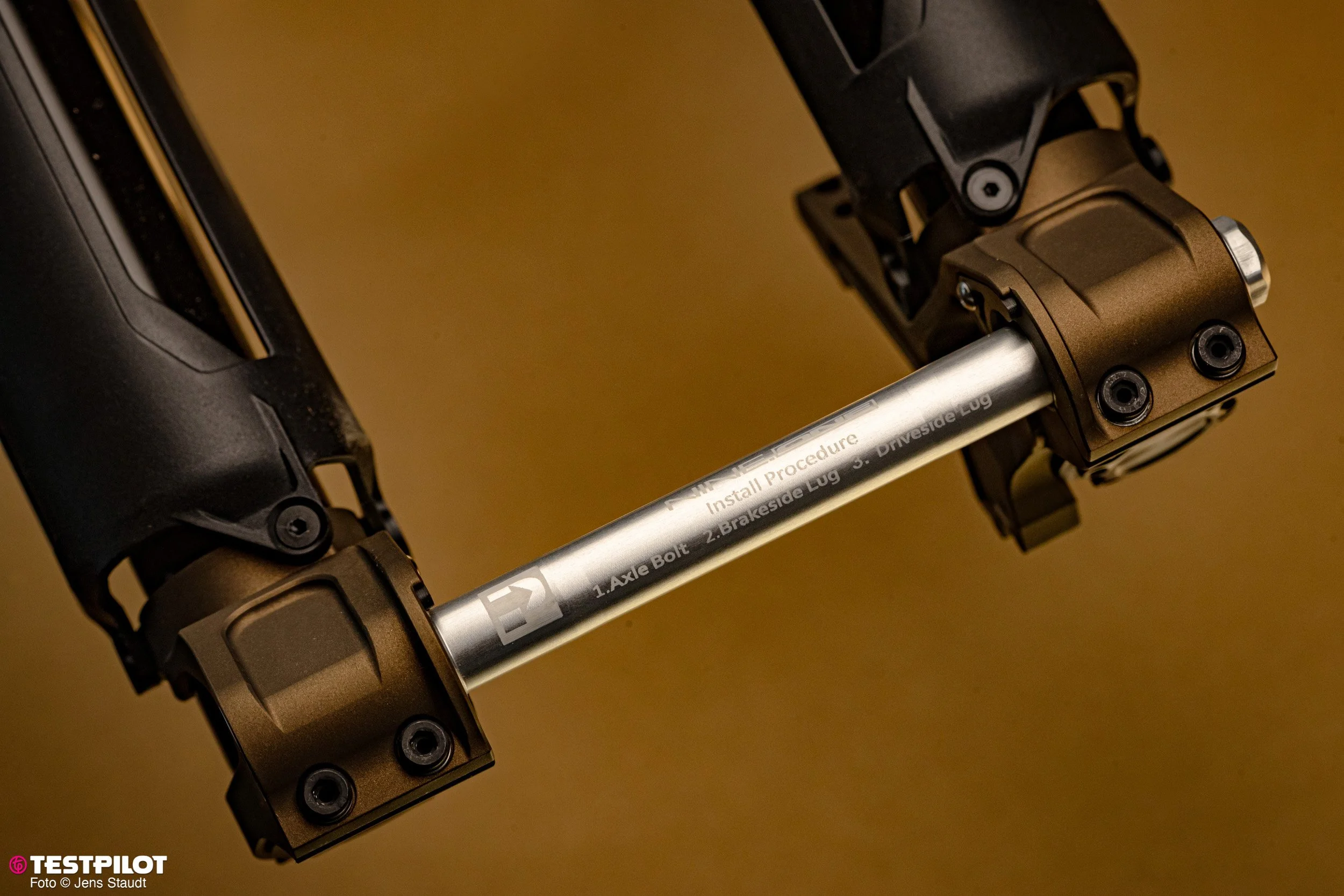
The floating 15 x 110mm Boost thru-axle is designed (when used correctly) to eliminate binding (and the resulting friction) caused by tolerances and variations in hub width. Clever touch: instructions lasered right on the axle.
Like all manufacturers using an upside-down design, Push highlights the increased bushing overlap as a key advantage. This is intended to deliver the familiar USD feel—less friction and improved small-bump sensitivity. As the fork moves deeper into its travel, leverage forces are further reduced compared to traditional right-side-up designs—Push explains it this way:
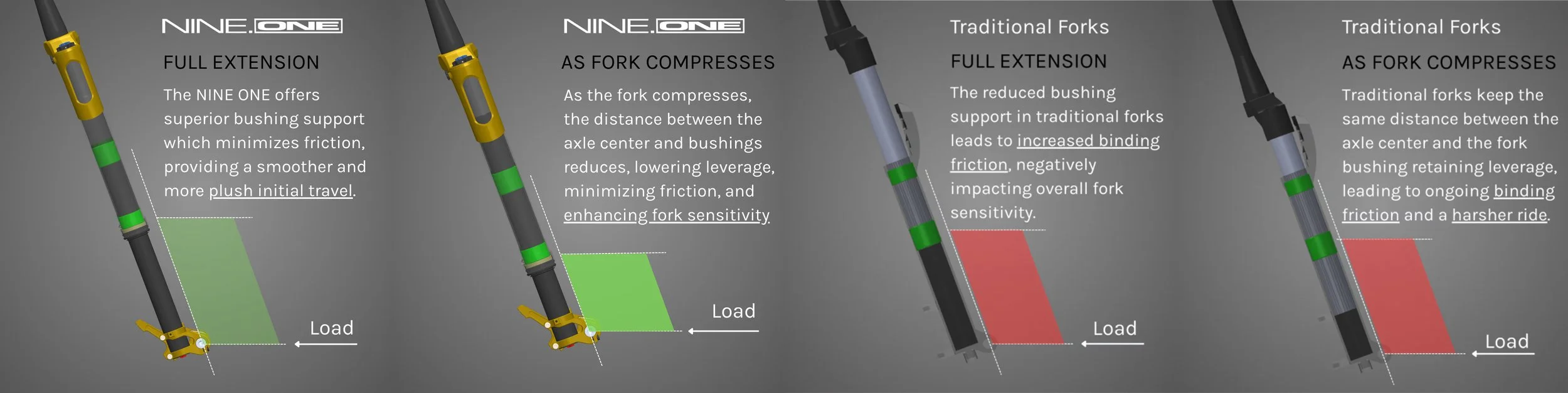
Push put a significant amount of work into the development of the bushings. They are precisely fitted and hand-calibrated to the stanchions. The Nine.One also features a bushing design where the slide bushings, along with Push's proprietary ULF seals, are permanently submerged in fork oil. All of this combined results in even less friction and even greater sensitivity on the trail.
Push Nine.One V2 – Coil Spring
The steel spring can be swapped out fairly easily in your home workshop. It is inserted on the left underside of the fork. To remove the cover, there's a special socket from Push—which is included with the fork.
Push offers the following springs:
30lb/in (Red)
35lb/in (Yellow)
40lb/in (Orange)
45lb/in (Blue)
50lb/in (Green)
55lb/in (Black)
60lb/in (Grey)
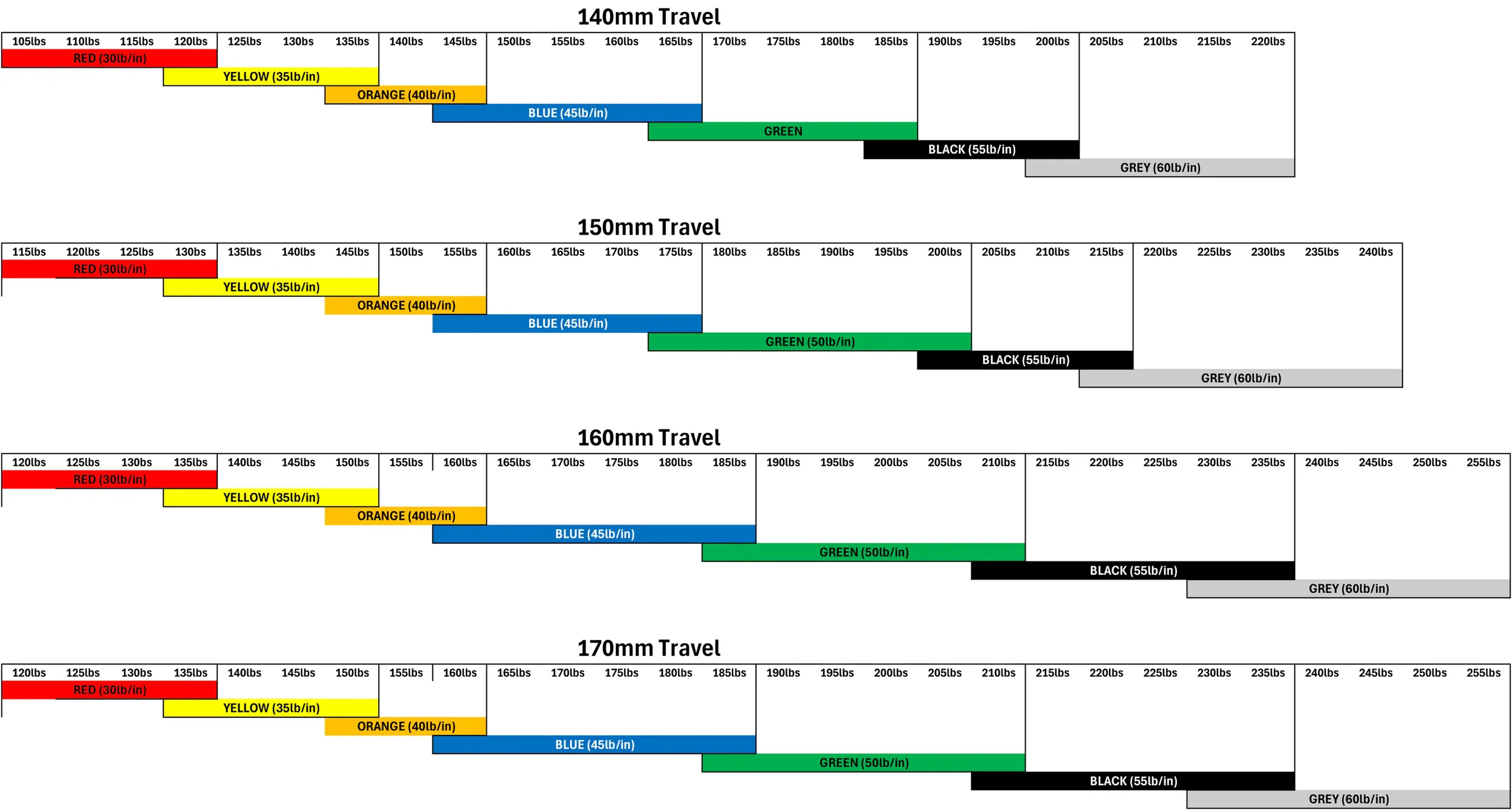
Which spring rate is right for you? Below you will find a reference table. You may need to look at the travel of your fork, because it will affect the range in which every spring will work best:
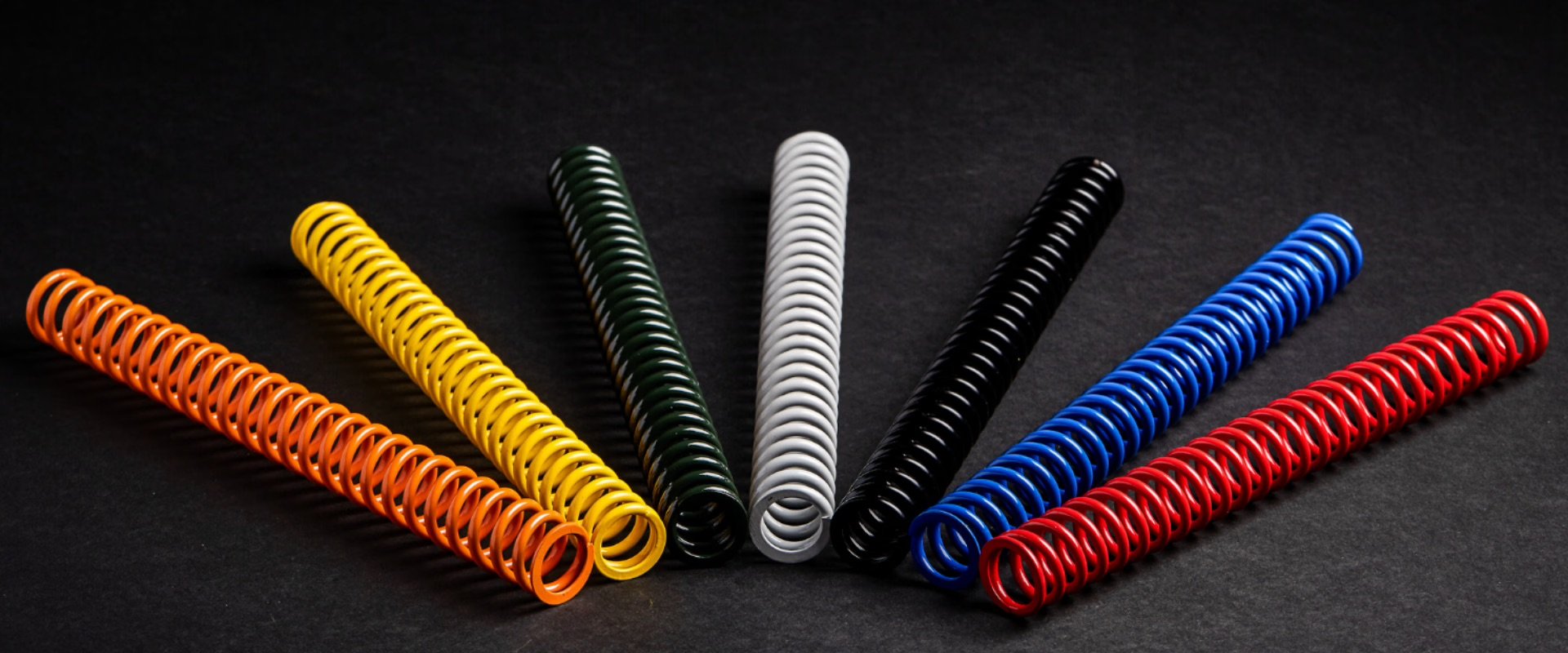
The seven different springs available for the Nine.One. You can learn how to swap the springs in this video:
Push Nine.One V2 – Damping
The Push Industries Nine.One V2 is not an off-the-shelf fork. Each one of them that leaves the factory is individually tuned to the customer. For customers outside the US, this is handled by the respective distributor. In our case over here in Germany, that's MRC-Trading.
The damping architecture, which is based on the Eleven-Six shock, is assembled according to the customer's weight and riding style, with the adjusters also preset accordingly. This base setup then arrives at the customer's door along with the Nine.One.
Push has extensive experience when it comes to fork damping, not least because of an earlier tuning product called the HC97. This compression damper assembly was installed as a replacement in a wide variety of Fox or RockShox damper cartridges and still enjoys a consistently positive reputation to this day.
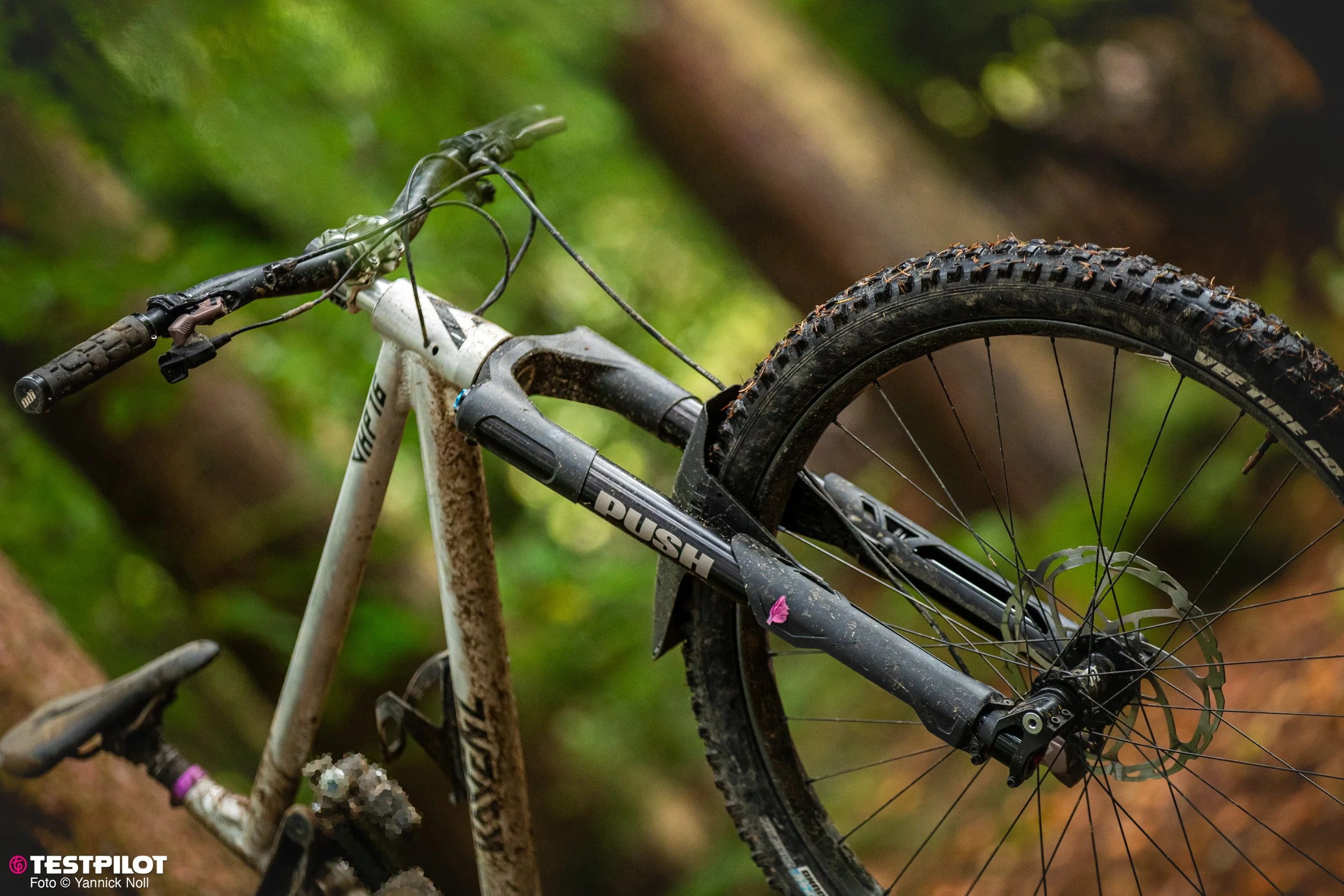
Every Push fork is individually tuned to the customer based on weight and riding style and is shipped with a base setup. In our case, this was handled by the German distributor, MRC-Trading.
Setup of the Push Nine.One V2
Push sets up the Nine.One V2 for you straight from the factory. Nevertheless, it's important to spend time with the setup because the tuning possibilities offer a broad range. It's probably safe to say that those who choose this fork not only want something "special" but are also genuinely interested in its functionality.
The base setup as delivered is always documented, so you can confidently experiment and get lost in trying different settings, knowing you can always return to square one.
For selecting the correct spring rate, Push relies on their laid-out table (you saw already further up this review). Depending on your weight, you might find yourself between two spring rates—one drawback of using steel springs as the spring medium. Push defines a transition range when jumping between two springs.
Depending on personal preference, you can then choose a softer or firmer spring. During testing, we covered rider weights of 154, 165, 209, and 220 lbs. We explored the limits using the green (50 lbs) and black (55 lbs) springs.
We achieved good ride quality with both spring rates. Nevertheless, we recommend that every user consider getting the alternative spring (softer or firmer) as well. The fork still responds phenomenally even with the firmer spring, and features like the switchable progression (Sub Chamber closed—explained in the next section) open up exciting setup combinations.
| Spring | Compression | Sub Chamber |
|---|---|---|
| Softer spring | less compression damping | open |
| Softer spring | less compression damping | closed |
| Softer spring | more compression damping | open |
| Softer spring | more compression damping | closed |
| Stiffer spring | less compression damping | open |
| Stiffer spring | less compression damping | closed |
| Stiffer spring | more compression damping | open |
| Stiffer spring | more compression damping | closed |
This list can be further expanded by the nerds by including rebound settings. You can choose to run the softer spring if you're using a faster rebound setting. Conversely, you can also use a firmer spring with a slower rebound setting.
For his weight (165 lbs), Yannick was on the stiffer side of the recommended weight range with the blue (45 lbs) spring; as a result, he preferred running the system without the Sub Chamber engaged. With this setup, the Nine.One worked particularly freely in the mid-stroke and generated maximum grip.
If you're also right in between springs with your weight and opt for the stiffer one, you can still engage the Sub Chamber, but you should open up the damping slightly to compensate. This makes the Nine.One feel even firmer and more precise. However, this comes at the expense of maximum traction and requires a bit more effort on long, rough descents.
These are subtle nuances—but they demonstrate just how wide the tuning spectrum of the Nine.One V2 is and how finely its character and feedback can be tailored to personal preferences.
Rampup. Bottom Out. Travel.
Rampup: Sub Chamber
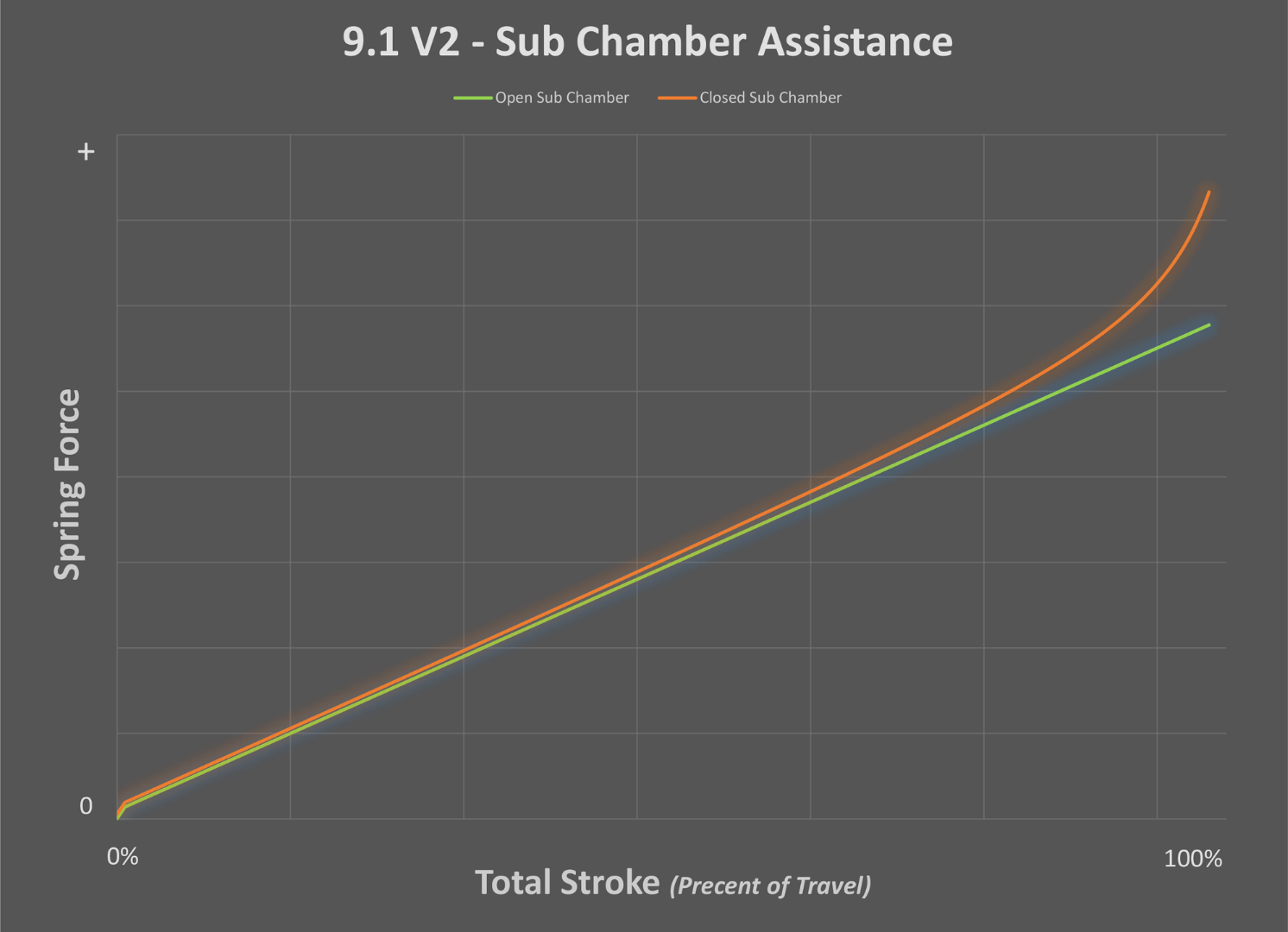
There is air inside every fork—and not just on the spring side. The Nine.One V2 uses a steel spring, of course, but this doesn't operate in a vacuum either. As a fork compresses, various internal volumes decrease, compressing the air trapped inside. This means even a coil-sprung fork has some air-induced progression. The amount of progression depends on the size of the volume and how much it changes. And this is precisely where Push steps in to turn this characteristic into an advantage.
On the top of the fork, there is a small dial for what they call the "Sub Chamber." Turning it 180° closes a valve, sealing off an air chamber inside the fork.
With this chamber now isolated, its air volume acts like an additional source of progression. When the Sub Chamber is open, the total air volume within one fork leg functions as the progression volume, and the fork feels largely linear (thanks to the steel spring!) until the hydraulic bottom-out takes over. Activating the Sub Chamber closes a pneumatic blow-off valve, sealing off a smaller internal air chamber from the rest of the fork leg volume.
This smaller volume generates more progression, providing additional support to the steel spring in the mid-stroke. Previously, with the larger volume, the fork was less progressive and more linear in its travel usage, meaning you'd use more travel for the same obstacle or landing with the same spring rate. In the more progressive setting, the primary working range of the fork is pushed higher into the travel, giving you more support on steep trails or for managing weight shifts, such as those on an e-MTB.
What makes this system particularly interesting is that you can adjust this parameter quickly and easily right on the trail, completely tool-free—no shock pump needed, and no need to open the fork.
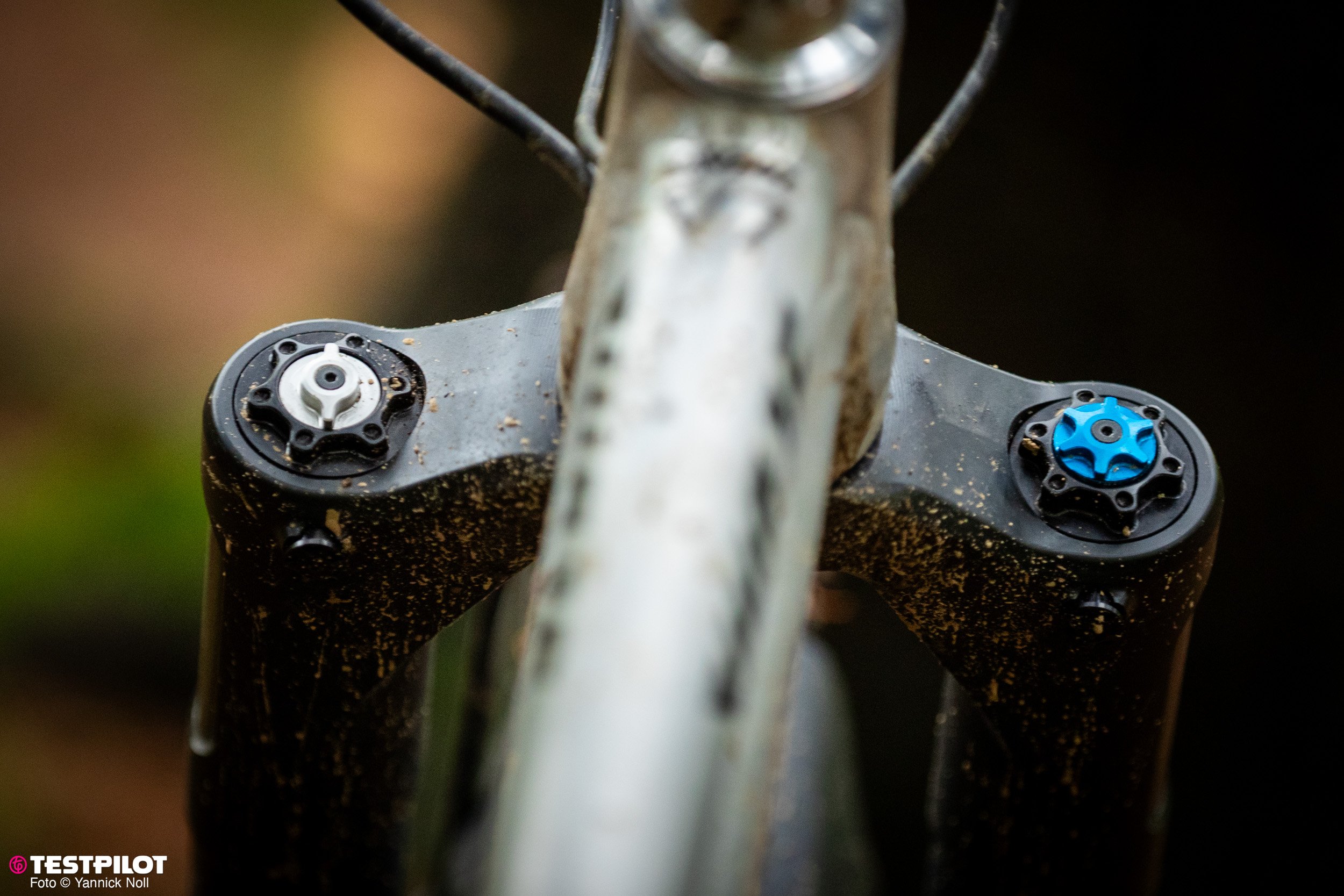
The left silver button is used to switch the Sub Chamber either on or off—there is no middle position.
Hydraulic Bottom Out (HBO)
Why would you need a hydraulic bottom-out if you can already increase progression via the Sub Chamber? What sounds like doing the same thing twice is actually simple to explain and is what makes the Nine.One V2 so special. Most manufacturers rely on air spring progression, and riders who generate harder impacts use plastic spacers to reduce the volume of the positive air chamber. If the forces are still high enough to cause a bottom-out, a rubber bottom-out bumper inside the fork prevents metal-on-metal contact and protects against damage.
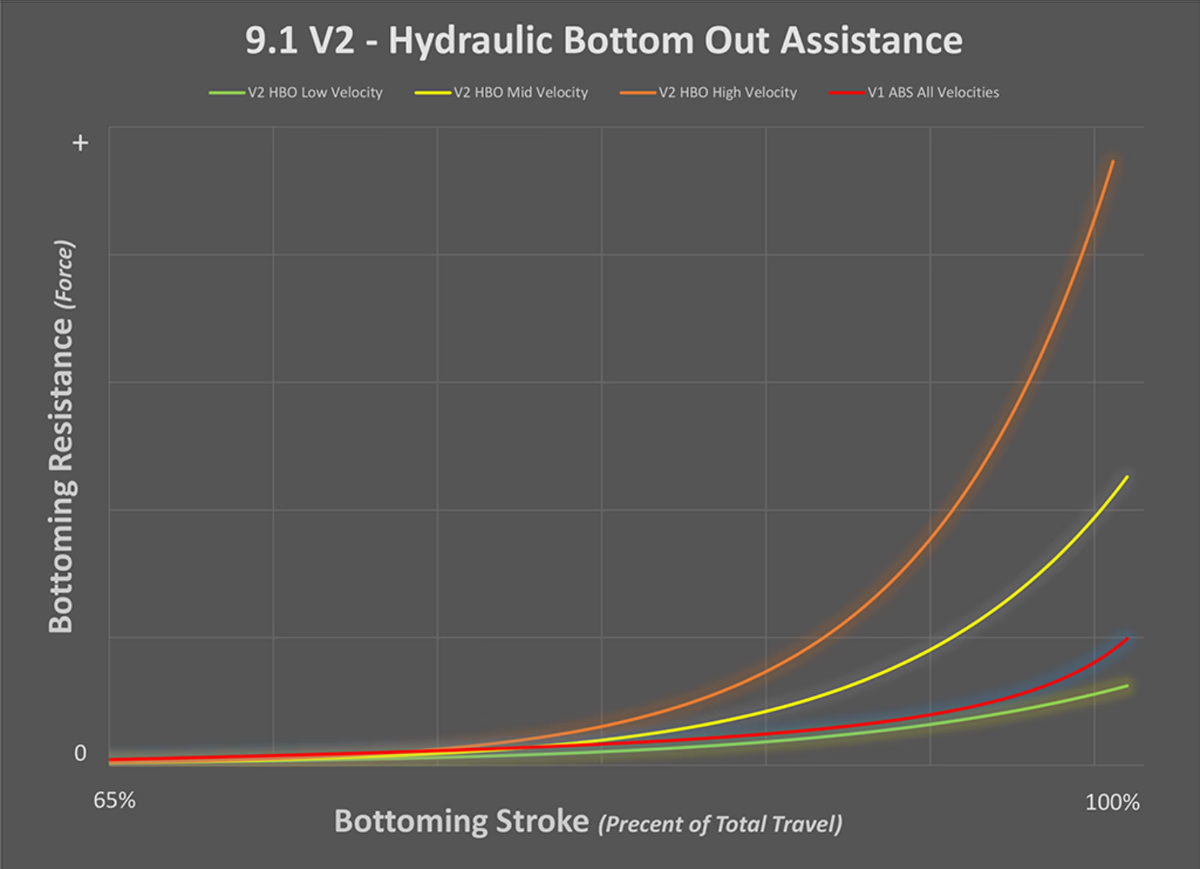
A hydraulic bottom-out is a more complex solution, but it offers added benefits. While progression from an (air) spring can only store energy, damping can also convert energy into heat, depending on shaft speed. The result is that in those moments when a landing might be right at the limit of what you can handle, you get better damping control—and when things are less rowdy, you still have full travel available. The issue of sitting on the progression of an overly progressive fork is elegantly avoided.
Since Push has a bunch of full-on nerds on staff, they weren't satisfied with just that. The HBO doesn't only affect the final bottom-out; it influences the last 70 mm of travel—which is a full 41% on the 170 mm version. Subtract sag, and you're looking at roughly 50% of the travel being influenced by this unit.
Still not enough? Correct. This range is also adjustable. Using a shock pump, you can adjust the pressure in a small air chamber behind the HBO, with a range between 10 and 40 psi. This changes the hydraulic bottom-out curve, allowing you to dial in how much damping force builds up deep in the travel.
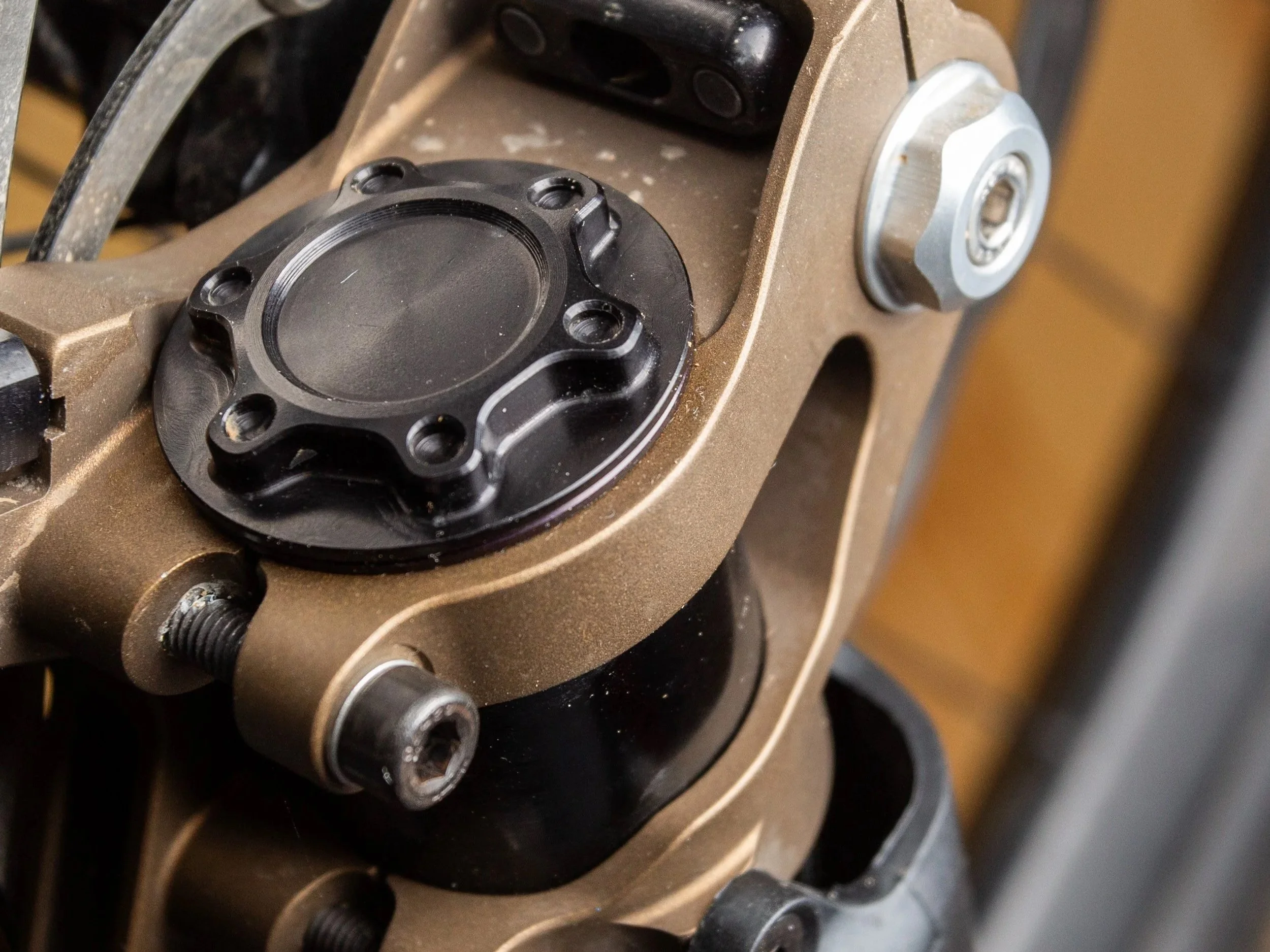
On the left bottom of the fork, beneath this cover cap, you'll find the air valve for the hydraulic bottom-out system.
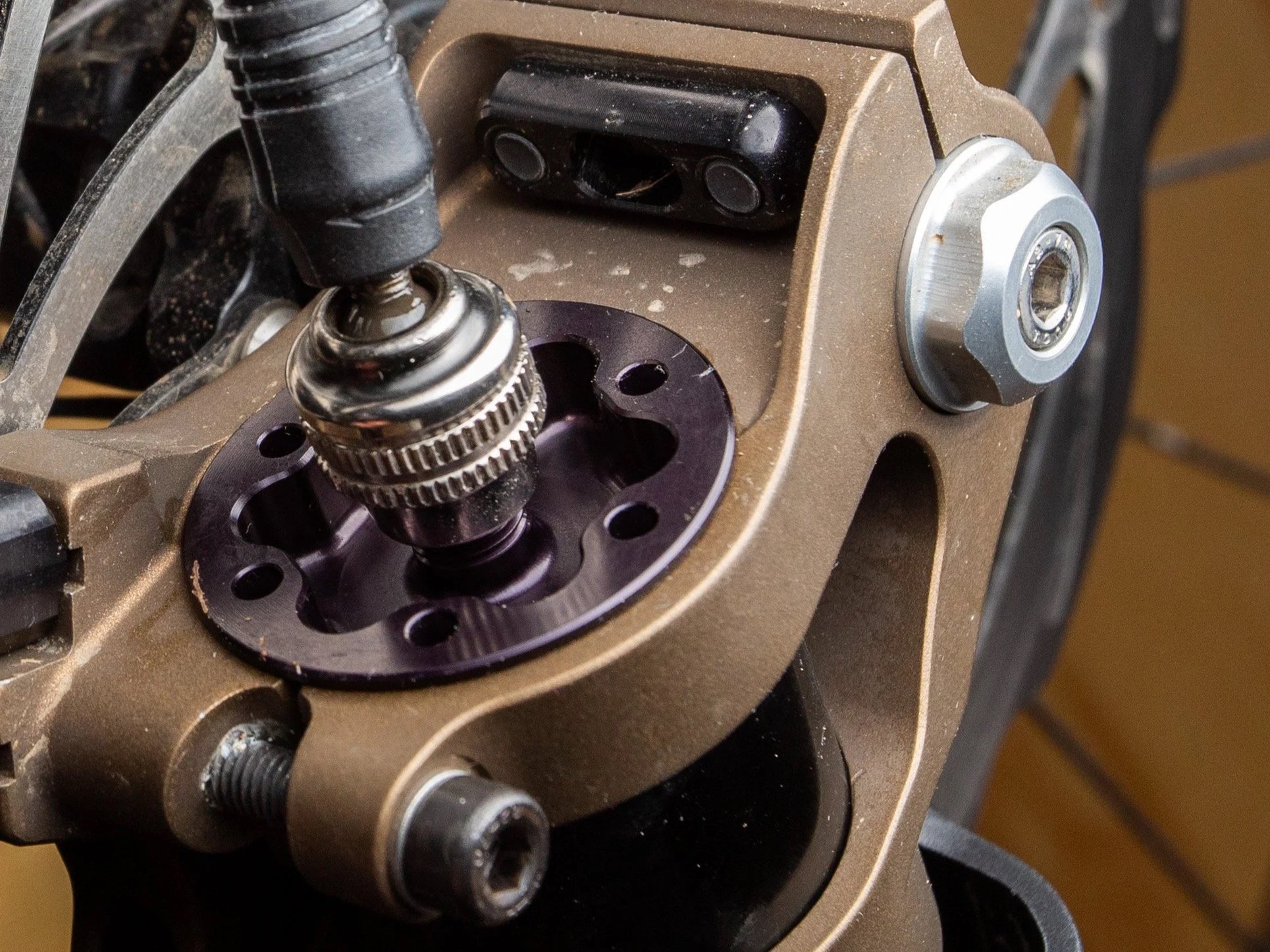
Here you screw the shock pump onto the valve and can adjust the bottom-out protection.
Changing travel
Internally, the travel is adjustable—via an adjustable bolt, the fork can be set in 10 mm increments from 140 mm to 170 mm.
To achieve this, you need to completely disassemble the spring side. However, with some mechanical experience and the right tools, this is not a problem.
Push provides an instructional video:
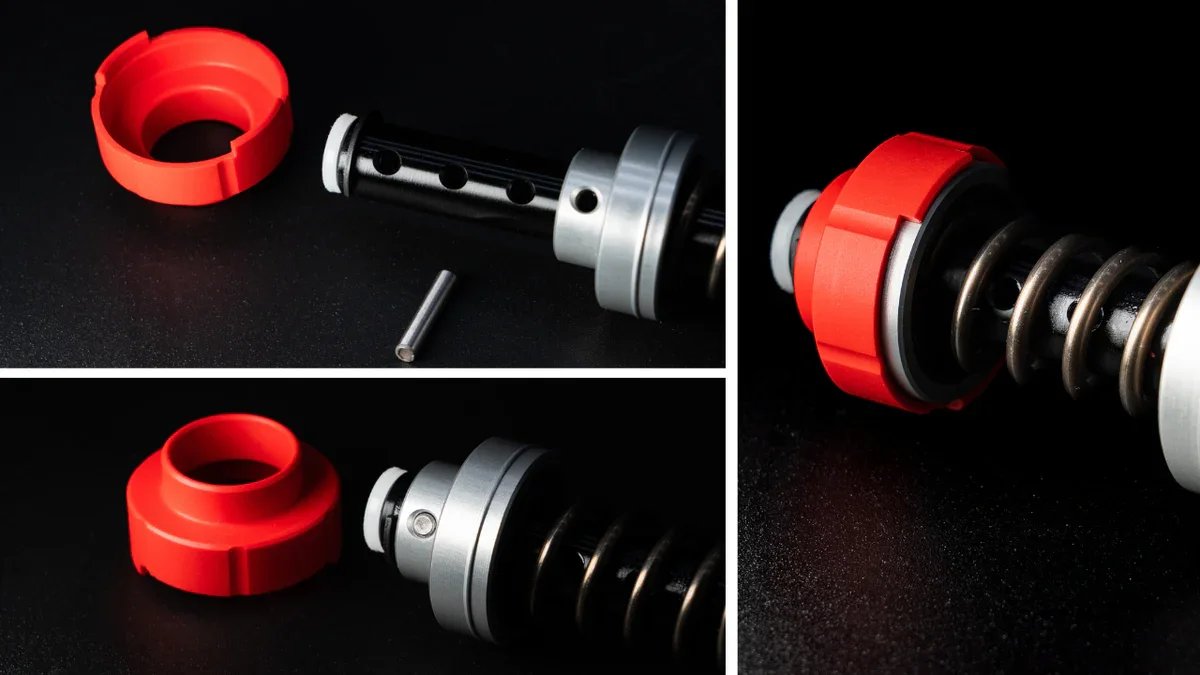
The silver piston is used to adjust the travel. Depending on which hole on the black shaft you position it in, you get 140, 150, 160, or 170 mm of travel. The silver pin secures the piston in place. The red spacer is placed on top of the piston.
Push Nine.One V2 thru axle and how to install the wheel
By design, upside-down forks require a bit more attention when handling the front wheel. Once you have the dropouts properly aligned and the hub installed, there is a specific procedure to bolt it all down to ensure a twist-free installation.
Propper mounting the 15 x 110 MM-BOOST-axle
Insert the front wheel into the dropouts and slide the axle through the dropouts and the hub.
Tighten the axle from both sides (4 Nm).
Tighten the clamping screws on the brake side (alternately, to 5 Nm).
Tighten the clamping screws on the drive side (alternately, to 5 Nm).
To prevent the fork twisting (and therefore binding later) when installing the front wheel, it's essential to follow the correct tightening sequence and torque specifications. Clever touch: the tightening sequence is laser etchted right on the axle.
For those looking to push the stiffness values of the Nine.One V2 up a notch, hubs with torque caps can be used. Appropriate installation aids are screwed onto the inside of the lugs for regular hubs.
Sidenote: During the test period, we rode the Nine.One V2 both with and without the included fender. The fender connects both dropouts to each other, and with it installed, threading the thru-axle is a bit easier.
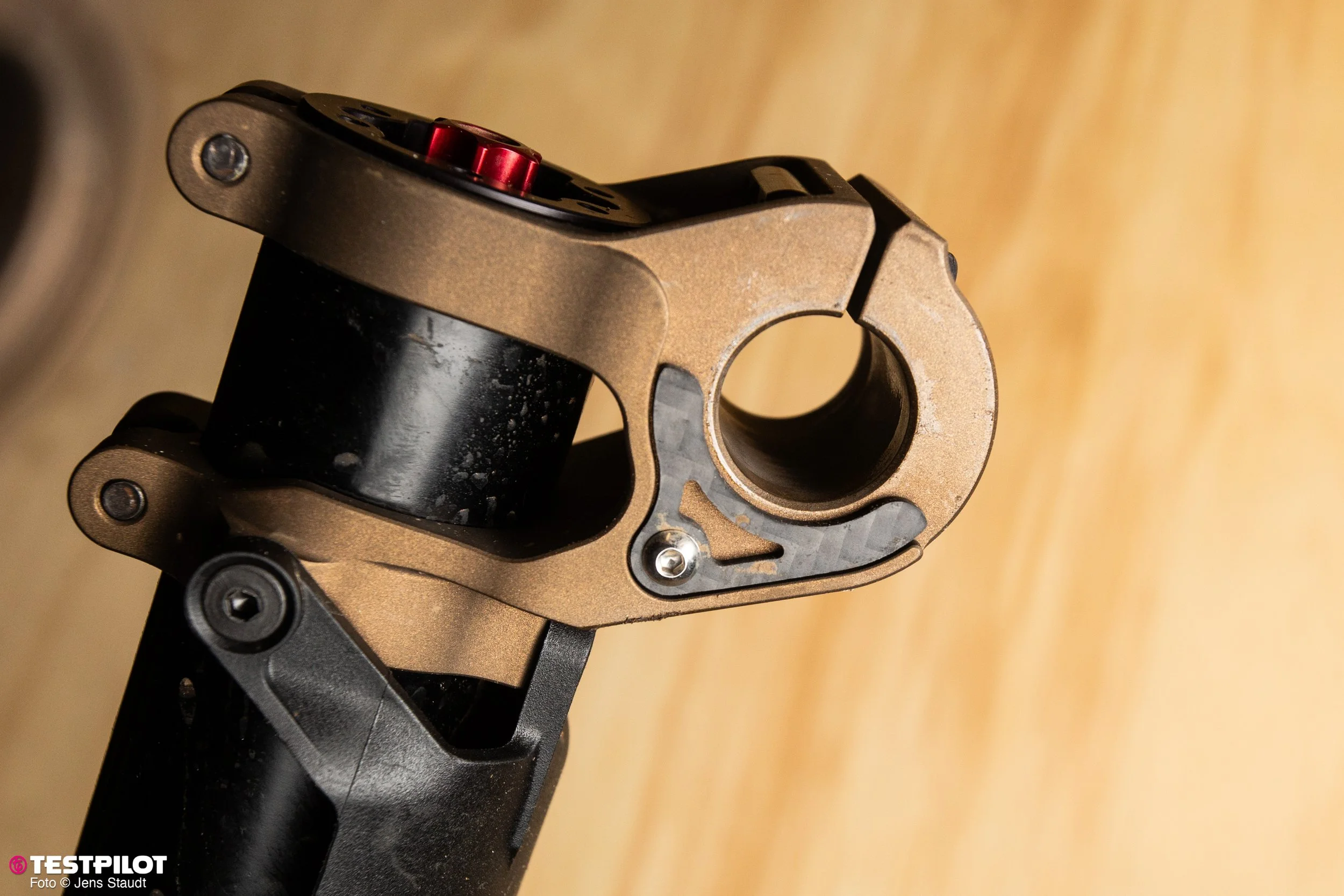
The wheel installation aids are screwed onto the inside of the lug.
On the Trail
If you haven't studied all the technical details and just want to know how the Push Nine.One V2 performs; here's the spoiler straight away. The same statement from every tester after their first ride: "This is a different league."
All testers have plenty of experience with both coil and air forks. While we didn't have an air version of the Nine.One (frankly, they don't make one) Push redefines what riders should understand when talking about a "coil feel".
For plushness and sensitivity over the tiniest pebble on the trail, no off-the-shelf fork comes close to the ride feel of the Push. You're almost bewildered by how much calmness there is up front and how much more composure and focus you can devote to picking your line.
Picking a line and plowing through? Is it because of the weight? Does it just stick to the ground like an e-bike because of its higher weight?
Honestly, the fork's additional weight is barely noticeable on the trail, because, to everyone's surprise, the Push Nine.OneV2 is not a bulldozer that simply flattens everything and sticks you to the ground.
If you need or want to pop off a root ball or a rock garden, the Nine.One V2 is there to help. How does that square with its higher weight compared to other forks on the market? Shouldn't lighter always be better? You have to look at it more closely. It also matters where the weight is located, and that's where physics comes into play.
The more substantial crown and the damper unit are situated near the head tube and are part of the sprung mass. Down below, only the slender stanchions and the axle mounts move. On traditional right-side-up forks, the heavy casting hangs directly on the axle—making it part of the unsprung mass. Less mass at the lower end means lower inertia. When you input an impulse at the bars, less unsprung mass needs to be accelerated. Additionally, the main mass is positioned higher. It's like not having to lift the weight all the way from the floor during a deadlift.
The combination is a winner. It reduces the effective moment of inertia of the front end and makes the bike feel more agile than the raw weight number would suggest. This quite literally makes your life easier on the trail—and at the latest, when you first pop off something, it'll have you staring down in disbelief, because it's surprisingly light and unobtrusive.
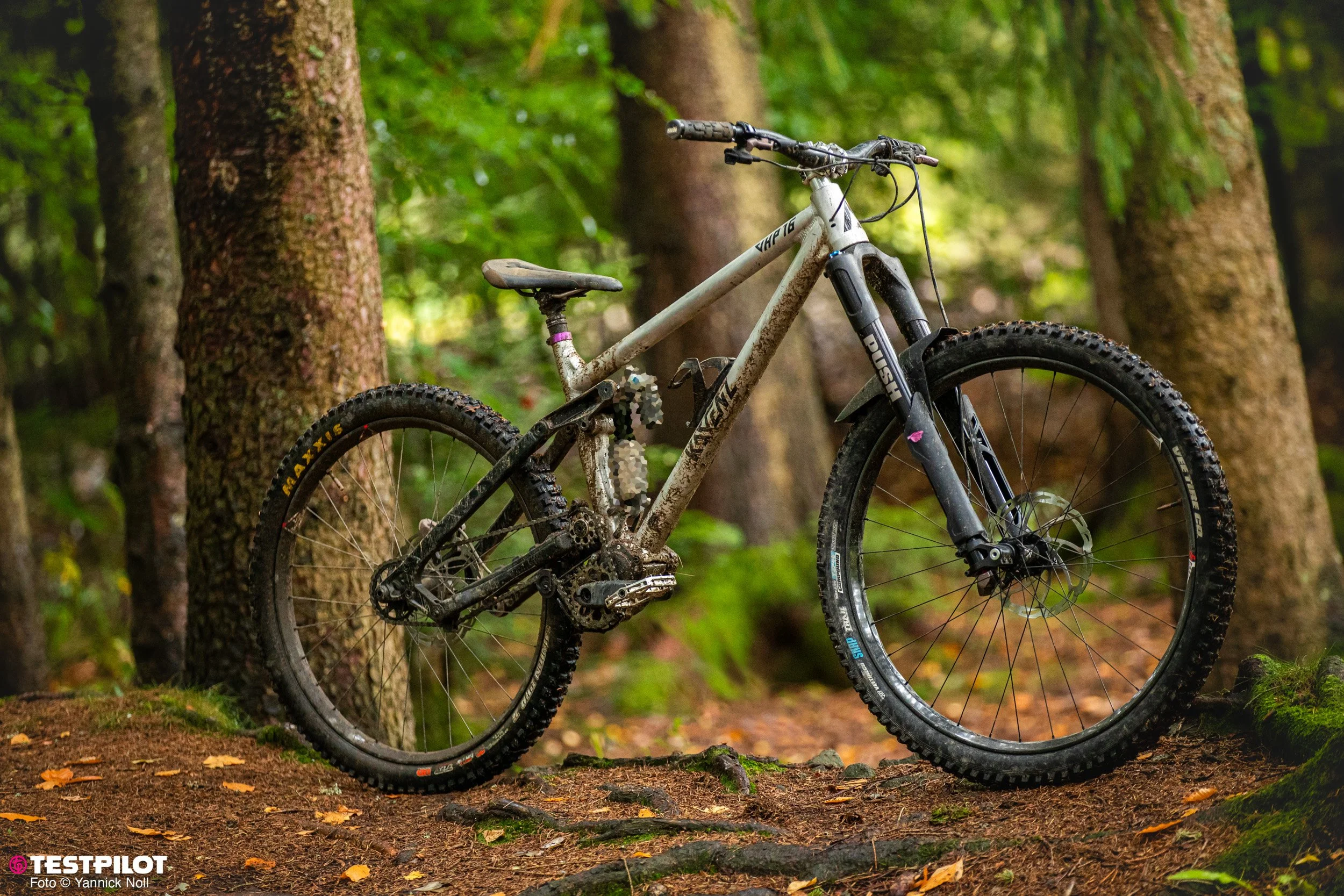
Because the sprung mass is naturally positioned close to the head tube, with only the slender stanchions and axle mounts "hanging" down below, the Nine.One is simply easy to lift.
The Nine.One's spring and damping curve can be tuned so perfectly via the Sub Chamber and the long-stroke HBO that you rarely wish for anything more. Not only can you set up the front end to do exactly what you want, when you want, and use as much travel as needed—it's also possible to mimic the kinematics of the rear suspension. Nothing stands in the way of a perfectly balanced chassis.
Simply put, the range of the curve and the damping quality of this fork are plain impressive. Rock garden ahead—and bam—it's already behind you. Or rather you question yourself, what rock garden? You almost feel like you're riding through the rocks rather than over them. It feels like some kind of black magic, because the Push constantly leaves you wondering how it manages to combine characteristics that, with other forks, always come with compromises.
"Plushness comes at the expense of precision... Chassis stability comes at the expense of sensitivity... Compliance in the chassis is paid for with a vague ride feel..." – None of that applies to Push. You simply get it all. No more compromises. Are we praising this too much? As critical as we are, we have to say no. The overall package of the Push just works. Try to hit that line on the slope littered with slimy roots, and the fork will follow your input. No deflection. Just grip.
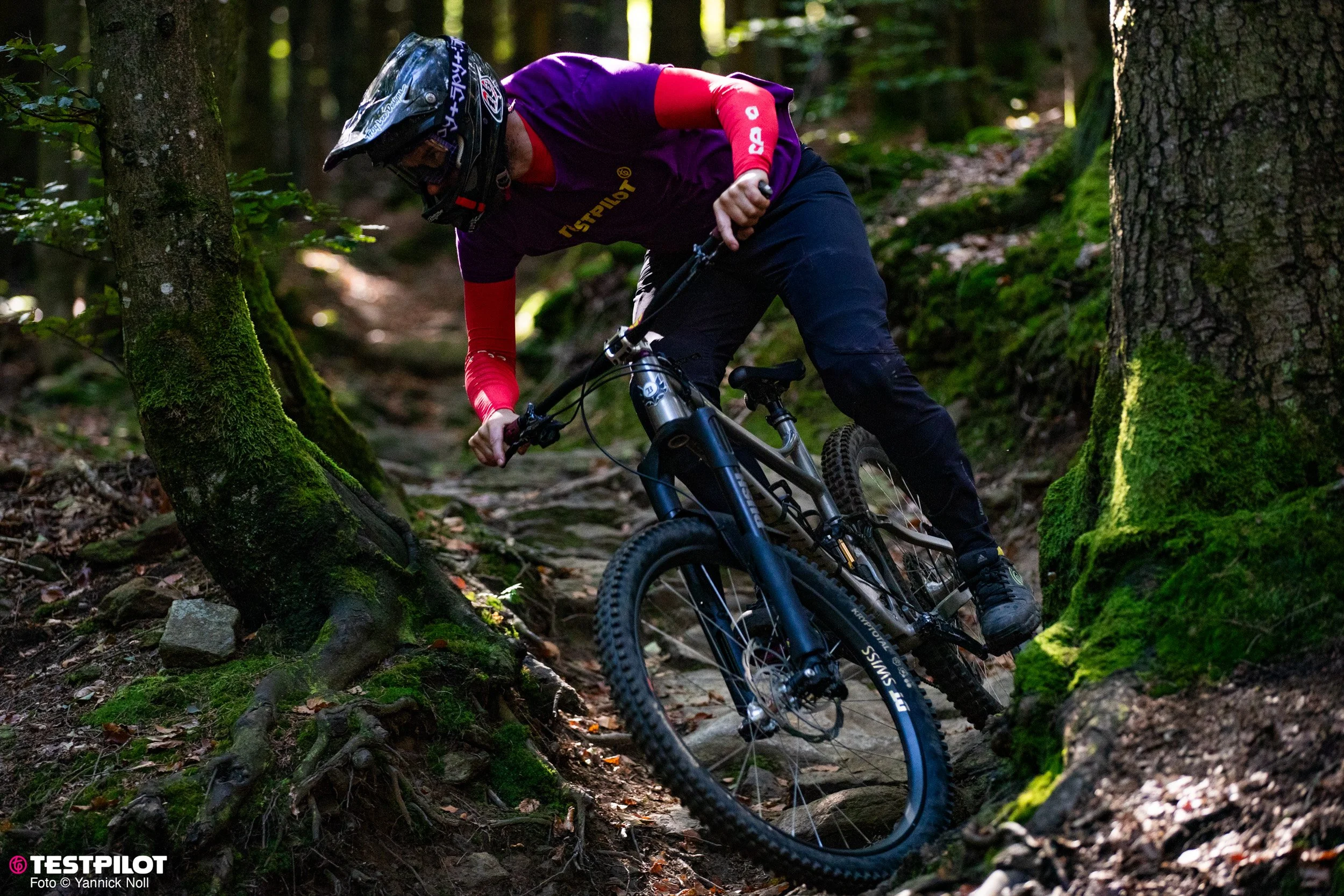
Then there's the elephant in the room: Is it stiff enough? Hours of discussion followed the test rides. Yes. The Push is more flexible than what you're used to from mainstream forks like the Fox 38 and ZEB. However, it doesn't make you feel uncomfortable or disconnected from the ground. The advantage of the Nine.One being able to twist slightly over edges and roots increases grip and the feeling of security more than any perceived loss from too much flex would diminish it. If you exclusively ride smooth jump trails with massive berms, you might want more stiffness—but then again, you don't need a sensitive fork that absorbs impacts and provides grip in those situations anyway.
The switchable Sub Chamber feature is particularly practical. When you're riding with intent and having one of those days when you're hitting every line, engage this chamber. This keeps you higher in the travel and gives you reserves when the impacts on the chassis get correspondingly harder.
If it suddenly starts raining or the next trail gets slippery, open the chamber for more grip and a more linear curve. The fork will then provide even more grip, and you'll be able to ride lines you never thought possible. A properly tuned HBO ensures you never get pulled too deep into your travel when you slam into a compression on the trail with the Sub Chamber open.
Technical Report
A mudguard on an upside-down fork is always a challenge. You either hang one the size of a full-on motocross fender directly under the head tube, or you design the mount to come from the bottom up. Push chose the latter—and if a stone finds its way up, the fender can unclip, preventing a locked-up front wheel.
The brake hose also clips into the fender and doesn't require any additional screws.
Unfortunately, the overall construction is a bit flimsy—we had to use tape to prevent the brake hose from rattling against the fender. If you ride without the fender, you have peace and quiet.
How does the perfect rider profile for the Push Nine.One V2 look like?
Do you need it? Do you want it? Anyone who has ridden the Push Nine.One V2 and experienced what it's capable of will answer both questions with YES.
Conclusion
Custom-crafted and tuned to the last detail. Forging its own path with the Sub Chamber and long-stroke HBO. Every parameter is adjustable to meet even the most individual demands. Customer service with re-tune options and a personal touch. The Push Nine.One V2 clearly sets itself apart from the mainstream. Highly distinctive and exclusive, it occupies its own niche in the suspension market. And yet—the damping quality and the possibilities for tuning its curve are simply unrivaled. Chef's kiss!
| Things to consider. | What is worth mentioning? |
|---|---|
|
|
What’s next?
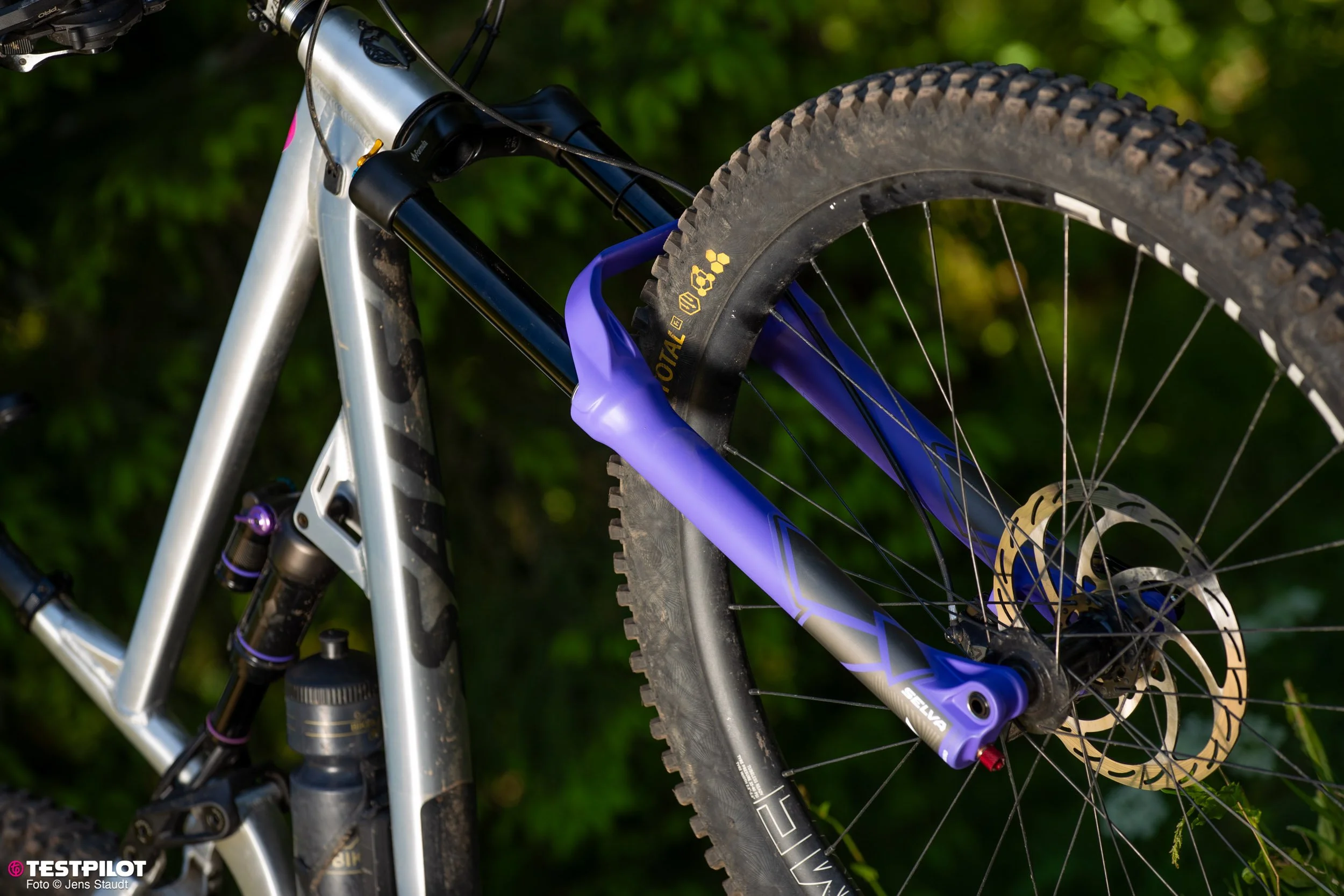
Formula Selva V—We already tested it last year. Then came the long-term test, and now it had to prove itself again in our benchmarking. Too slender and too light, or just right? We were curious!
You want more reviews?

Author – Jens Staudt

Height: 191 cm
Weight: 103 kg
Riding style: With his racing background, the lines are planned, even if there is anything bigger in his way. If possible, sections will be jumped over. You should use the entire width of a trail. Others would say - uncompromising.
Motivation: A product should function carefree and for as long as possible. If you have to screw less, you can ride more. He likes to tinker and see how the bike can be optimized.