

Review: SR Suntour DUROLUX38 X EVO
Reading time: 8 Minuten
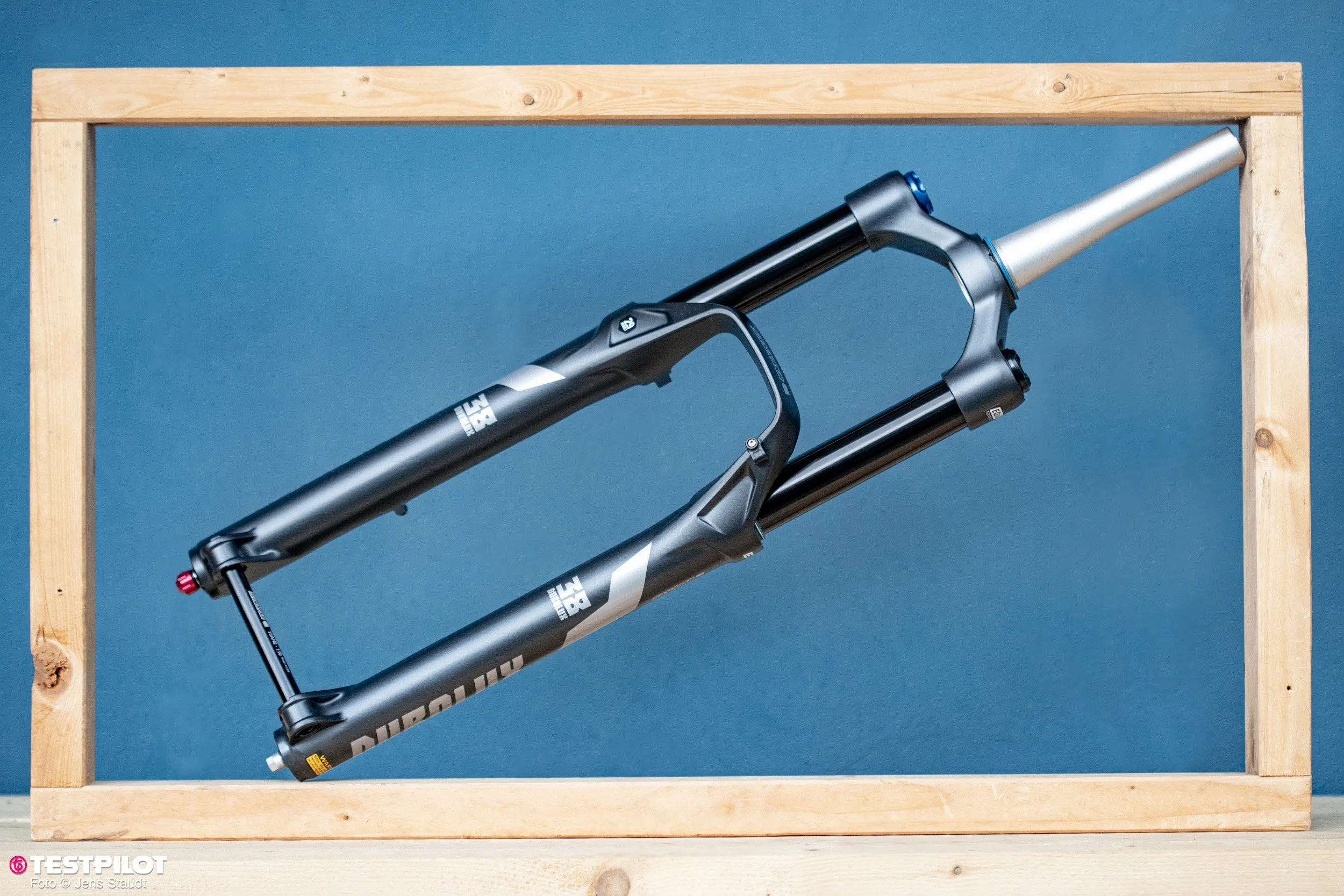
The DUROLUX series embodies the SR Suntour philosophy: solid performance at an affordable price in a robust overall package. There are two models – the DUROLUX38 and the DUROLUX38 X. The latter, with the X designation, is the one we tested. It is the heavyweight of this line – designed for the toughest use on e-enduros or in freeride. Slightly more weight. A robust chassis, 38 mm stanchions, and a simplified damping architecture leave little room for guesswork when setting it up.
Can this simple, durability-focused fork hold its own in practice? We put this supposed Toyota Hilux of suspension forks through an intensive test. Including a close-up look at its internals.
In the core MTB segment, SR Suntour is still associated with an image from their other business area: that of a very broad portfolio focused heavily on the entry-level sector. Their top-tier products don't feature as many adjusters as some other manufacturers. Is this a missed opportunity in a world of shiny things? However, the number of fancy dials doesn't necessarily say anything about the performance level.
We have already used this fork during our comparative test of 36 mm and 38 mm stanchion forks. Equipped with a new 170 mm air shaft, it competes here against the rest of the field. Suntour offers it with travel options from 160 to 180 mm.
Technical info – SR Suntour DUROLUX38 X EVO
| Application | E-Enduro, Freeride |
| ⌀ | 38 mm |
| Travel | 160 / 170 / 180 mm |
| Settings | Luftdruck, LSC, LSR |
| Suspension | AIR EQ |
| Damping | RC+ CPS |
| Wheel sizes | 29″ |
| Max. Tire Width | 2,6″ |
| Axle dimension | 15 x 110 mm Boost |
| Brake rotor | PM 203 mm (max. 220 mm) |
| Offset | 44 mm |
| Axle-to-Crown | 580 mm bei 160 mm |
| Steerer tube | 1,5–1 1/8″ |
| Casting | Aluminium |
| Wipers | SKF |
| Fender | Long/ short Version |
| Color | Metallic Slate; Gloss Black |
| Weight | 2.656 g |
| Warranty | 2 Jahre |
| Price (RRP) | ca. 899 € |
| Website | srsuntour.com |
Tech bits SR Suntour DUROLUX38
SR Suntour DUROLUX38 – Chassis
The chassis of the DUROLUX38 series is built on a classic, robust material combination. The stanchions are made from an A7000 series aluminum alloy. The DUROLUX we have for testing is from the 2025 series—since then, it has only been available with 38 mm stanchions. If you browse the Suntour website, you'll still find a DUROLUX36 with 36 mm stanchions; however, this fork is from the 2021 model line and is now outdated. On the lighter DUROLUX38 (without the X), the crown is hollow-forged, which is intended to provide additional stiffness with reduced weight. As with most other manufacturers, the lower casting is made from magnesium.
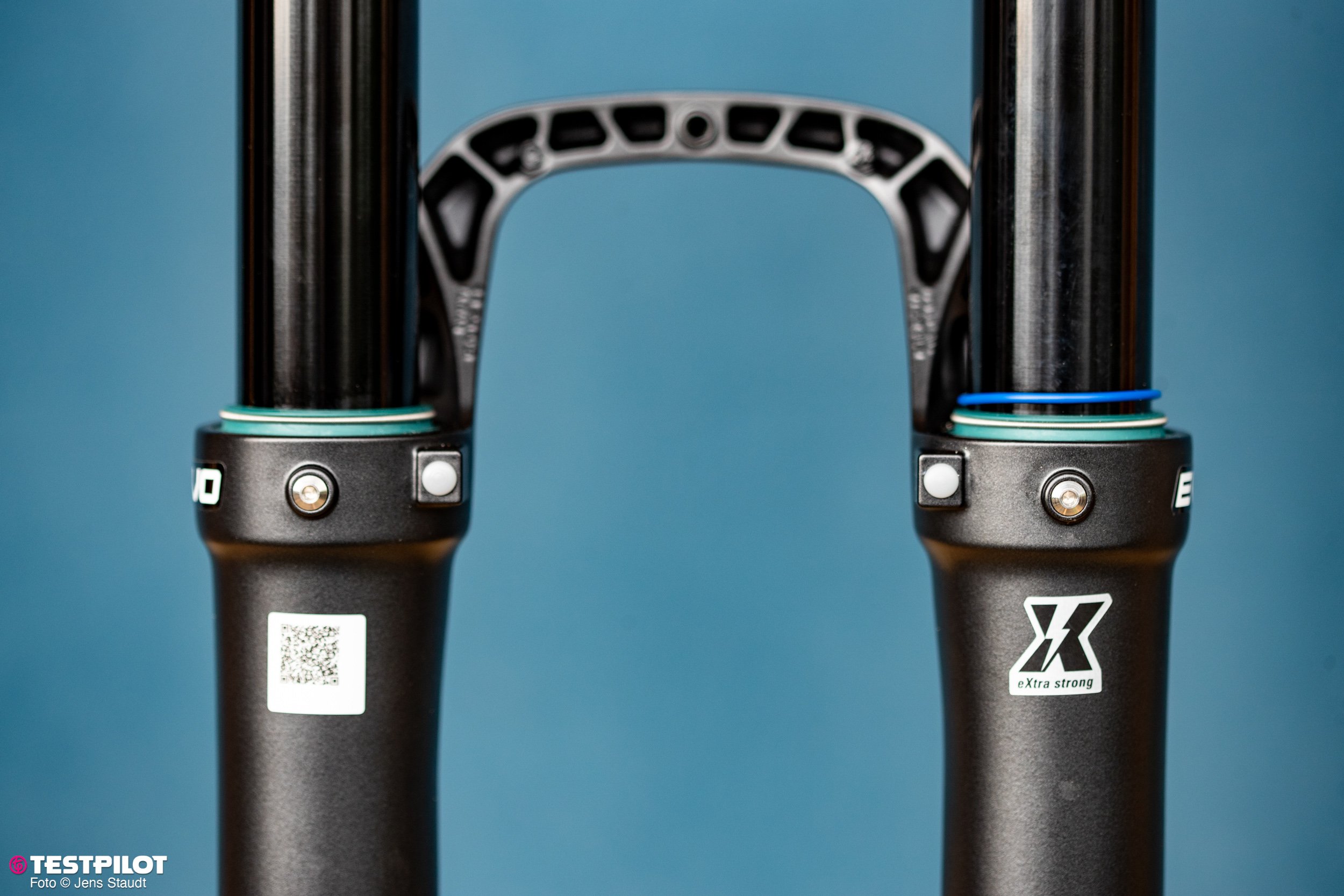
The key difference with the DUROLUX38 X: it features a reinforced chassis. Additional material is used on the crown and casting to further increase stiffness. This version is specifically designed for heavy eMTB, freeriding, and for riders who really push hard. Certification for system weights of 150 kg underscores this. Additionally, the e-MTB version features mounting points for ABS systems.
All models have nicely attachable fenders—available in a short and a long version.
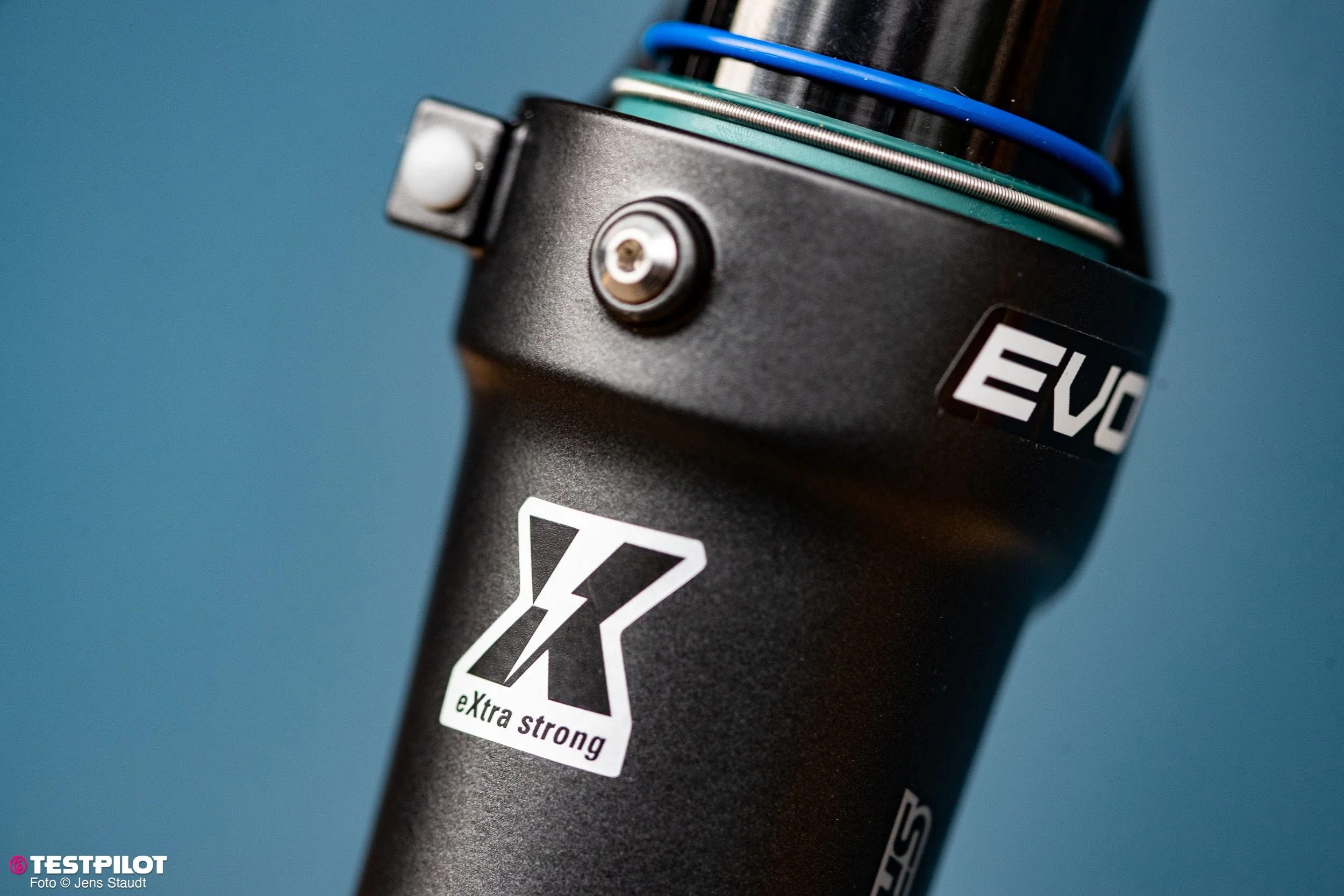
Our testing contender: X stands for eXtra strong.
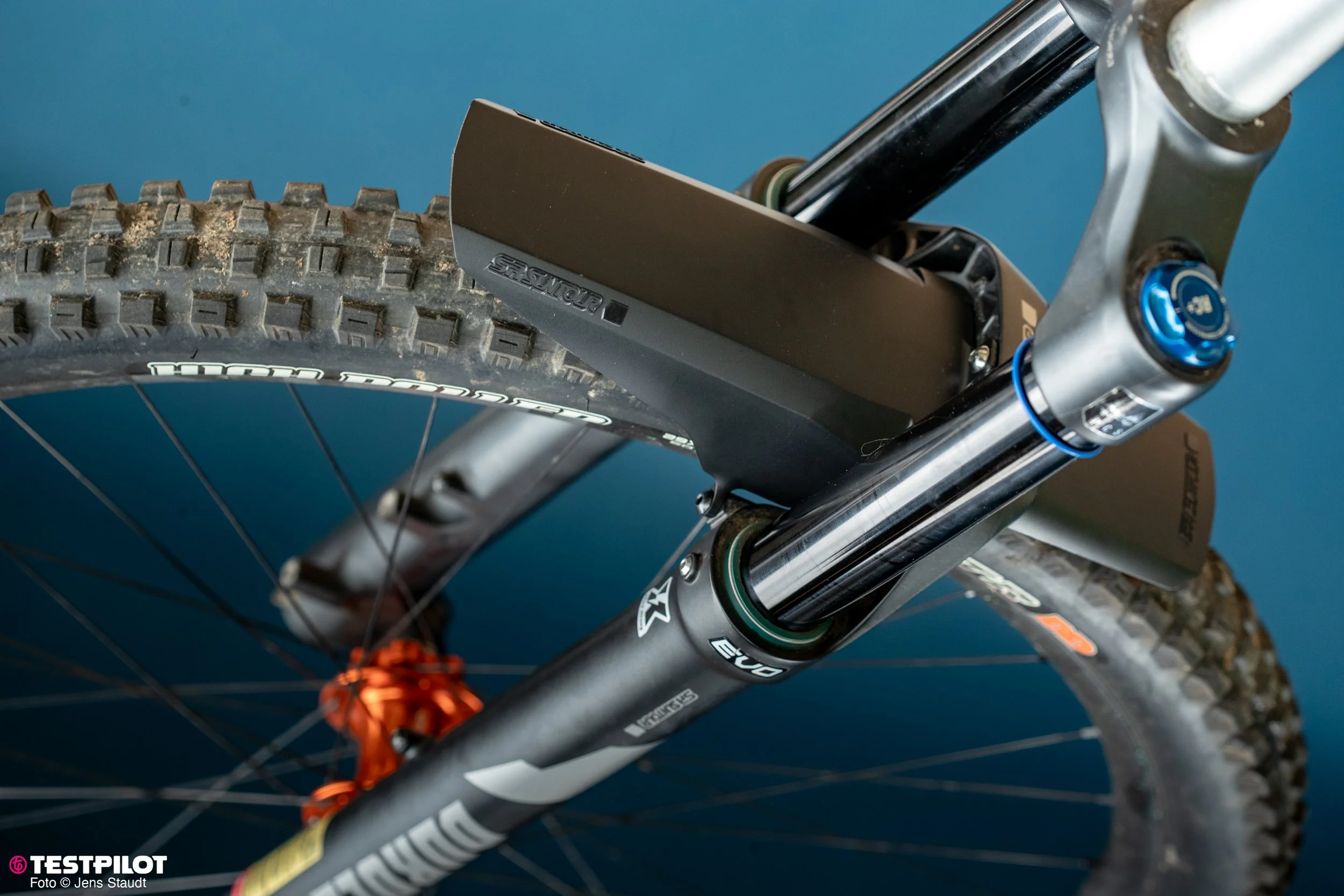
Three bolts for a nicely integrated fender.

SR Suntour Durolux38 X – Airspring
The heart of the fork is the EQ EQUALIZER™ air spring system. This system works with a positive and a negative air chamber, separated by a piston. During compression, this piston rides past the transfer port (see image below), a small recess in the stanchion that connects the positive and negative air chambers. When you sit on the bike, pressure equalization occurs with every compression stroke. This allows the air spring to automatically adapt to rider weight and sag. Manually equalizing by pumping the fork several times is therefore unnecessary. This reduces the margin for error during setup right from the start and ensures a customized negative spring force.
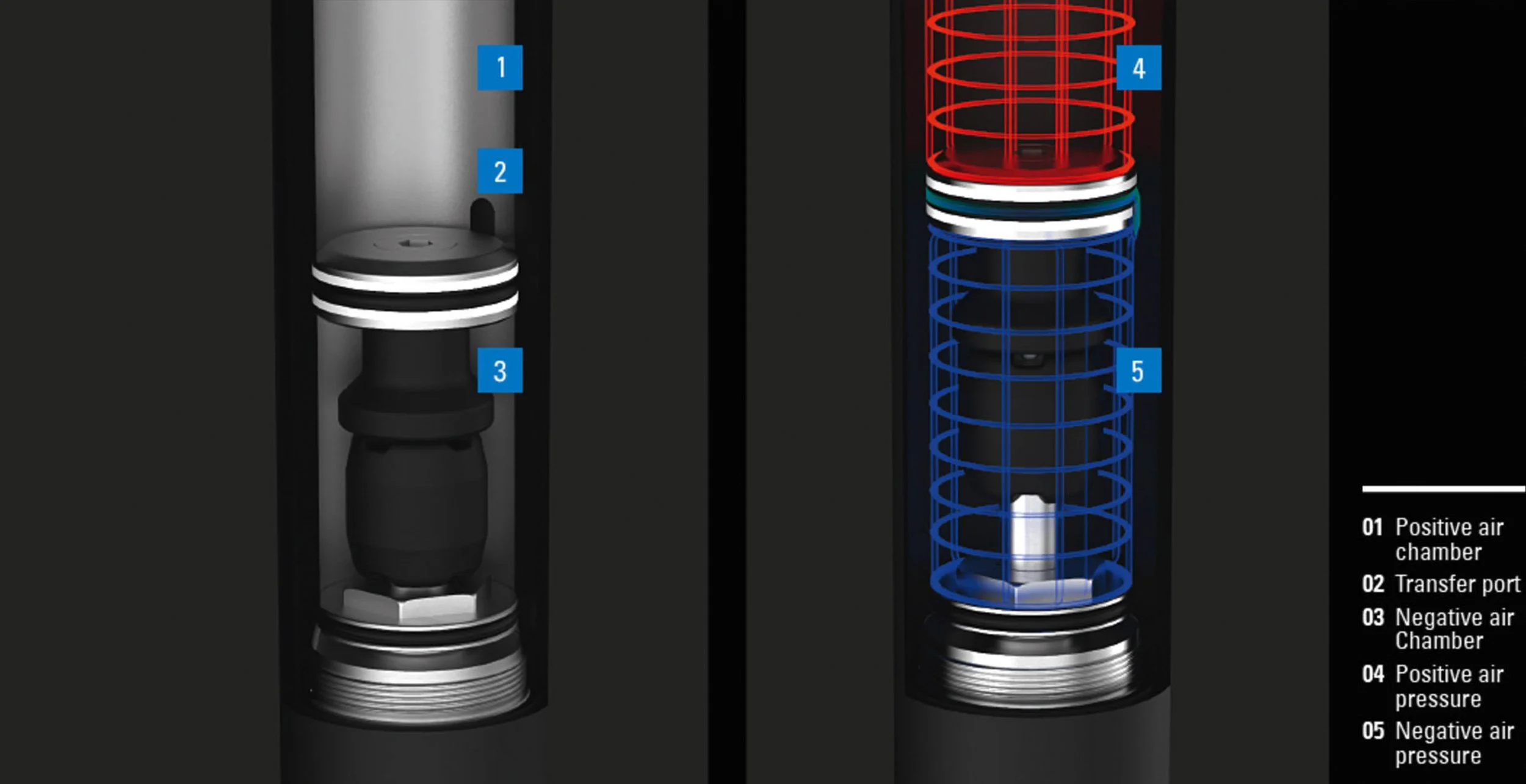
Suntour aims to achieve a linear spring curve through the interaction of all air chambers. The fork is intended to be more active and easier to get full travel. Riders who need more progression can use the simple volume spacers to reduce the (positive) air chamber size for better bottom-out resistance.
Quick pressure equalization at the casting is possible with almost all manufacturers. On the DUROLUX, so-called Lubrication Bleed Ports can be found on each leg side—a 2.5 mm hex key is needed here to release any built-up pressure. If you want to give the foam rings under the seals a fresh dose of lubrication oil, you can also do this through these ports.
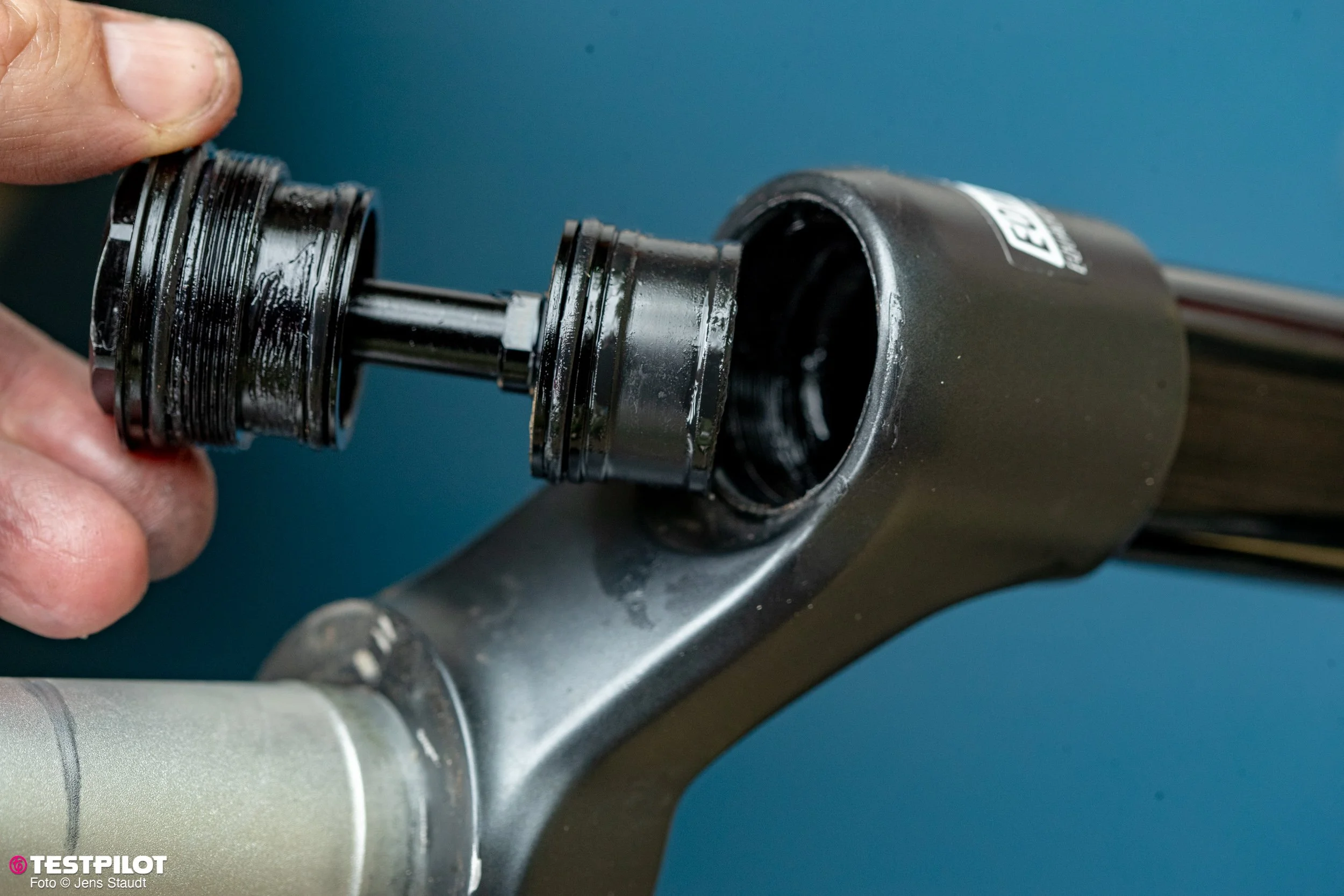
Rubber volume spacer will clip right in under the top cap.
Silver bolts hide the Lubrication Bleed Ports.
SR Suntour Durolux38 X – Damping
Since the introduction of the revised 2025 model series, the damping solution in the EVO models goes by the name RC+ PCS cartridge. It was developed with the team riders as part of the WERX program and relies on larger valve openings with increased oil flow. The result is said to be a better and faster response to impacts.
The RC+ controls have been simplified compared to the previous model: externally, the rider only has one dial for low-speed rebound and one dial for low-speed compression. Both dials control a needle valve inside in a classic manner. High-speed forces are determined internally by a fixed shim tune and are no longer externally adjustable.
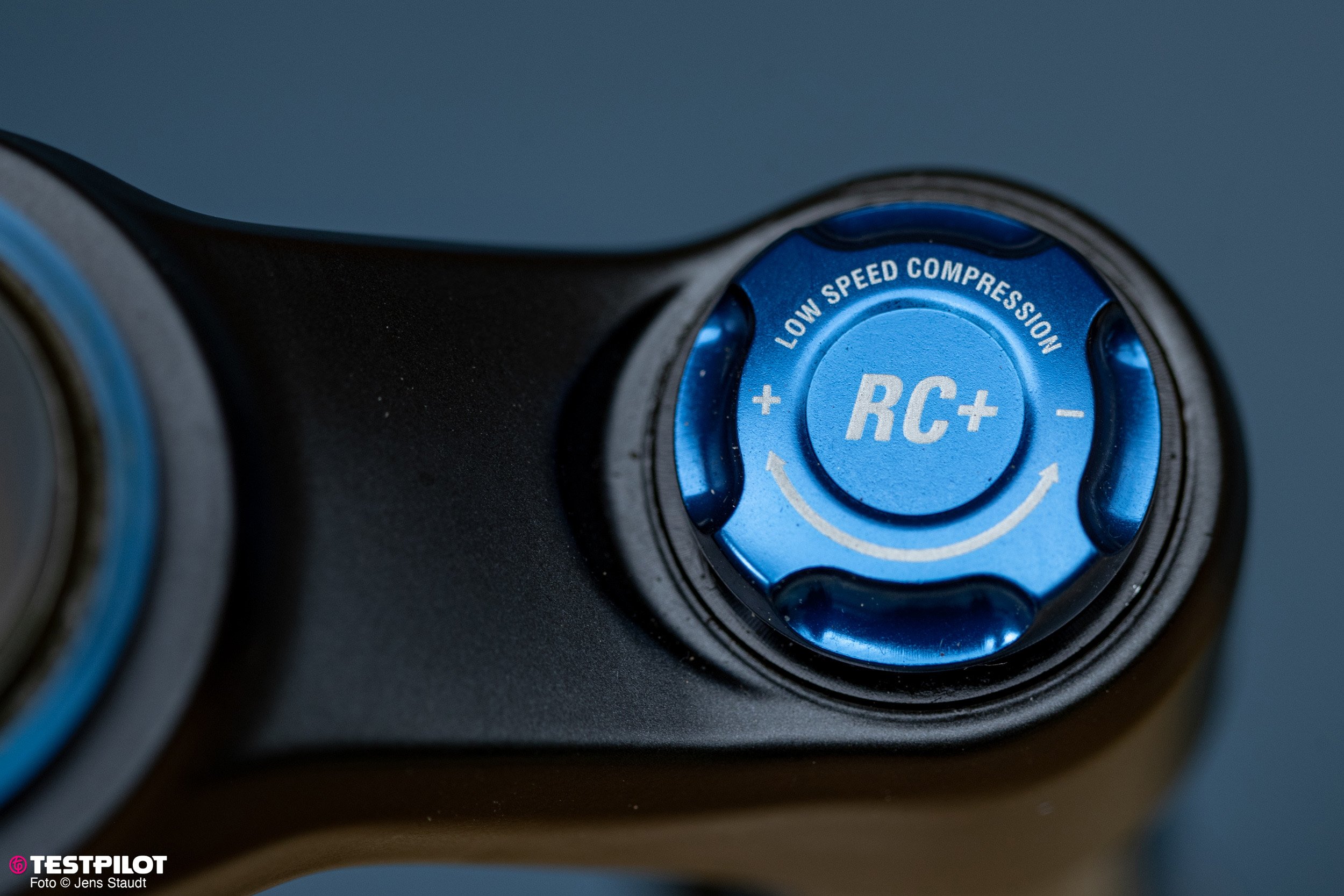
Reduced dials. The 2025-EVO-Modells will just give you one dial on the top…
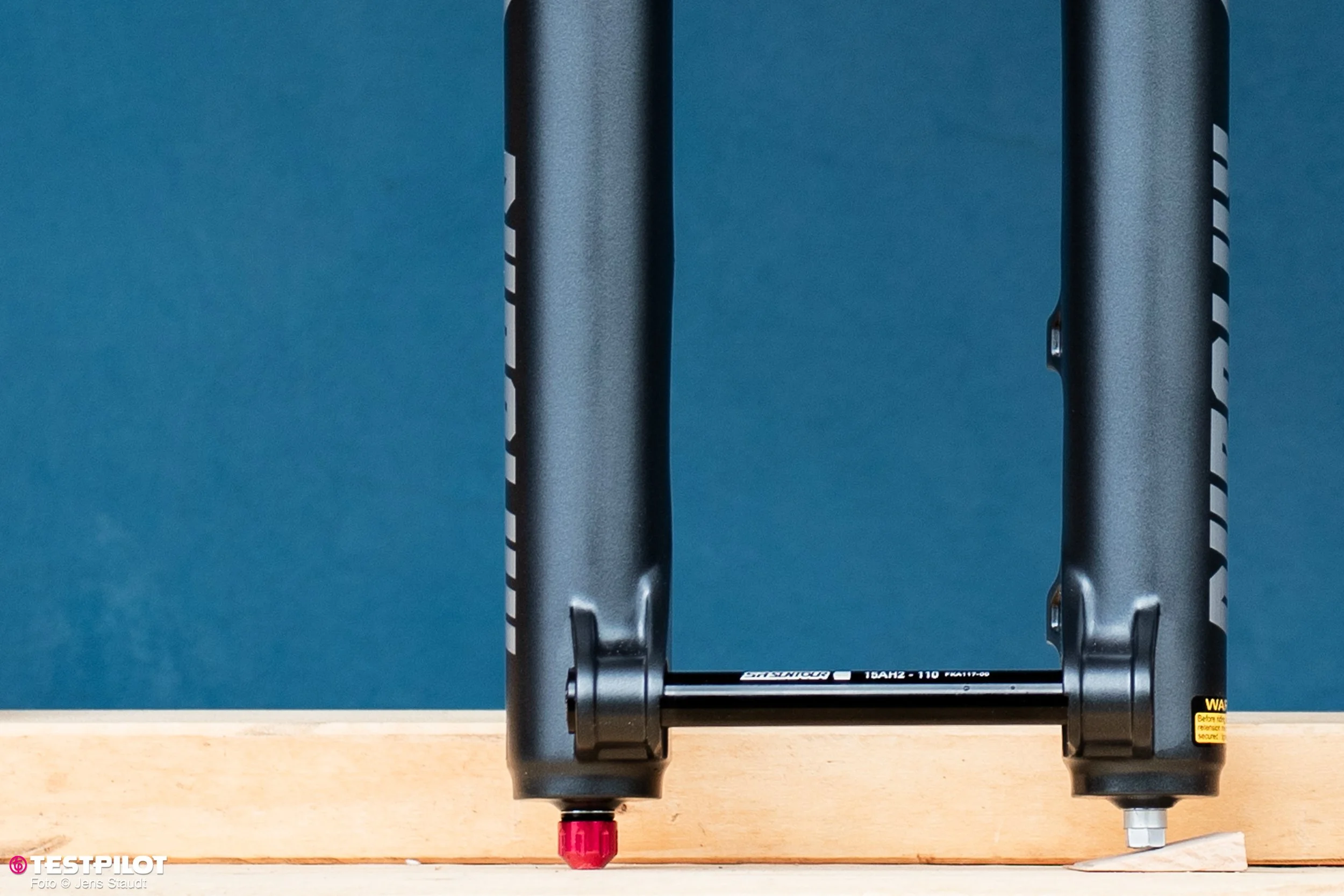
and another single red dial at the bottom for rebound.
PCS stands for Piston Compensator System. A spring-preloaded floating piston displaces the oil volume during compression. At the same time, the damping oil and air are separated from each other—this is intended to prevent cavitation. If air mixes with the oil, pressure builds up in the oil—damping becomes uncontrollable, the fork suddenly feels soft, spongy, or nervous, and starts making slurping noises.
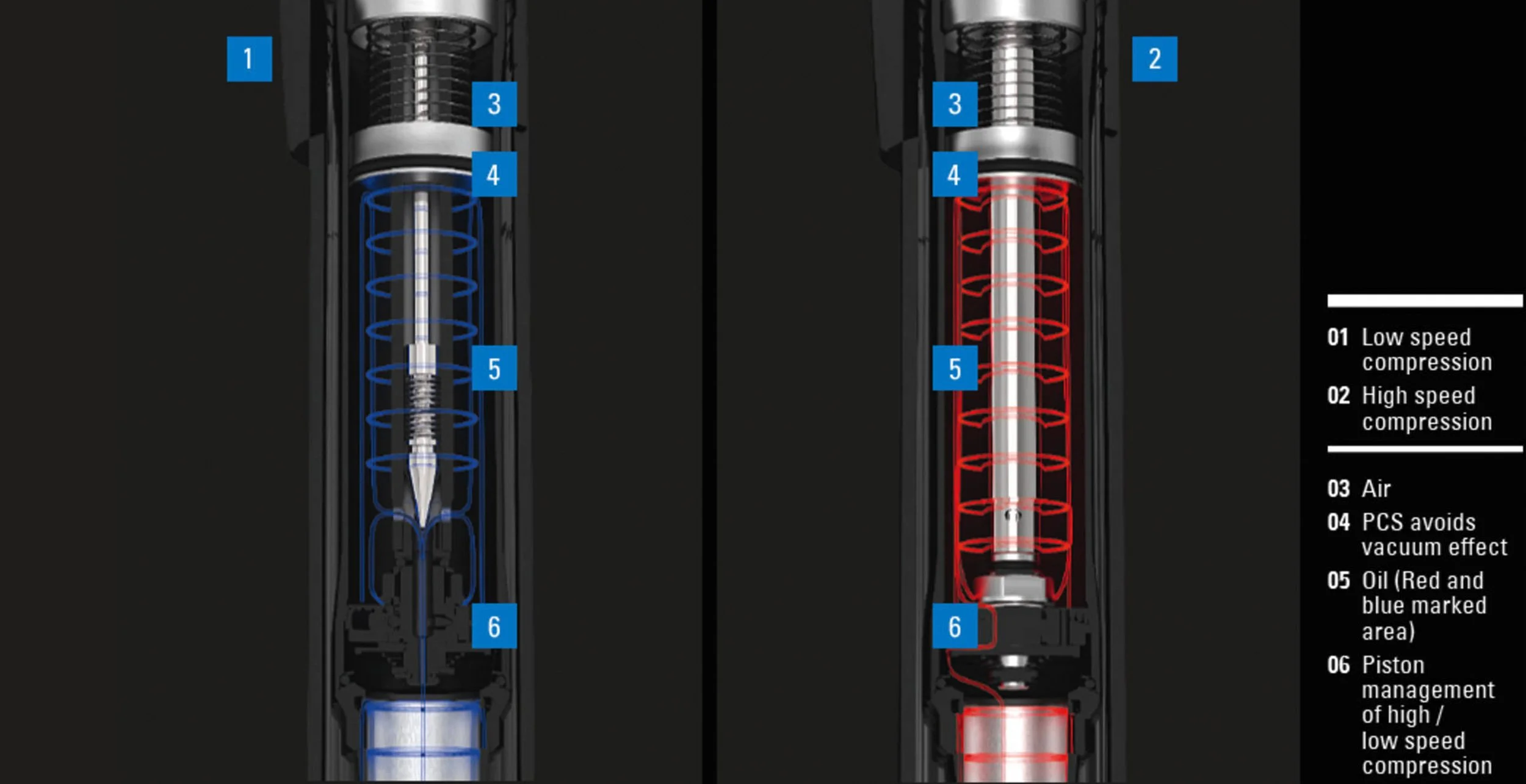
Another key feature is the Semi-Open Oil Bath (SOBA). This system combines the sealed RC+ PCS damping cartridge with an additional, defined lubricating oil bath in the lower legs. The damping oil and lubricating oil do not mix. This allows the damping to operate in a sealed unit while the oil in the lowers serves to lubricate the bushings and seals. This reduces friction, dissipates heat better, and is intended to ensure consistent suspension performance—even on long descents.
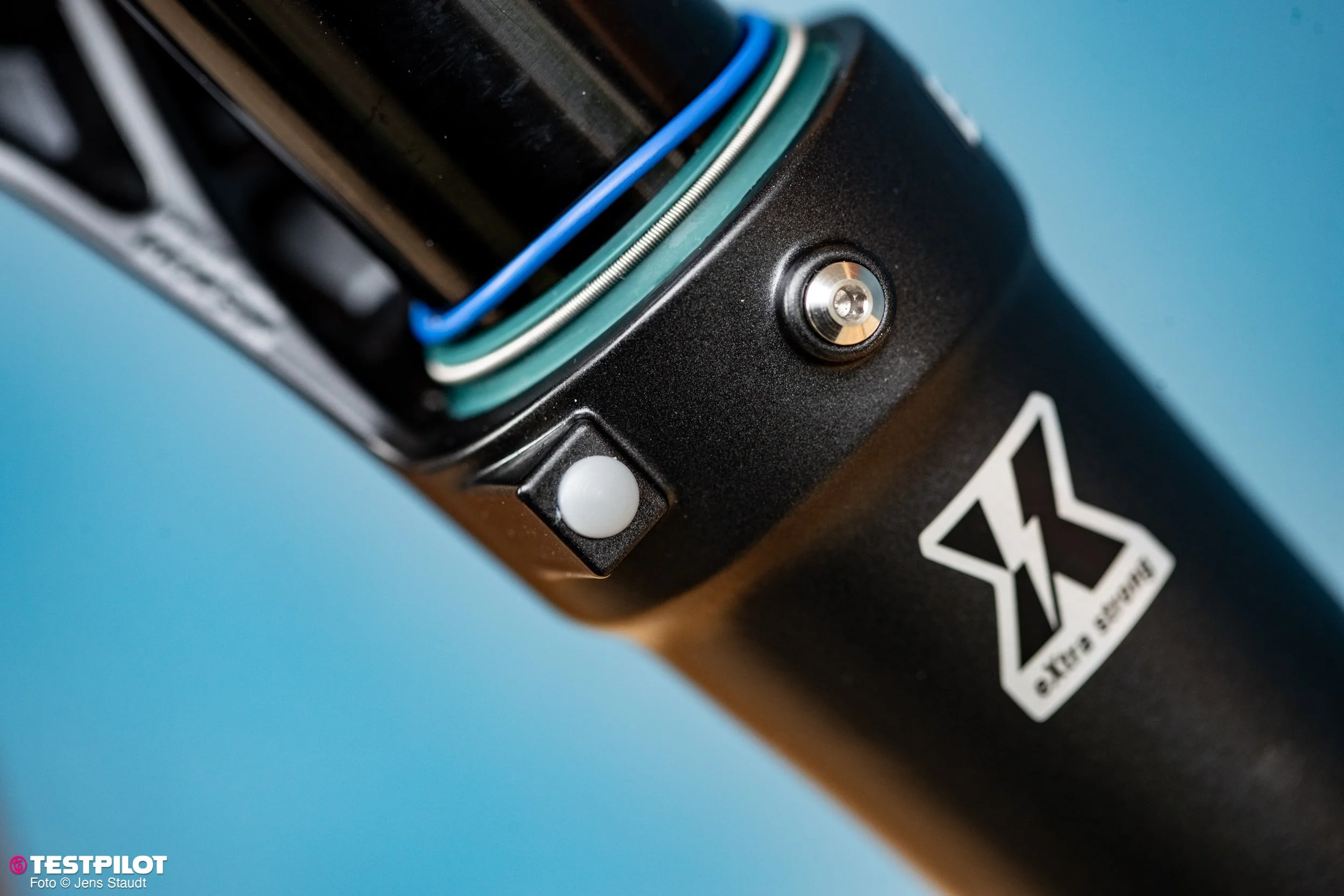
The screws on the Lubrication Bleed Port can be removed using a 2.5 mm hex key. A syringe can then be inserted directly into the opening.
Setup the SR Suntour DUROLUX38
Where other manufacturers stick quite specific starting points for PSI and the associated rebound clicker settings onto the fork, SR Suntour directs us to the manual. Here, too, they keep it basic. The Taiwanese company limits itself to a sag recommendation of 25–30%. There are no specifications for rebound or compression. The rebound offers 26 positions and the compression 15. So, pump it up. Sit on it. Set rebound to taste, compression to the middle, and off you go.
| Fork travel | SAG (%) | SAG (mm) |
|---|---|---|
| 180–160mm | 25–30% | 54–40mm |
| Rider weight (kg) | DUROLUX38 | DUROLUX38 X | DUROLUX36 X / DUROLUX36 / AURON36 |
|---|---|---|---|
| < 55 | < 40 | < 40 | 35 – 50 |
| 55 – 65 | 40 – 50 | 40 – 50 | 50 – 60 |
| 65 – 75 | 50 – 60 | 50 – 60 | 60 – 70 |
| 75 – 85 | 60 – 70 | 60 – 70 | 70 – 85 |
| 85 – 95 | 70 – 85 | 70 – 85 | 85 – 105 |
| 95 > | 85 + | 85 + | 105 + |
| Factory set pressure | 70 psi | 75 psi | 85 psi |
| Max. pressure | 105 psi | 110 psi | 120 psi |
Volume spacer
With the DUROLUX series, Suntour uses rubber-like 15 mm volume spacers. 3 spacers are installed from the factory in the 170 mm travel fork. To adjust them, you must, of course, first release the air pressure, then unscrew the air cap on the top of the left fork leg using a socket or adjustable parallel pliers. On the underside of the air cap, up to 7 spacers can be stacked in our 170 mm version, thereby reducing the volume of the air chamber. For 180 mm travel, the maximum is 6 spacers, and for 160 mm, it's 8 spacers.
Release all the pressure. Clip on the spacer. Done.
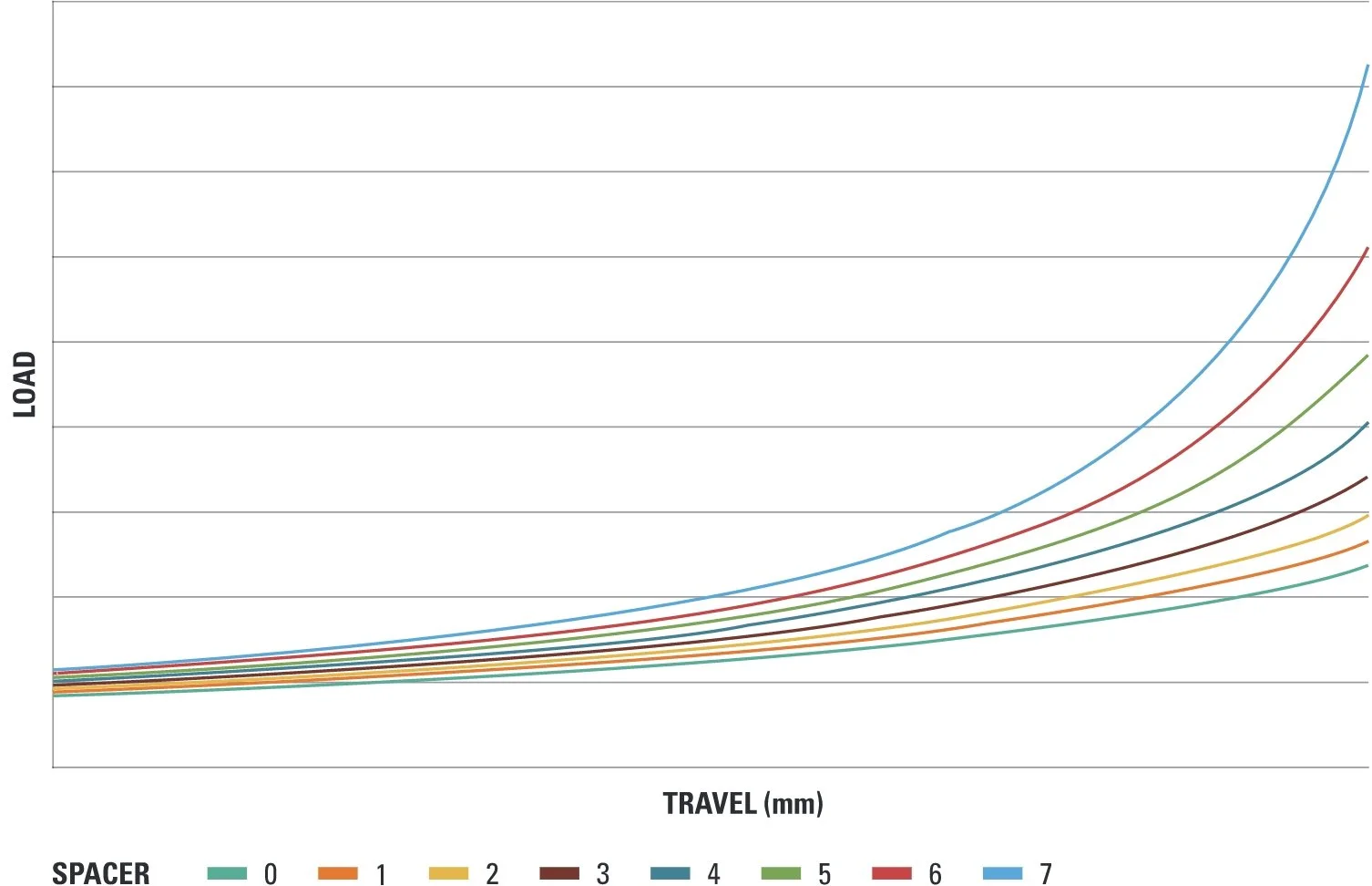
The spacer affect mostly the last third of the travel.
SR Suntour DUROLUX38 thru axle and how to install the wheel perfectly
For the DUROLUX38, the 15 mm thru-axle is inserted from the right side of the fork in a classic manner and tightened with a 6 mm hex key to 8–10 Nm. There is no compensation for fluctuating hub widths via one or more screws. Simple, quick to do.
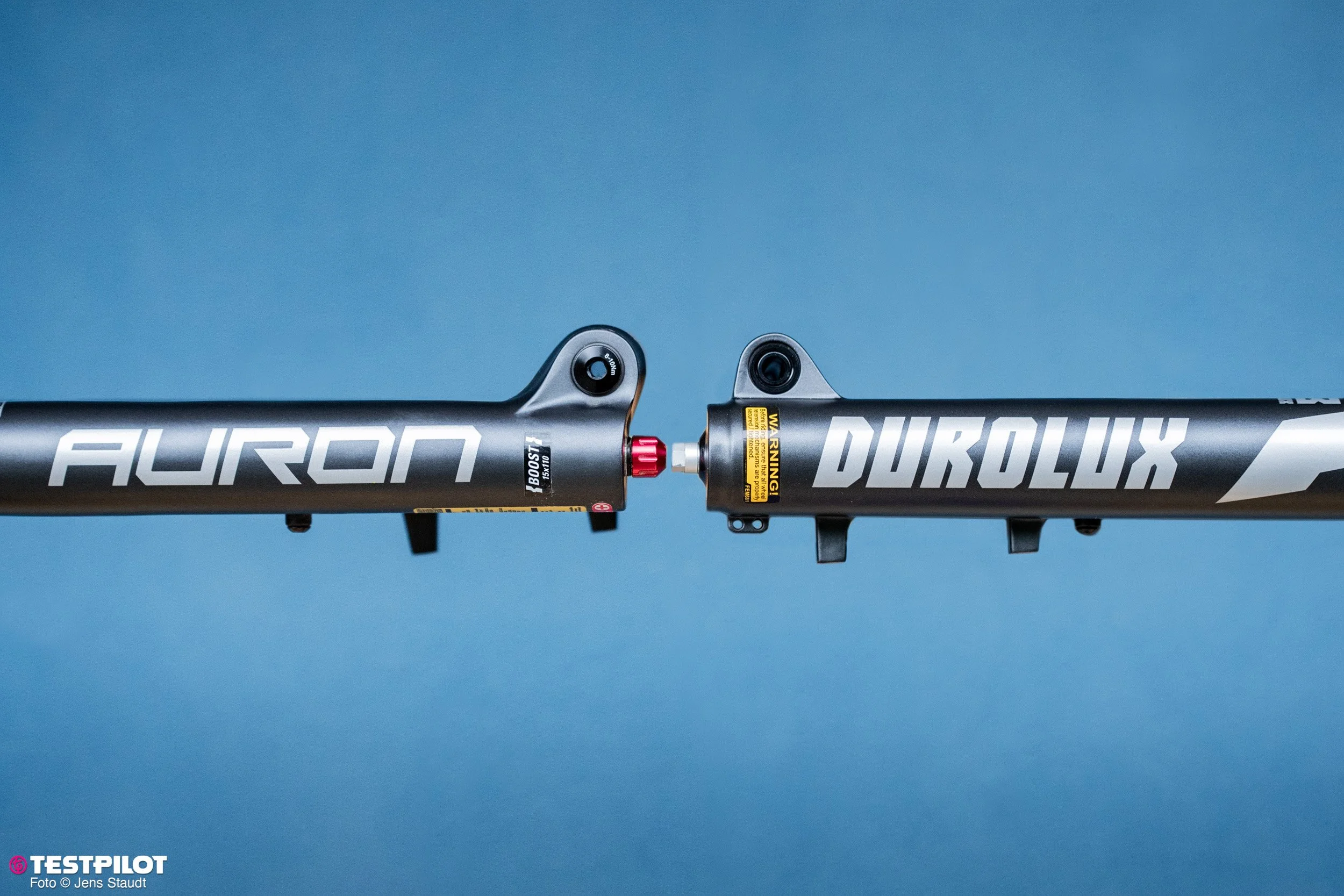
Insert the thru-axle from the right side and tighten—this is identical for the DUROLUX and AURON.
On the Trail
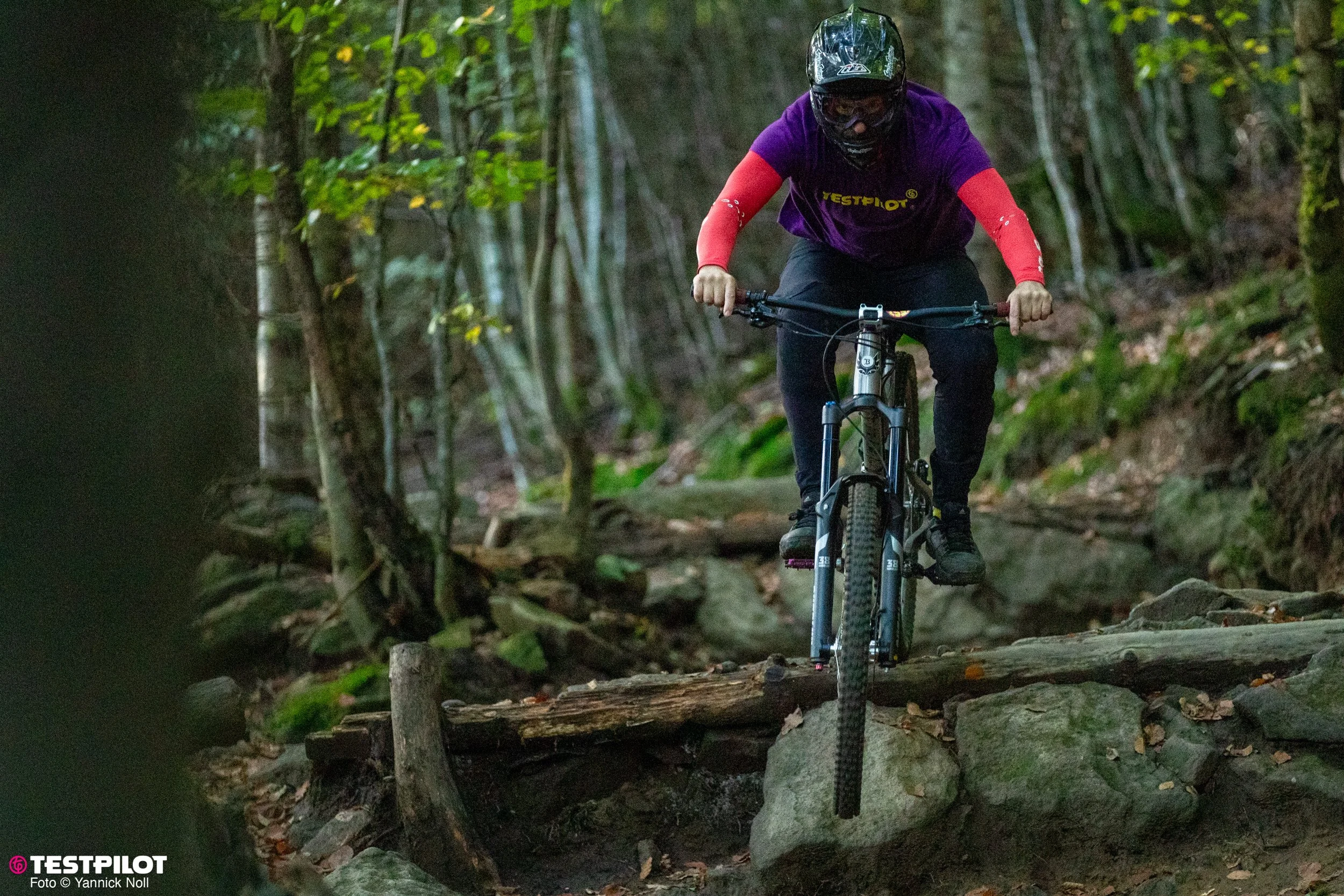
After we gave the DUROLUX some love (see explanation), it had to hold its own in our benchmark test with additional impressions, just like the other representatives.
We already described it in the setup section. It doesn't take long until you can hit the trail. Because there isn't much to adjust. This also helps your focus on the trail. No pondering whether you might need one click more or less here or there. Install the DUROLUX. Do the basic setup. Measure sag. Done. Ride. No getting lost for hours in a fine-tuning frenzy. There's no doubt about whether you've adjusted high-speed or low-speed rebound or compression.
We are certainly never the ones who complain about too many adjusters and options to fine-tune a product, but we also have to say it can be quite liberating when the technology is simpler in design and works in the background, instead of constantly leaving you in doubt about whether there isn't more to be had.
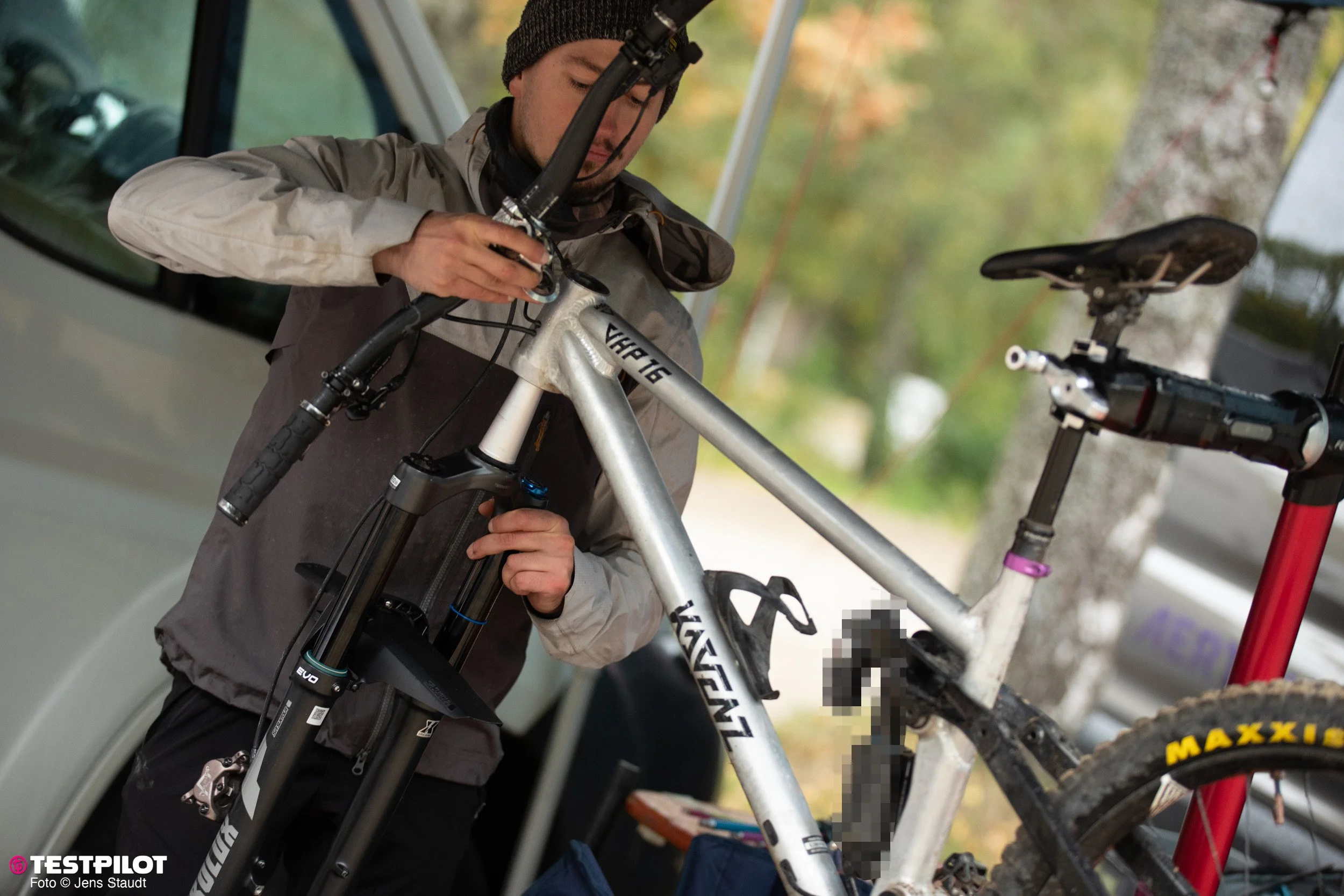
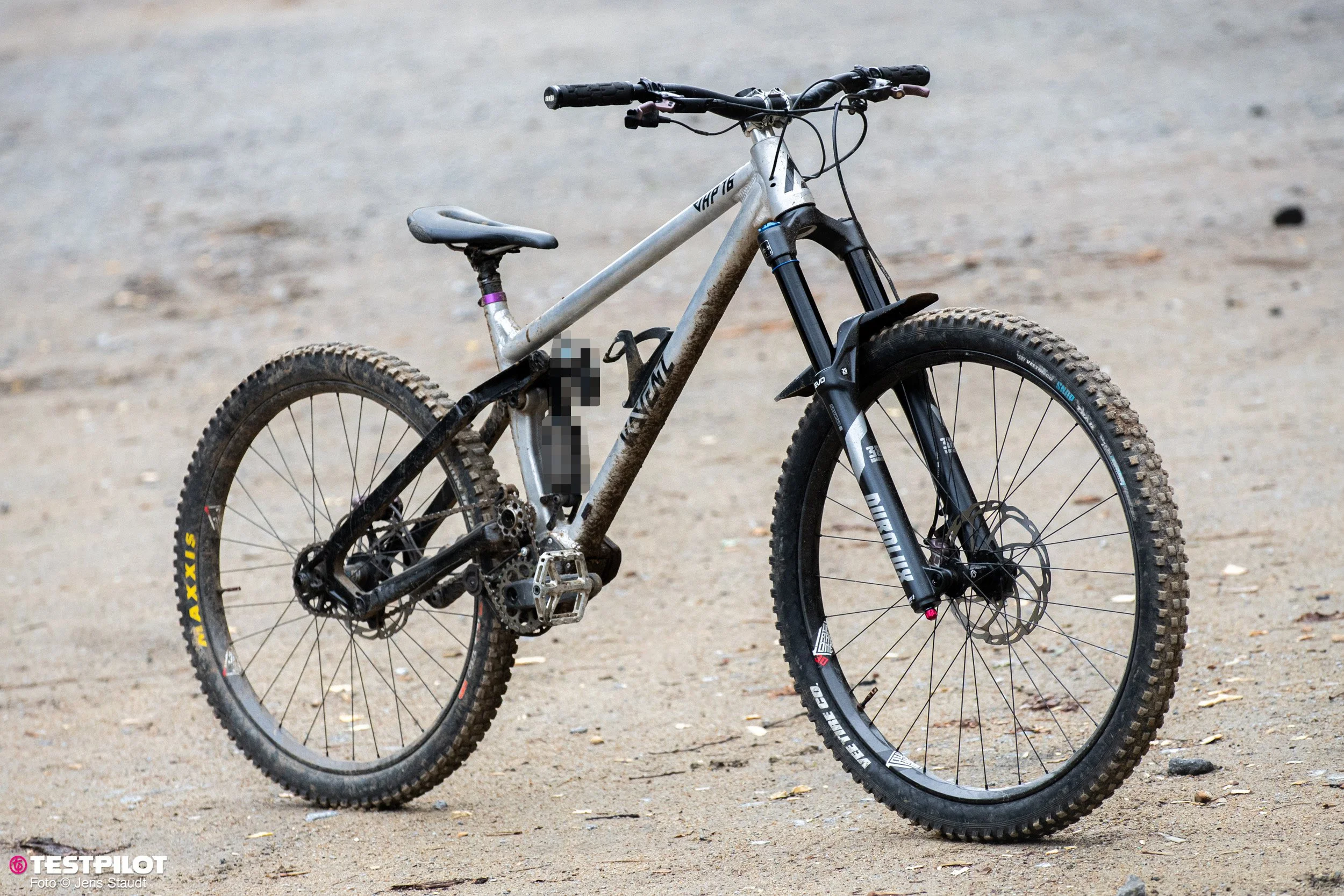
The stiffness of the DUROLUX38 X was already described in the comparison article with the AURON. And yes—the DUROLUX lives up to its design specifications and performs at a high level in terms of directness during practical testing. This was especially evident during testing in the bike park, where speeds were higher and impacts were harder. Really harder, no ambiguity. What felt like almost too much for even heavy riders on moderate home trails was absolutely welcome here in this weight class.
Accordingly, the fork translates rider input reliably and quickly, without ever leaving you unsure of where your front wheel is. You aim, and it gets to work. Where it takes longer with the competitors to find the perfect setup, you can spend a long time just fine-tuning the last clicks for RC+ and rebound on the DUROLUX. Confidence grows, and you can let it rip accordingly.
Then you can start adding additional volume spacers to adjust the travel progression. In the 170 mm version, up to 7 can be used. Freeride huck-to-flat! Jens was already satisfied with a total of two, while Yannick, as a lighter rider, even went down to just one spacer. Anyone who prefers a very plush ride might even want to remove all of them.
But if you enjoy riding aggressively, if you push hard into corners and see landings where there are none, you can simply upgrade. Then the end of the travel announces itself at the handlebars less frequently.
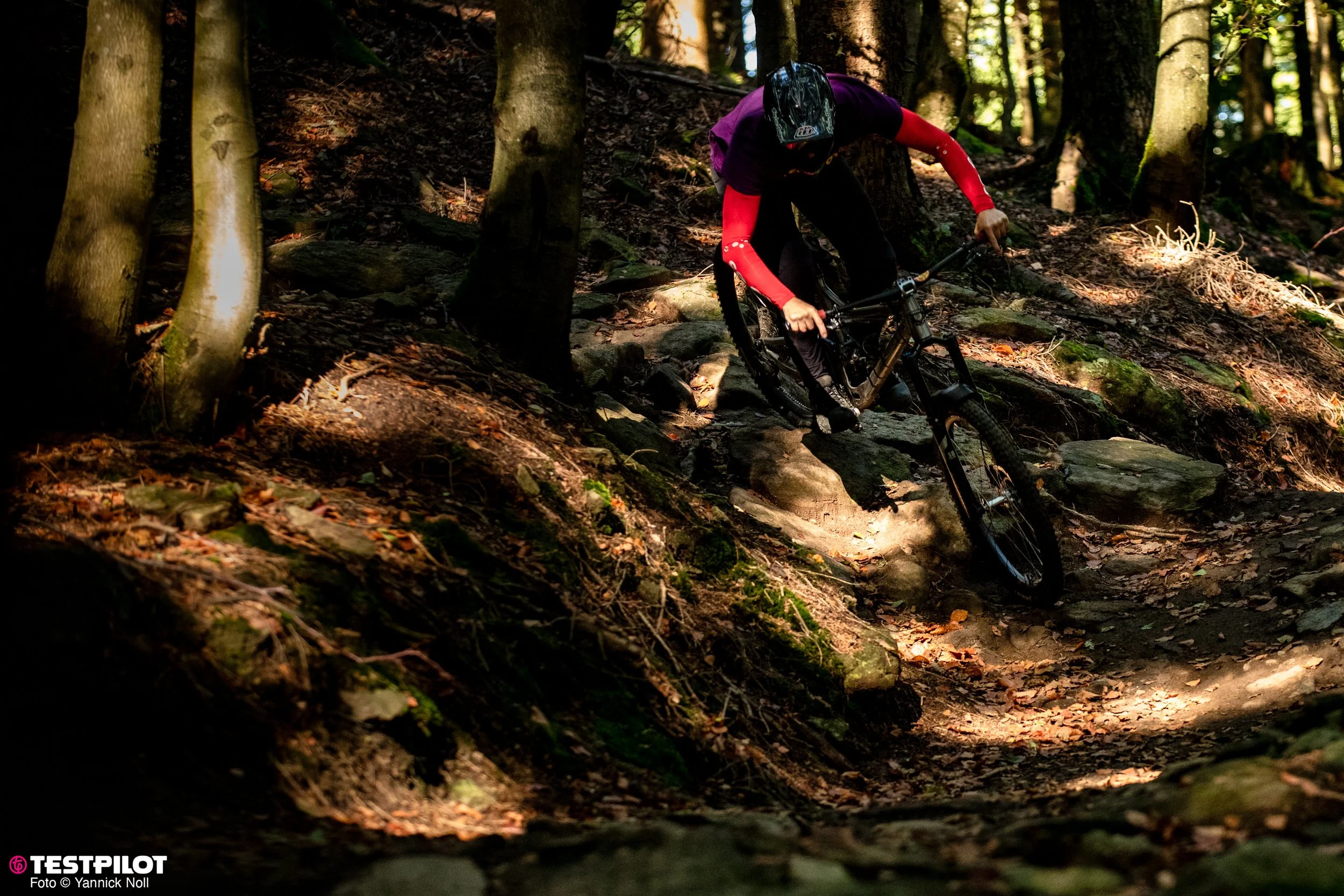
Sometimes you have to be careful not to be led by prejudice. Especially when a shock or a fork doesn't come with numerous, color-anodized, pretty knobs that could also pass as jewelry. Forged. Blue. RC+ laser logo. The compression adjuster looks simple visually, but don't be mistaken—appearances can be deceiving.
We were positively surprised. You know that moment when the landing suddenly disappears behind you and you're still high up in the air? Your arms get long, and you grip the handlebars for dear life. THUDDD. Was that it? Overshot landings and jumps to flat were significantly absorbed by the Durolux.
You can feel how the damping reacts very well to higher shaft speeds, and you don't have to rely solely on the spring side to avoid bottom-outs. And once again, confidence in the control the fork provides increased. No wallowing, no excessive use of travel, or other unpredictable antics.
To achieve this feeling, we would recommend not running the compression fully open. Around the middle position or 1–2 clicks towards firmer was a good value for us to maintain this exact ride feel. Thus, the DUROLUX offers good support and works actively through the travel without becoming insensitive. Everything remains very controlled, and even the roughest terrain is always manageable.
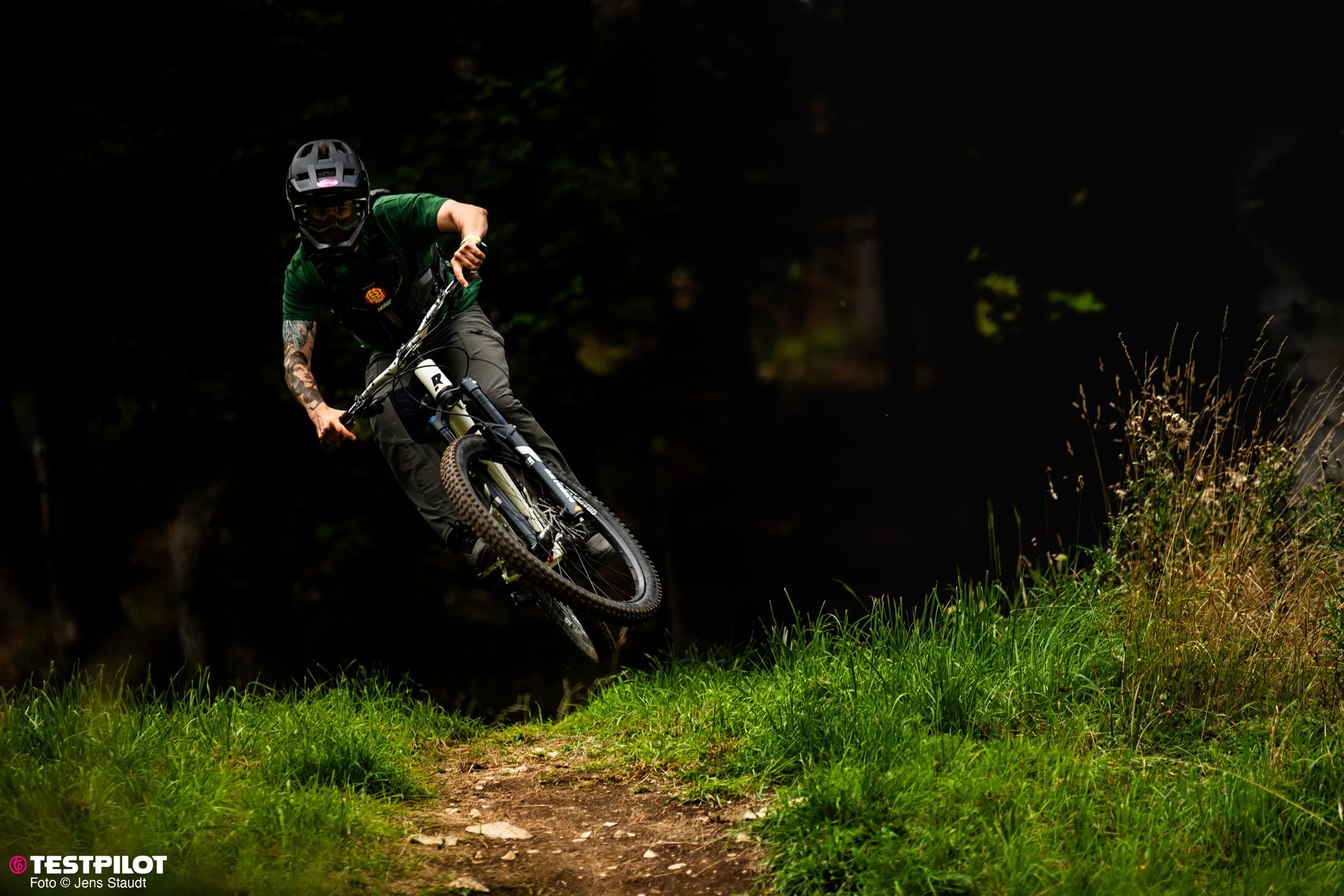
The DUROLUX38 X is the boldest representative among its closest relatives. It is stiffer than a standard DUROLUX38 and noticeably stiffer than an AURON. It can cost some energy eventually, but you might benefit from direct line choice and control over the front end as a bonus.
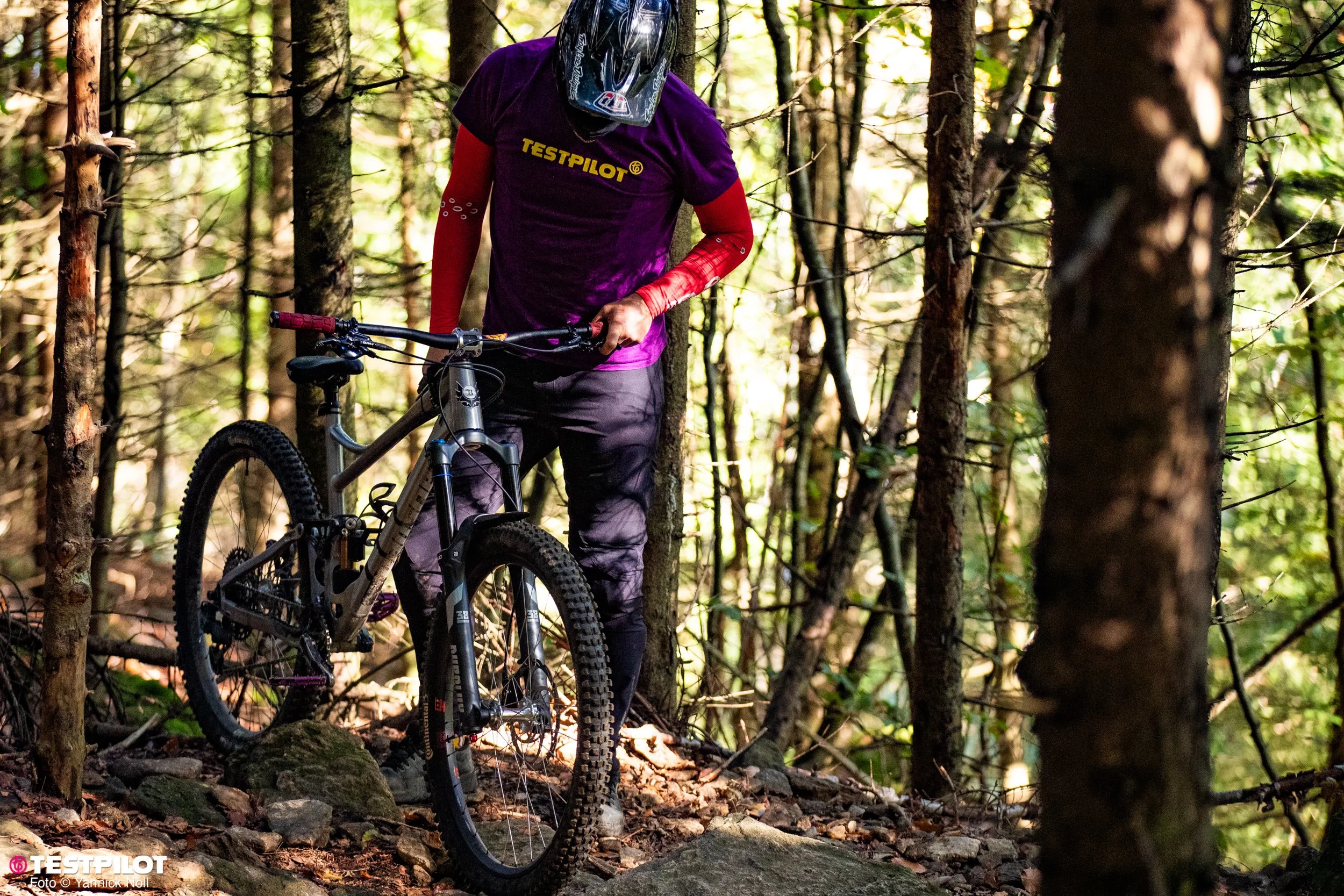
For Jens, at 0.1 tons, this was a pleasant level of stiffness in the bike park. For Yannick, with about 25 kg less body weight, the DUROLUX38 X provided the necessary confidence to really haul a..., especially on the fast bike park track.
However, on slightly rooty or rocky terrain, he occasionally noticed a slight deflection. During quick direction changes, he had to apply a bit more force to steer the fork the other way compared to, for example, the lighter AURON. On fast, rough tracks or big jumps, the DUROLUX38 X is a safe bet. On home trails and for slower-paced riding, Yannick would tend towards a less stiff model.
Suntour's philosophy of covering a broad spectrum with a simplified design works. And still—or perhaps precisely because of that—you have to ask yourself: "Do I need more?"
Technical Report
Suspension forks can't be judged in a parking lot. Nevertheless, the DUROLUX38 X sparked conversation already among our co-pilots during the comparison test: "If you push it, it is a bit unwilling somehow..." This impression was also noticeable on the trail—especially at low speeds and over small bumps. At higher speeds and when the fork was already working through its travel, it was hardly noticeable.
We got to the bottom of it and consulted SR Suntour. After an initial lubrication service, there was a slight improvement, but the optimum had not yet been reached.
According to Suntour, the company is currently transitioning to the so-called TAP (Total Alignment Process). In the future, this is intended to ensure that the stanchions align ideally with the bushings. The increased friction in our test fork could be traced back to non-optimally calibrated bushings—our fork was still from the last batch of team forks.
Because we estimated the DUROLUX's potential to be higher, we optimized it ourselves in the workshop with a bushing burnishing tool. The difference was more than significant: an absolutely clean response, no more unwillingness to get into travel—in any situation.
We hope that the announced TAP will ensure that all forks from the factory will eventually deliver what our fork, refined with a little extra love, was ultimately capable of.
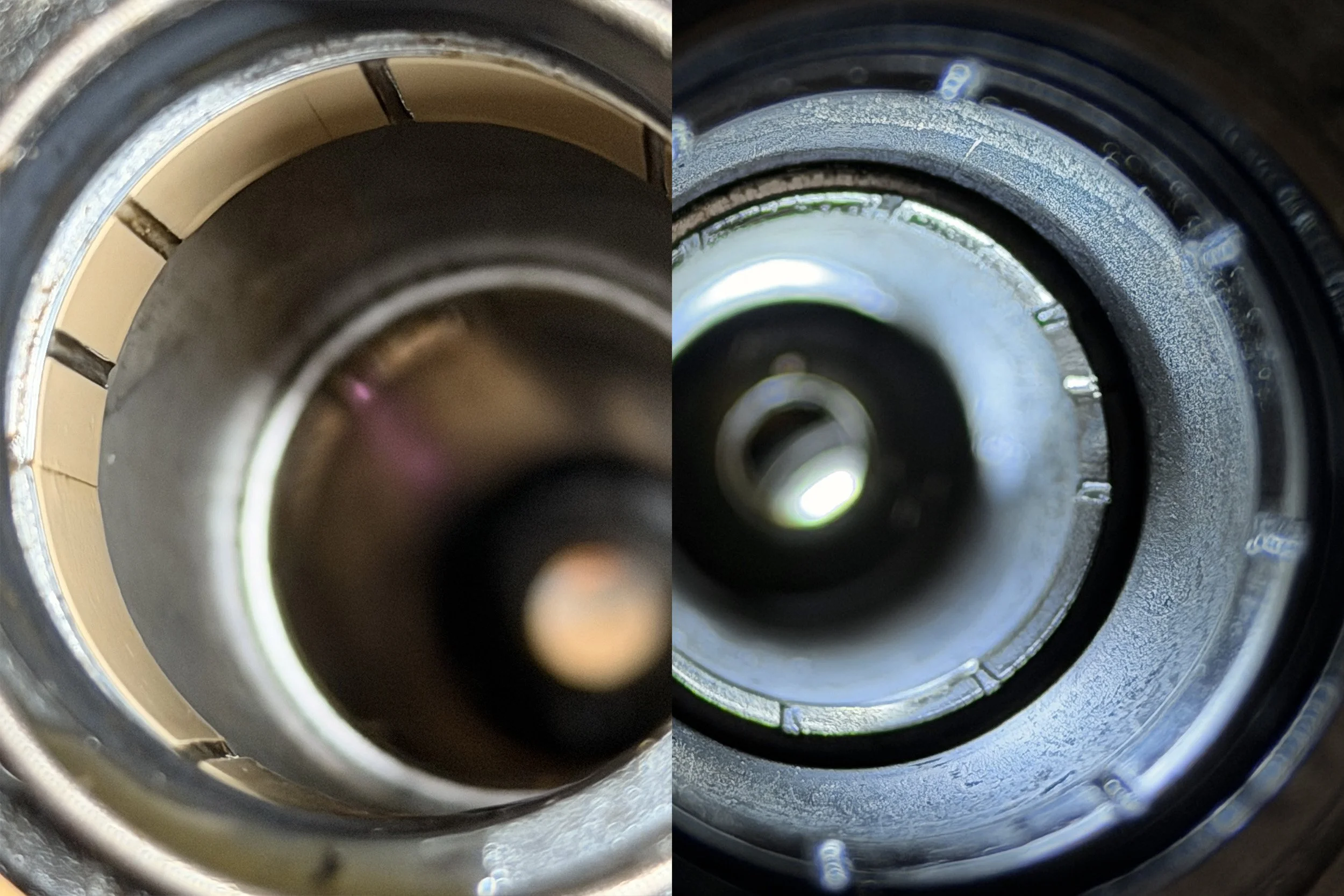
To illustrate: Here you can see worn bushings from another fork. They ensure the stanchions are guided cleanly. To achieve this, they are aligned in the factory. If they are not perfectly calibrated to the stanchions, the small bump sensitivity can suffer, and the fork can feel "jerky."
How does the perfect rider profile for the SR Suntour DUROLUX38 X EVO look like?
Anyone who just wants to ride. Every day. In the rain, in the woods, in the bike park, on the home trail. Anyone who doesn't want to constantly fiddle with adjusters but just wants to hammer out laps—for those users, the DUROLUX38 X EVO is perhaps not the most glamorous but a very honest partner. It doesn't show off. It works.
And isn't that exactly what you expect from a good tool? You don't think about it. It just gets the job done.
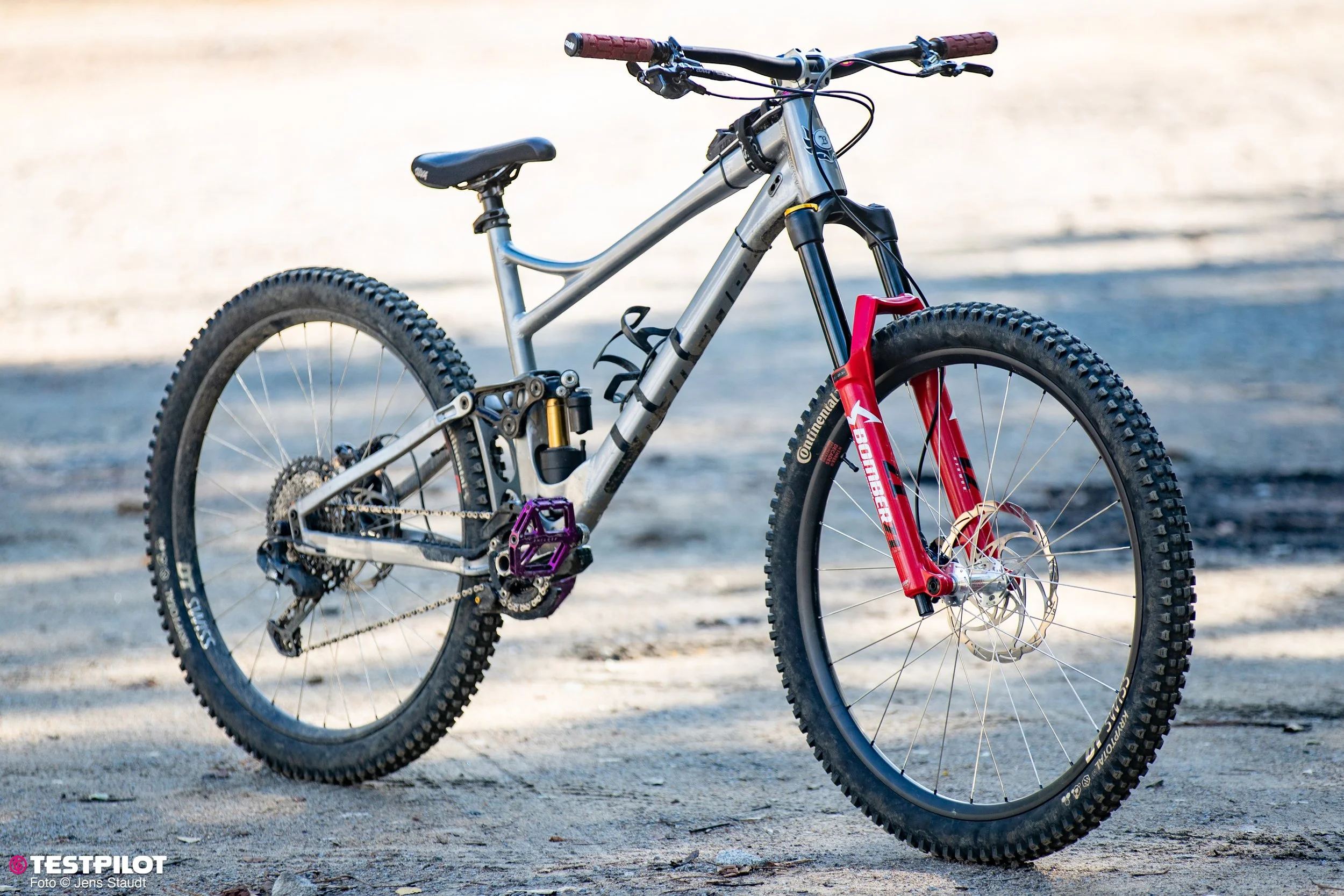
With a clean, understated look, the DUROLUX38 fits into almost any bike.
Conclusion
Give the DUROLUX38 X EVO some love, and it will just keep on going. SR Suntour manages to deliver solid performance, even with few adjustment options. The basic tuning of the damping is particularly positive in this regard. On hard landings and severe impacts, the high-speed damping intervenes in a clean manner, providing a safe and comfortable ride. The offered range within the simple overall package is worth considering.
While your riding buddies are still discussing the last click, you're already on your way back up for your next run.
| What is worth mentioning? | Things to consider. |
|---|---|
|
|
What’s next?
In the next review, we will cover the Marzocchi Z1 Coil. The adjustment options are even more limited due to the steel spring and GRIP cartridge. Does the principle of "reduced to the max" apply again to it?
You want more reviews?

Author – Jens Staudt

Height: 191 cm
Weight: 103 kg
Riding style: With his racing background, the lines are planned, even if there is anything bigger in his way. If possible, sections will be jumped over. You should use the entire width of a trail. Others would say - uncompromising.
Motivation: A product should function carefree and for as long as possible. If you have to screw less, you can ride more. He likes to tinker and see how the bike can be optimized.