

Reading time: 10 minutes
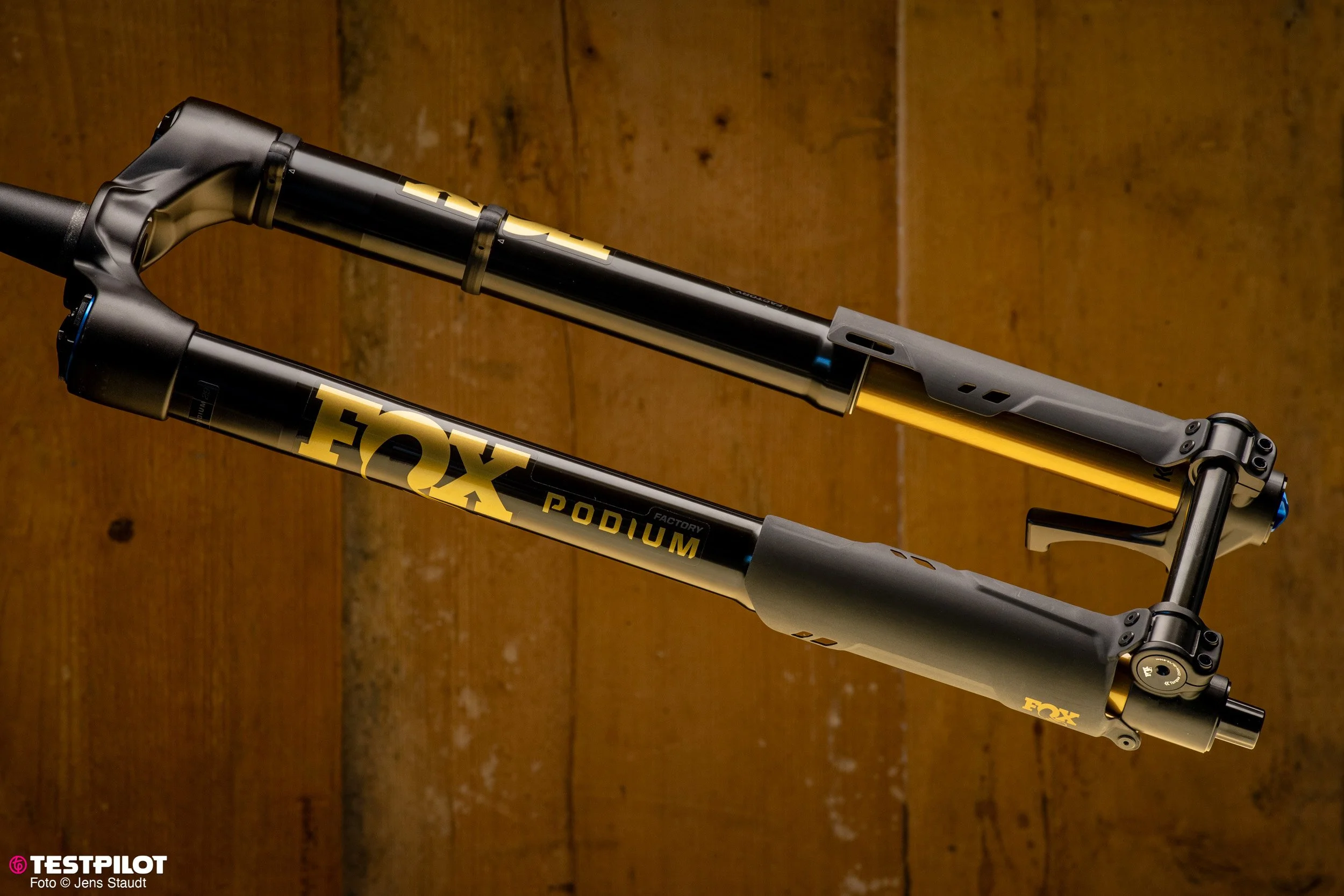
FOX finally did it. After we mountain bikers had to wait since 2011, when a 26-inch upside-down fork was teased in Gee Athertons bike at the US-Open, FOX’s debut in this segment arrived on the shelves 14 years later. The surprise: The Podium did not feature double crowns and aims rather for enduro and eMTB than downhill bikes.
Performance for heavy hitter, racer und e-biker? Here is our ride impression.
Technical info – Fox Podium Factory
| Application | Enduro / aggr. AM / eMTB |
| ⌀ | (47 mm upper) 36 mm |
| Travel | 150 / 160 / 170 mm |
| Settings | HSC, LSC, HSR, LSR |
| Suspension | FLOAT EVOL GlideCore Air |
| Damping | GRIP X2 |
| Wheel sizes | 29″ |
| Max. Tire Width | 2.6″ |
| Axle dimension | 20 x 110 mm Boost |
| Brake rotor | PM 200 mm (up to 230 mm) |
| Offset | 44 mm |
| Axle-to-Crown | approx. 577–587 mm |
| Steerer tube | 1.5–1 1/8″ |
| Casting | Aluminum |
| Wipers | Fox by SKF |
| Fender | optional |
| Color | Kashima / Black |
| Weight | 2,780 g |
| Warranty | 2 years |
| Price (RRP) | approx. €2,400 |
| Website | ridefox.com |
TECH bits FOX PODIUM
Why is everything on the FOX podium upside down in the first place? Didn't our regular mountain bike forks do just fine? The answer is: Flipping it upside down increases control. In motor-powered high-performance two-wheeled sports, whether MotoGP or motocross, the upside-down (USD) design has been the undisputed standard for decades. The most well-known reason for this dominance is commonly said to be a reduction in unsprung mass. A second advantage of this design is also considered to be that the bushings in USD forks are always well lubricated. But do these promises from our throttle-twisting cousins hold true in mountain biking? You’ll be able to find out later in a dedicated article…

FOX Podium – Chassis
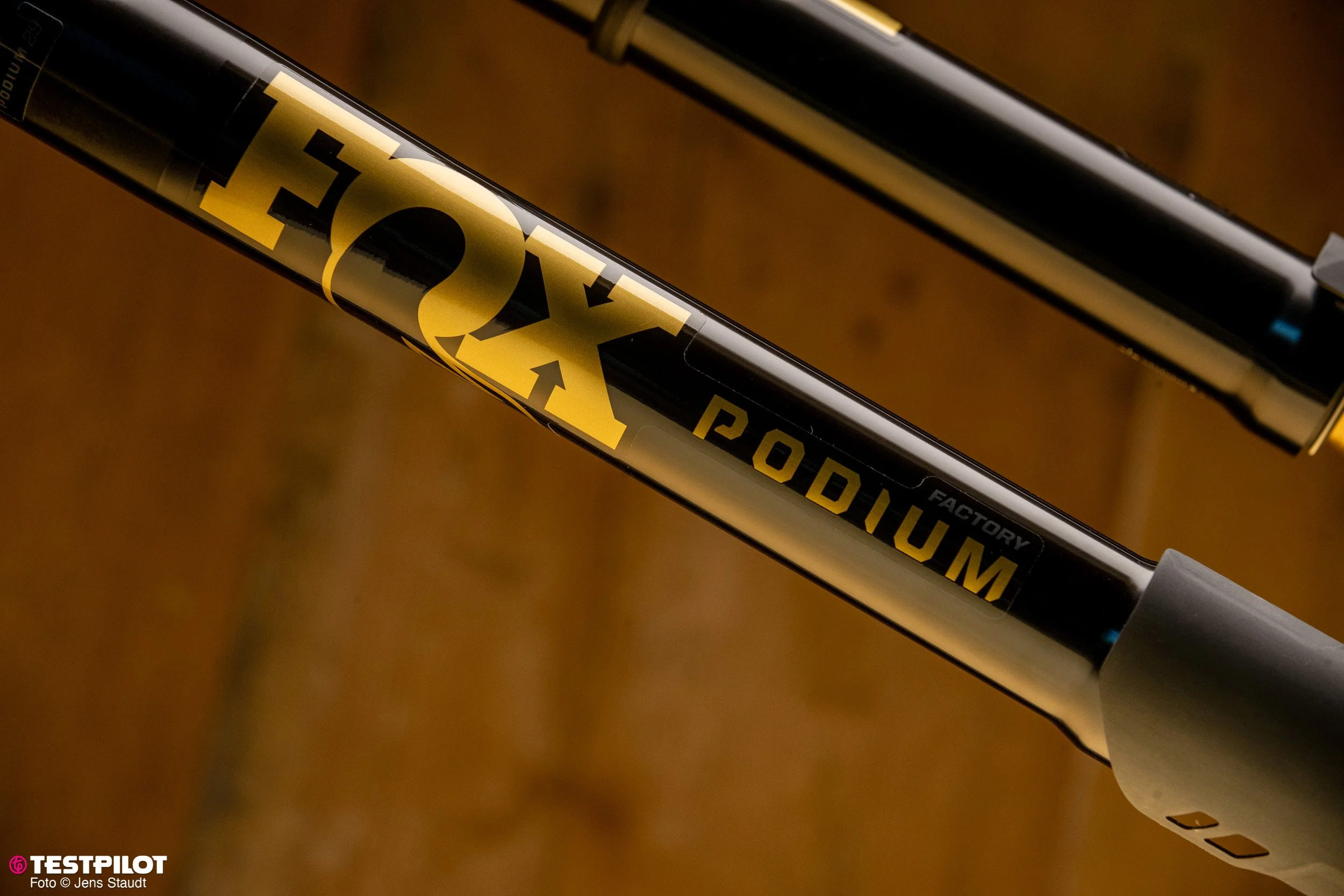
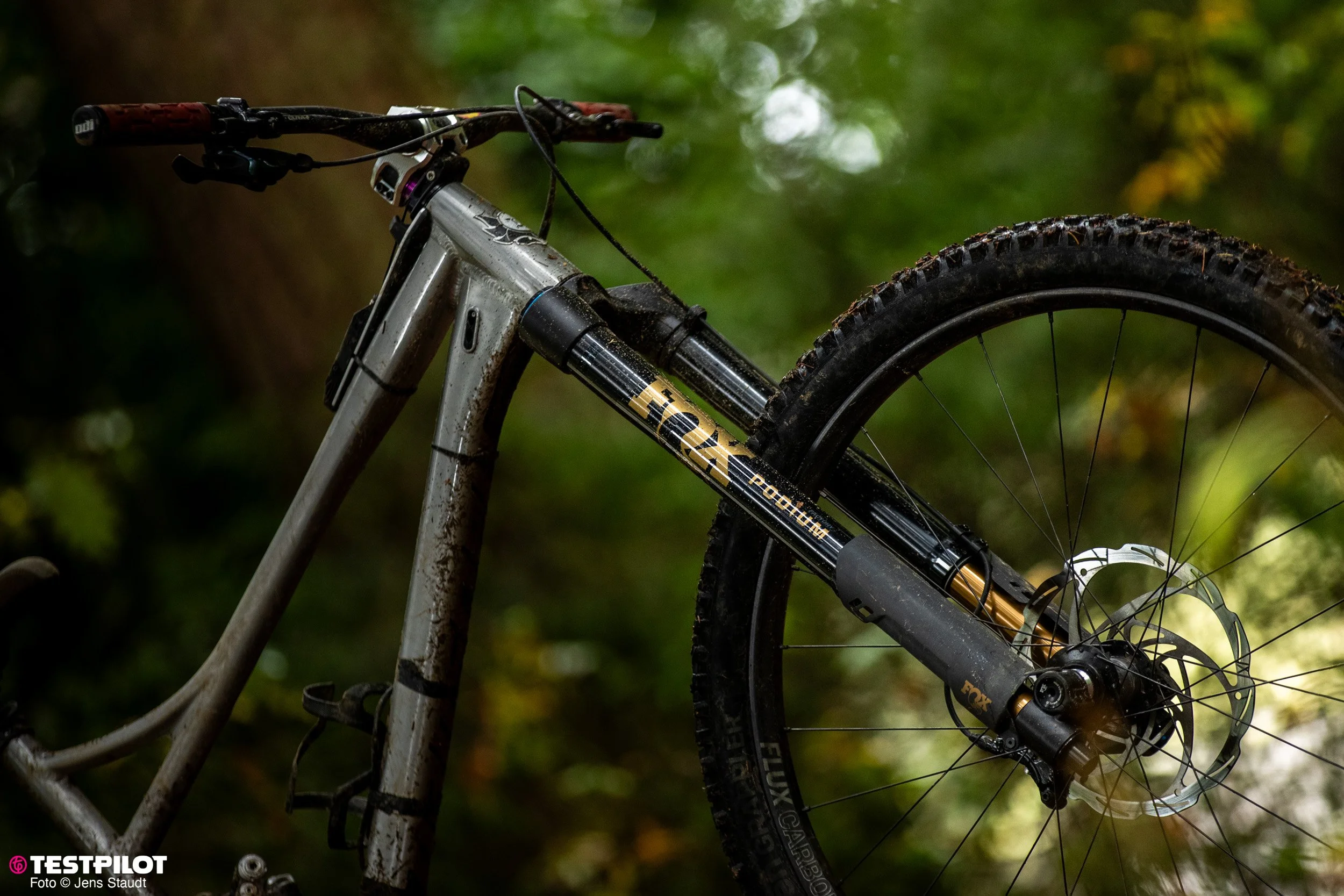
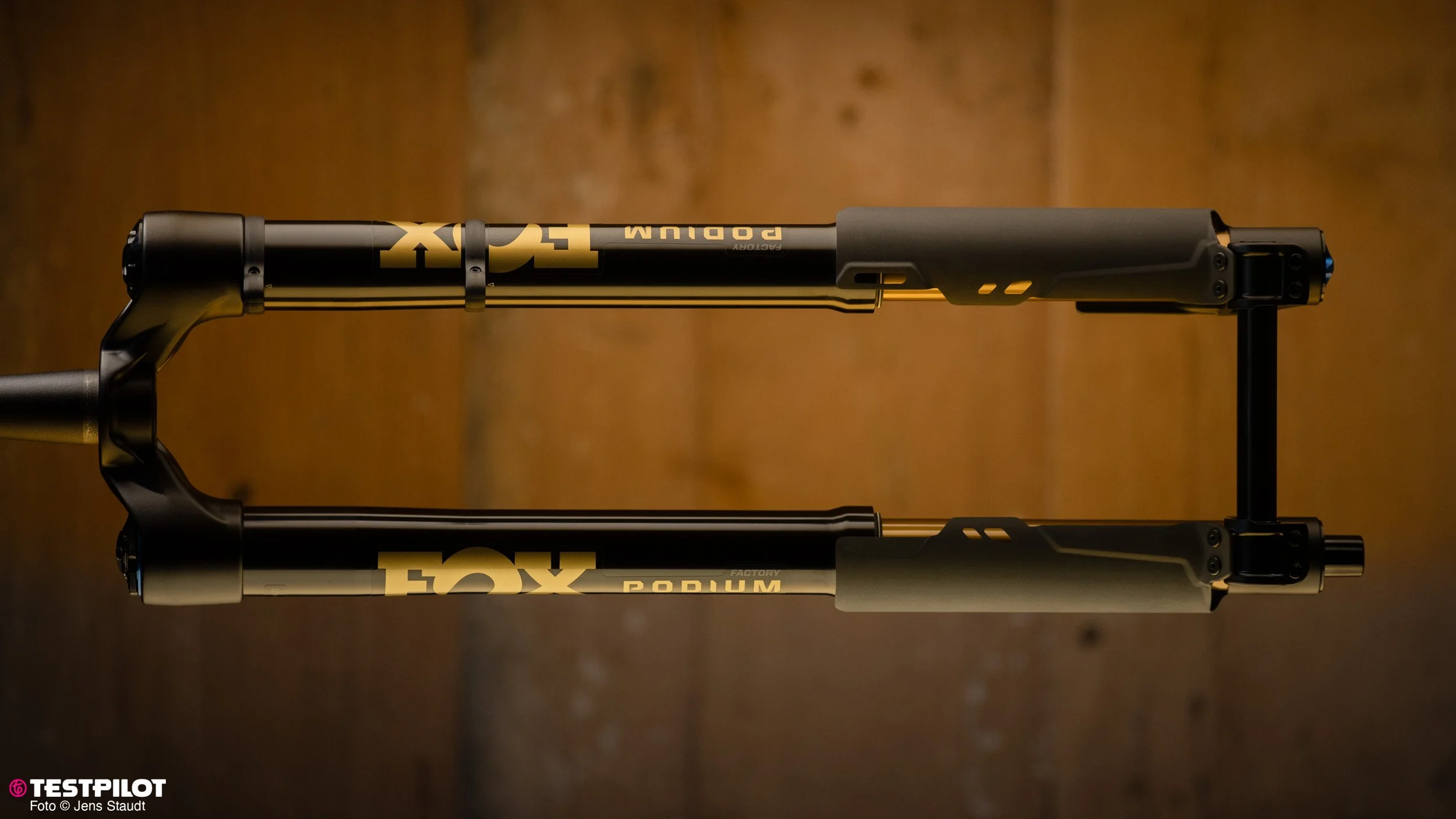
That's quite a big fella! The FOX Podium's stanchions, machined from 7075 aluminum, measure 47 mm and are joined by the massive crown. The latter is available in two variants. To match your frame. (Even more) massive and rigid for bulkier e-bikes or slimmer for regular mountain bikes.
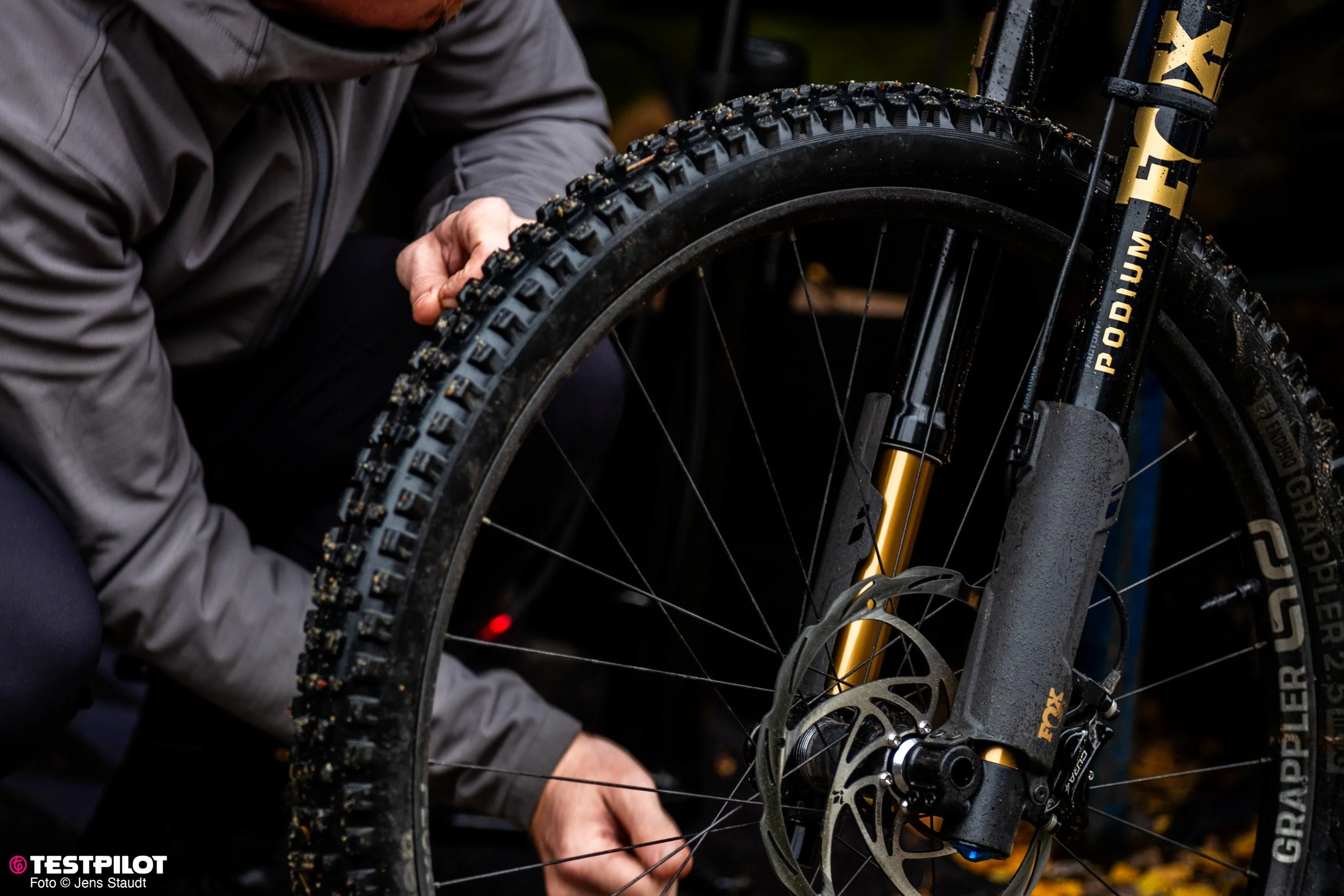
At the bottom, it's (surprisingly) not 38 mm but 36 mm tubes that emerge, visually striking with FOX's exclusive Kashima coating. Despite the decreased diameter, the fork, from no angle, still doesn't appear thin anywhere. To compensate for the reduced torsional stiffness due to one missing bridge, FOX uses a 20 x 110 mm Boost DH steel axle. Simply screw in the axle and fold the lever, like on other forks? Not here. There is a precise process you must follow for the fork to operate smoothly later. For this, you tighten all five bolts in a specific sequence and to a specified torque.
FOX rates its lateral stiffness on par with their 36, which should aid grip. Due to the bulky upper tubes—by design and intention—the stiffness in the direction of travel is significantly higher than that of a trail suspension fork. According to FOX, it's close to their 40.
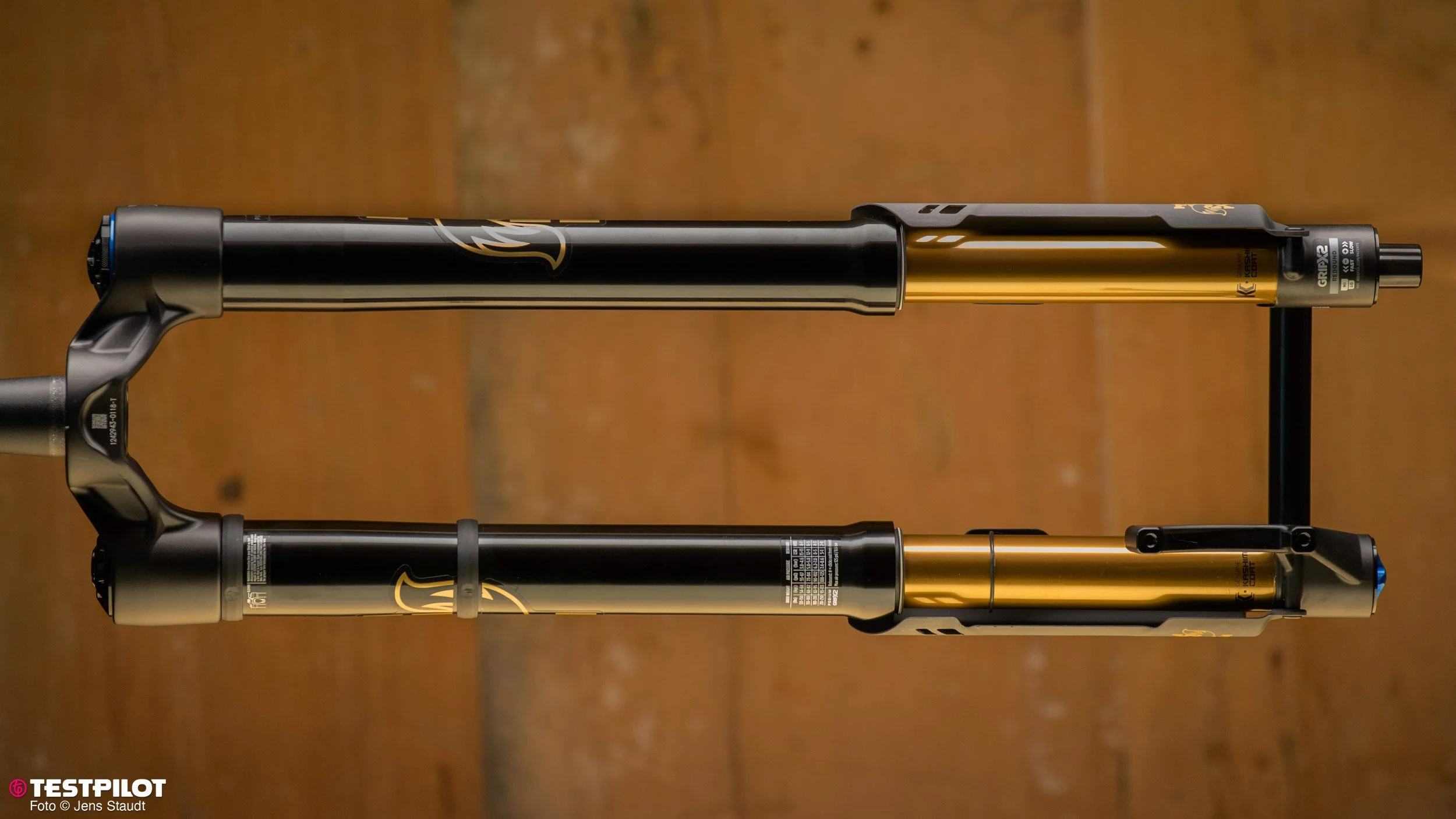
A bold fork crown paired with 47 mm aluminum stanchions. The lower fork assembly consists of 36 mm tubes with Kashima coating and a 20 mm steel axle.
Another key parameter is the so-called bushing overlap. This is the distance between the bushings within a fork. FOX states this distance to be 174.4 mm, which they claim is 32% more than on a FOX 38. Reduced friction and improved performance, even when working deeper in the travel through rock gardens, is the manufacturer's conclusion.
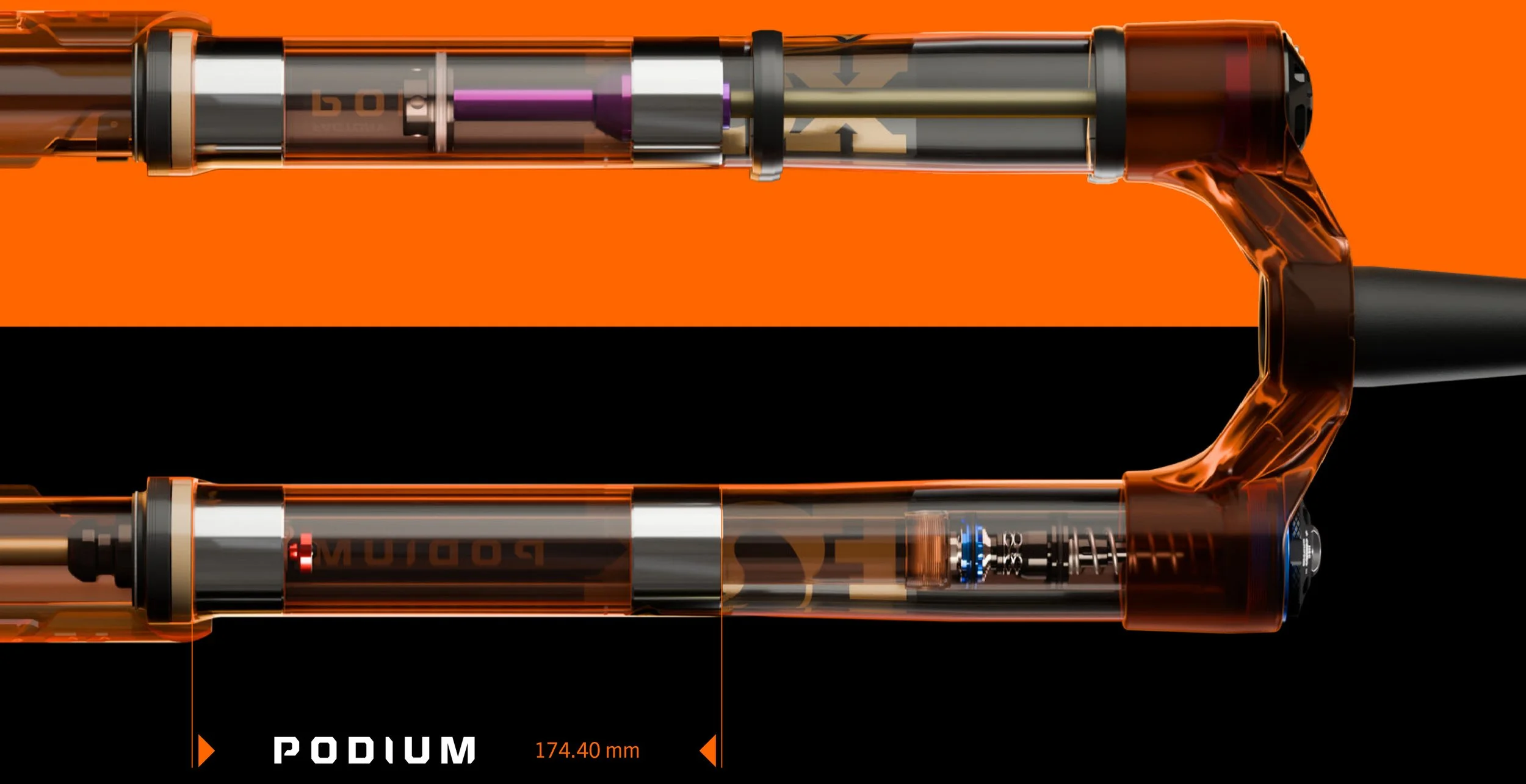
A key feature of the FOX Podium is the bushing overlap—the distance between the stanchion guiding bushings: 174.4 mm.
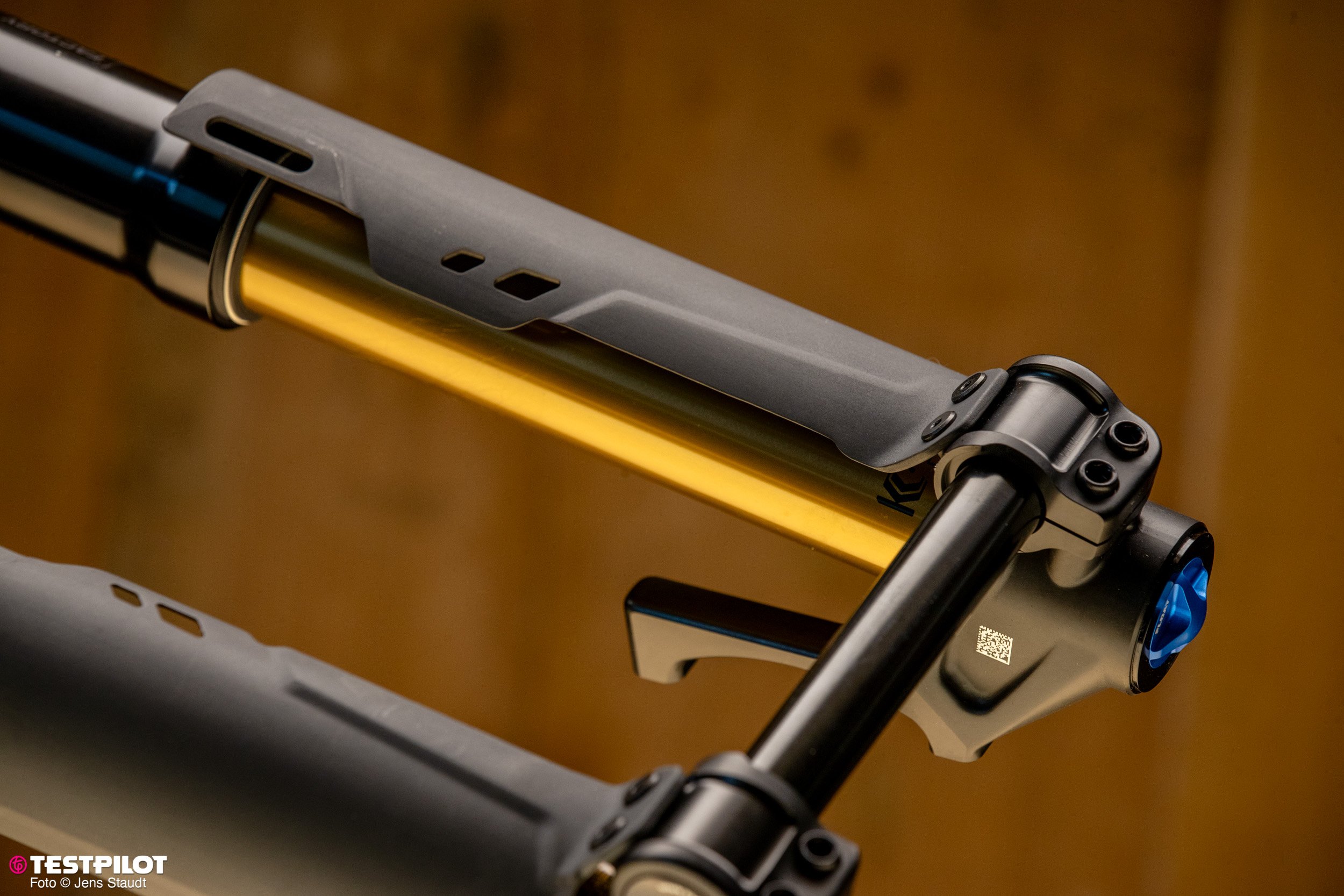
If you want to protect your pretty, precious possession, you should install the included stanchion protectors. These also provide routing for the brake hose. Without the protectors, a so-called "mast," which is nothing other than a brake hose guide, keeps the brake hose away from the rotating wheel. There is also an optional fender available. Its appearance resembles the front fender of a motocross bike, but with a price tag of 75 euros, it plays in a league far above typical moto prices.
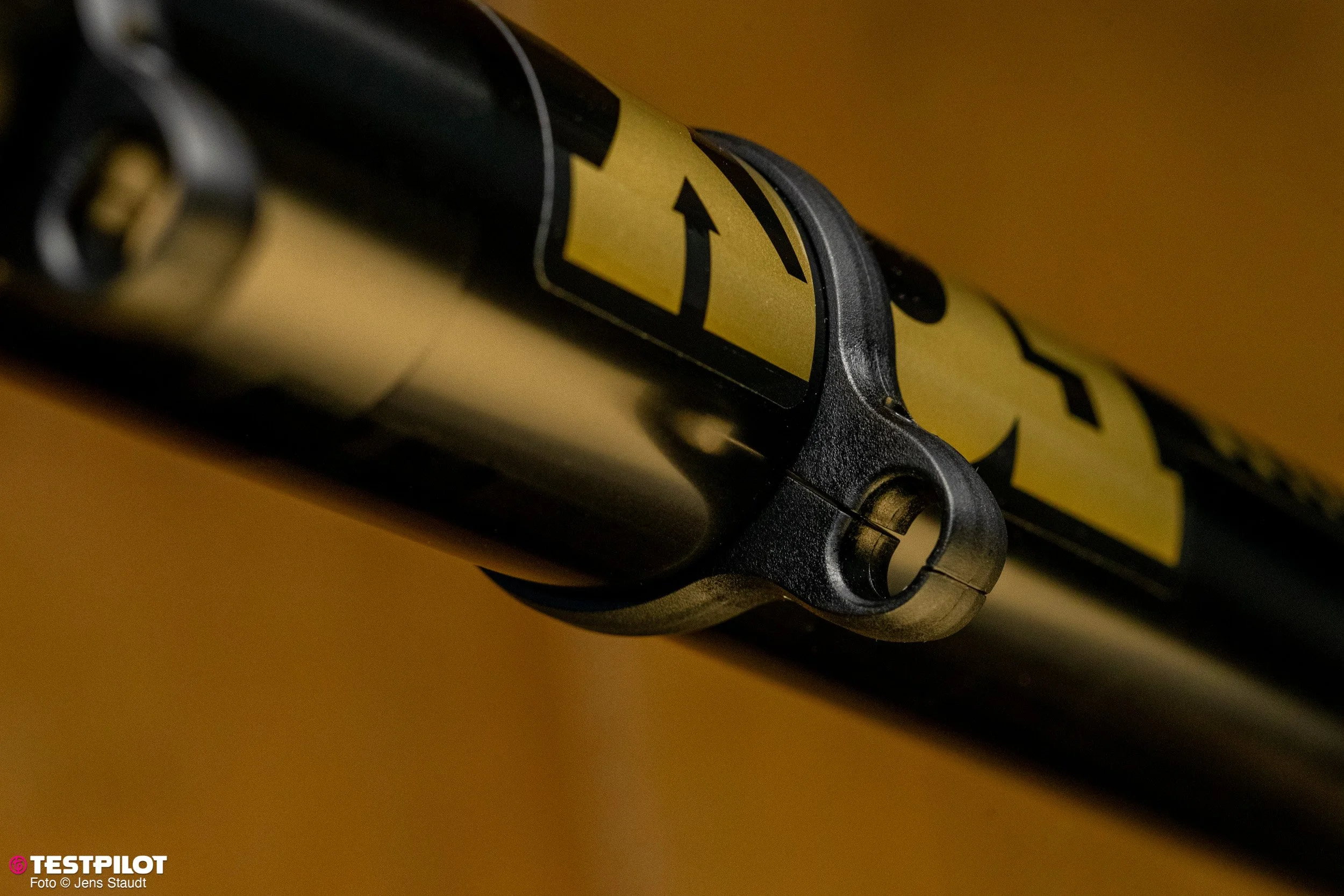
Two more guides on the upper part of the fork.
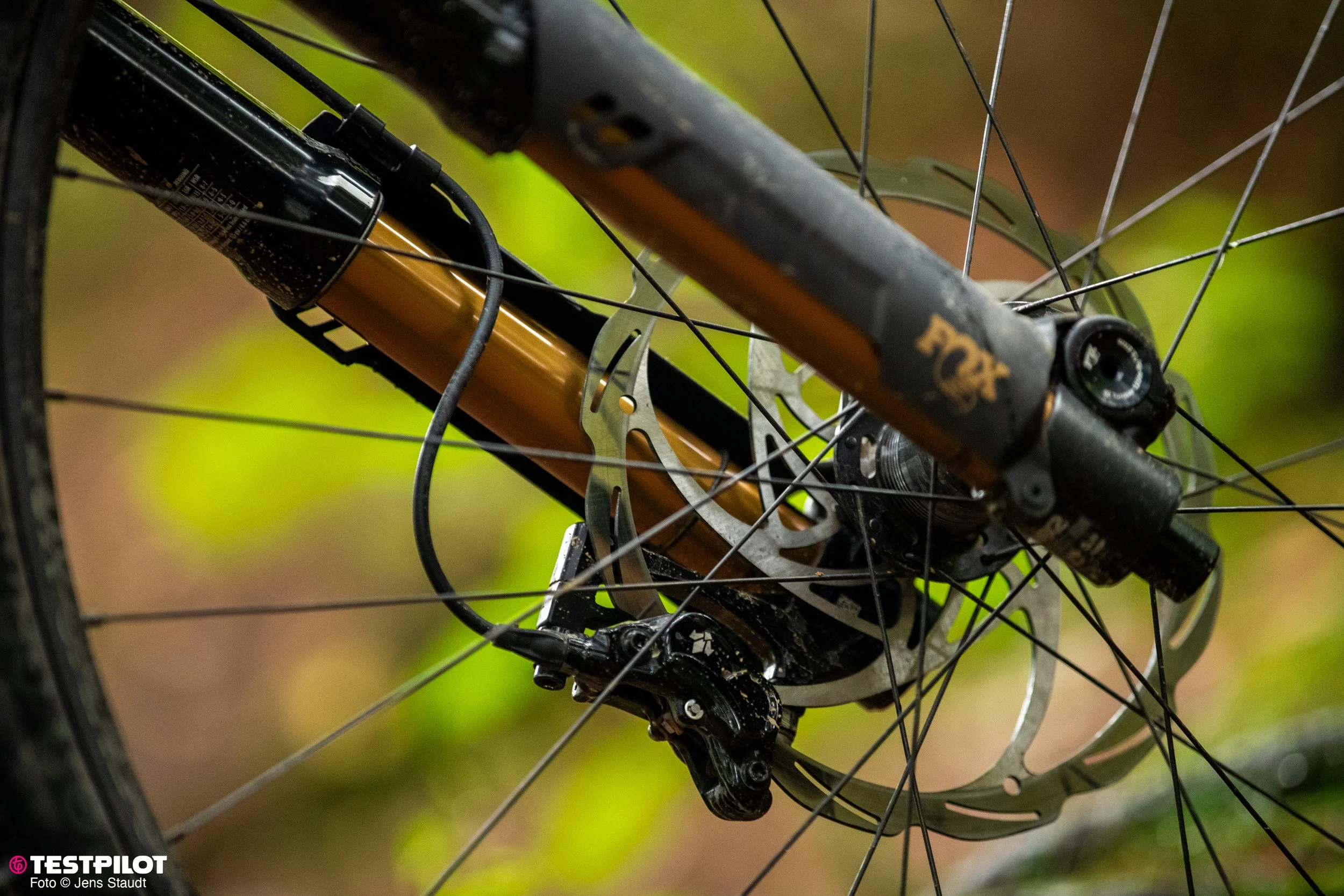
When using a fender, the hose is attached to it.
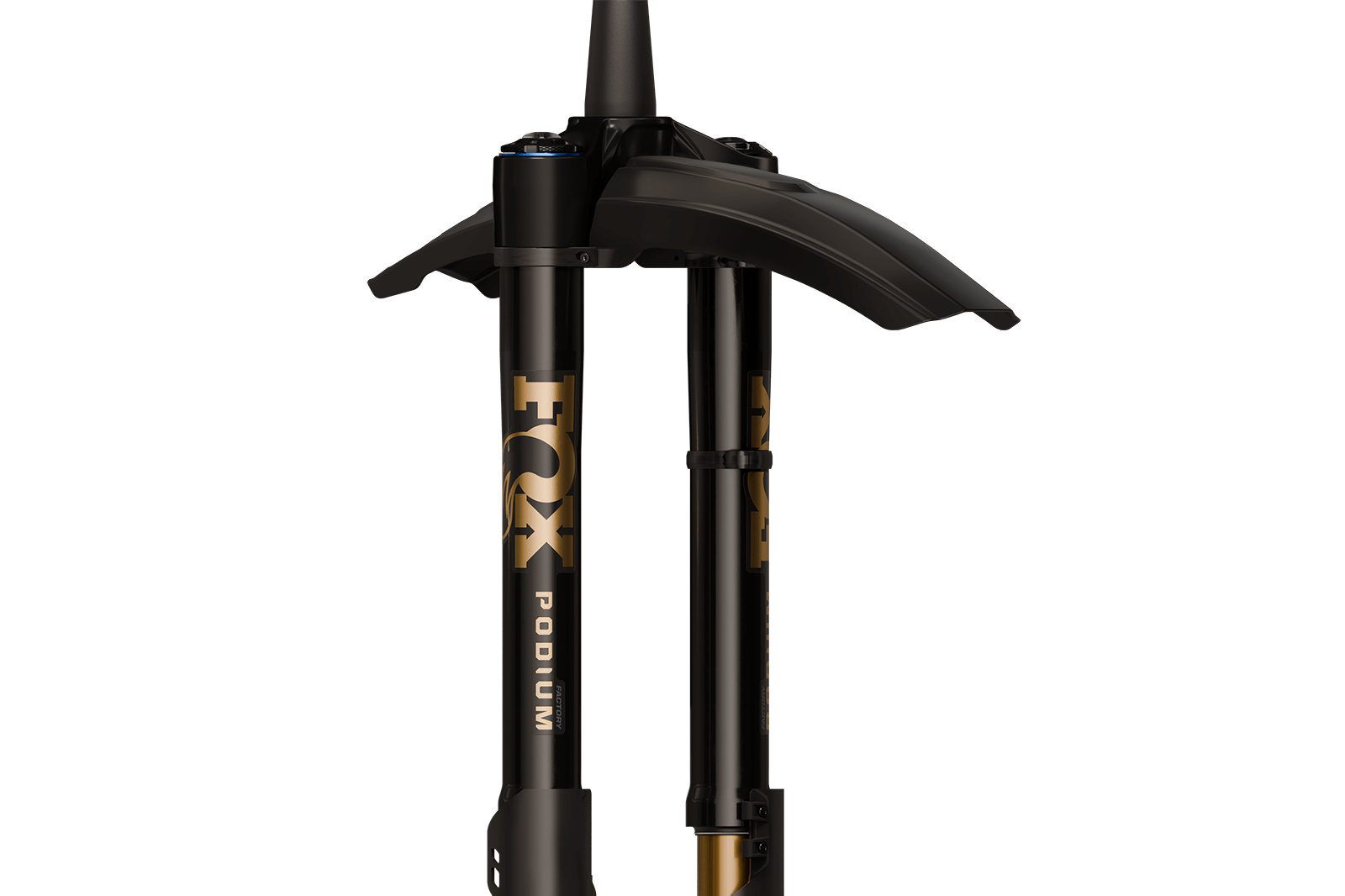
Maxed moto with the big, optional fender.
FOX Podium – air spring
The Podium utilizes the FLOAT EVOL GlideCore air spring. A flexibly mounted air piston is designed to help minimize friction even when the chassis is "twisted" from trail impacts. Furthermore, the sensitive response to the smallest bumps is said to be further improved this way.
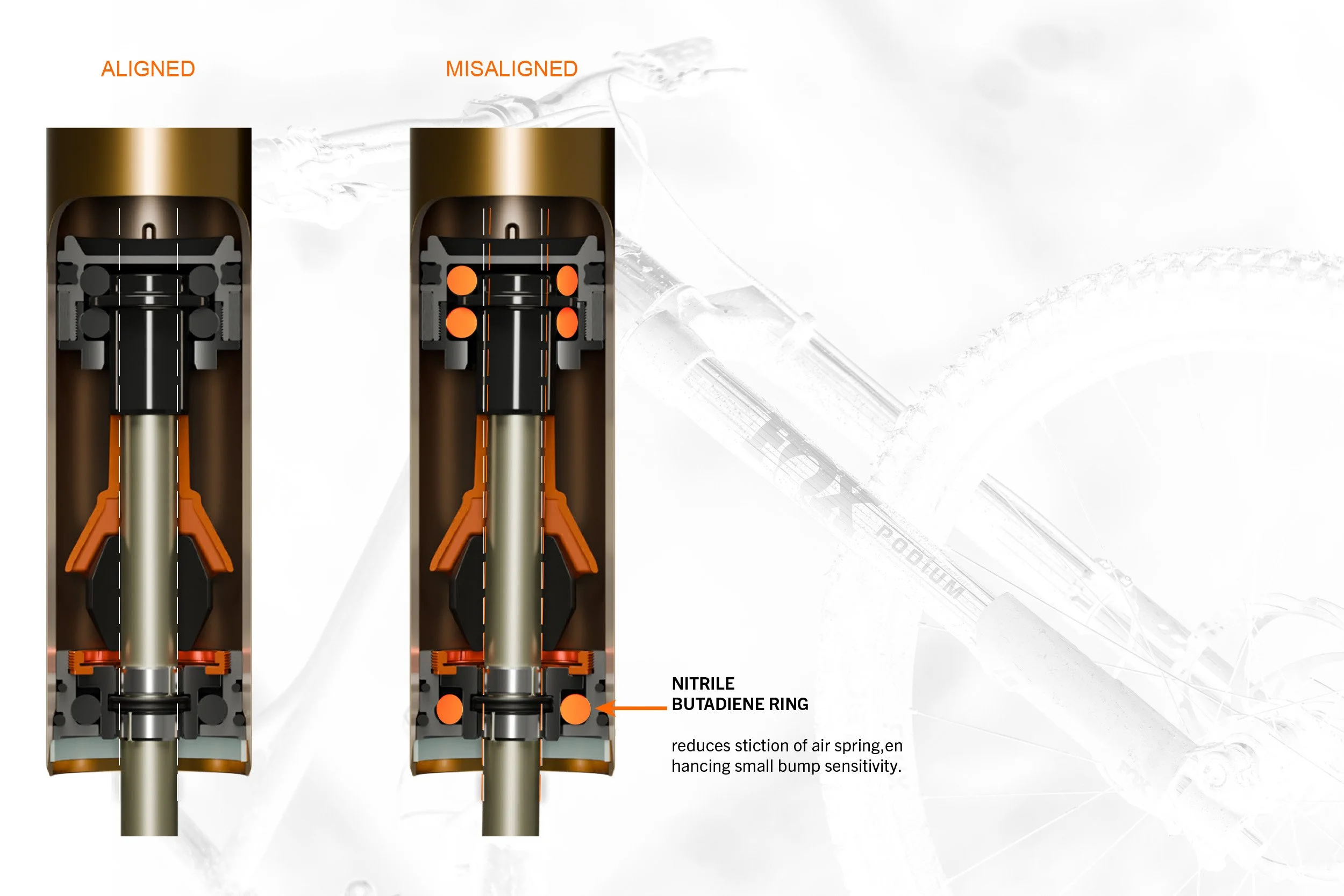
In the GlideCore system, the marked nitrile butadiene rings (synthetic rubber) provide lateral and axial freedom of movement for the air piston—this is intended to prevent the fork from "binding" and to make it more responsive.
Due to its design, this suspension is not filled with air from the top but from the bottom on the left fork leg. Be cautious! When unscrewing the shock pump, some lubricating oil can squirt towards the brake disc. It may also happen that the air chamber lubricant settles into the pump hose and thus later into the pump itself. To play it safe, flip the bike upside down, remove the front wheel, and only then bring in the pump.
FOX has always used solid plastic volume spacers. Using a cassette tool, the air chamber (release pressure first—obviously) can be opened and adjusted with up to 8 black "pucks". Then you may go out, and even the harshest huck-to-flats won't make you have any problems (unless you skipped your pushups).
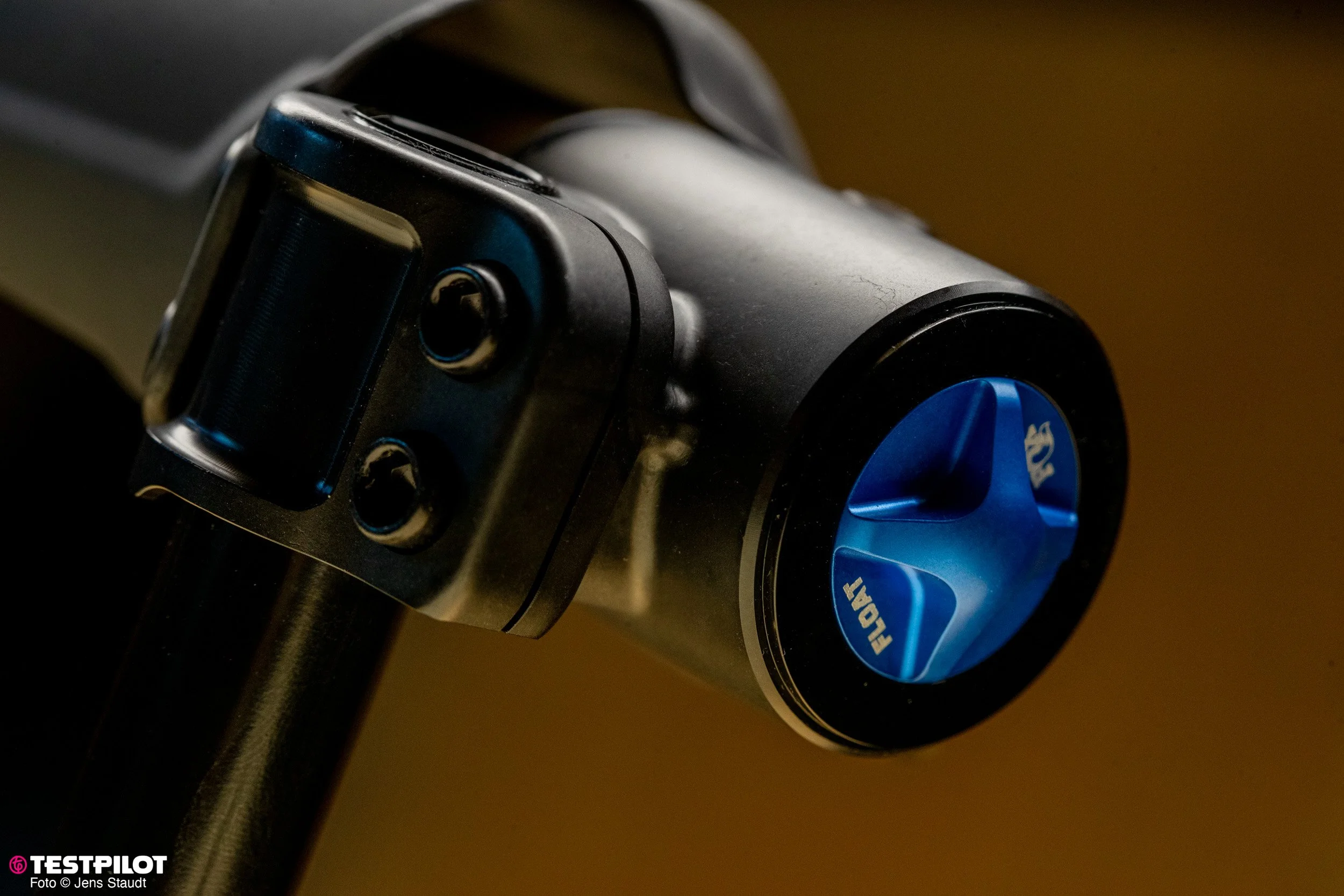
The air valve is located on the bottom left
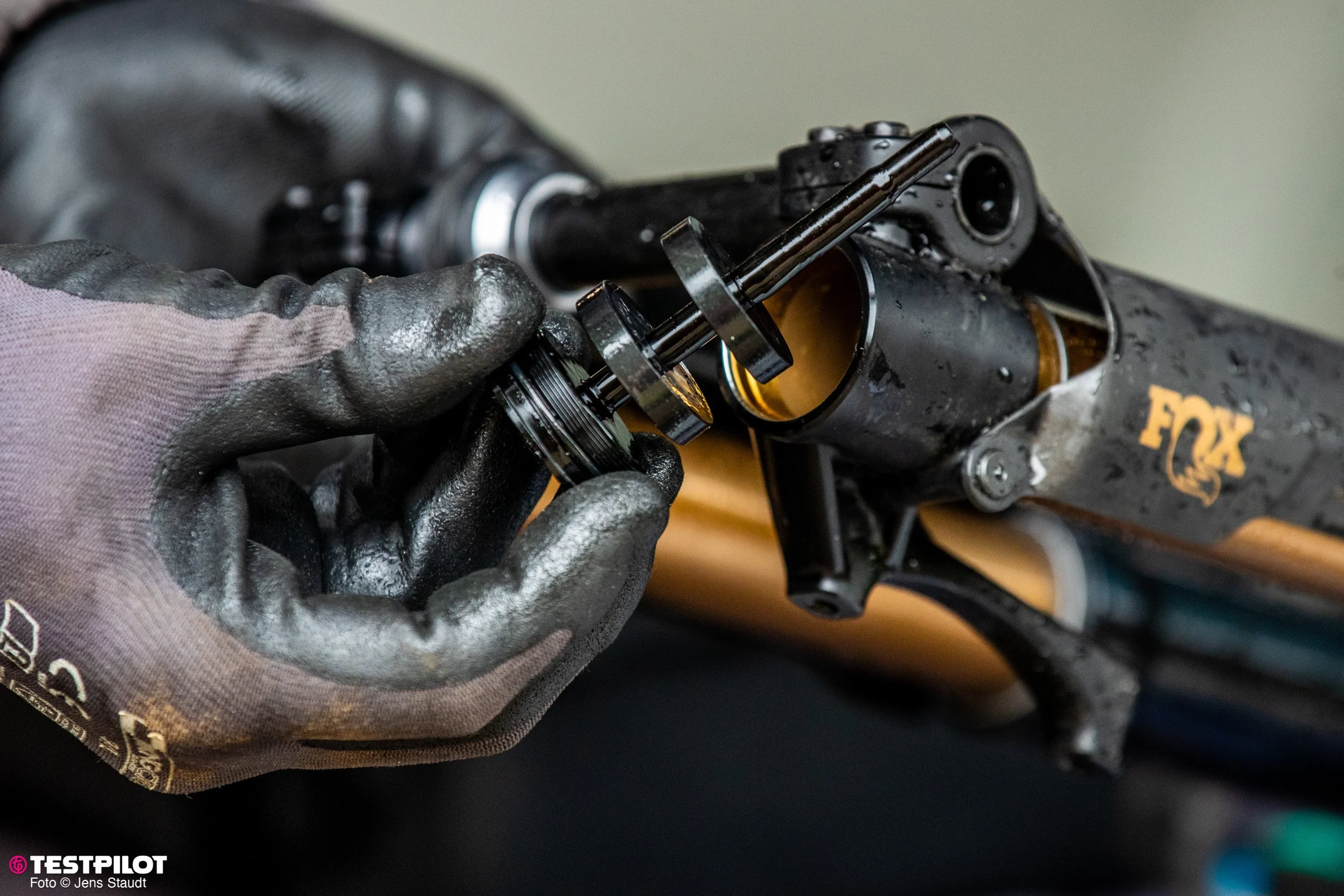
Behind it, you access the volume spacers aka "pucks". For easy, hassle free access, put the bike upside down.
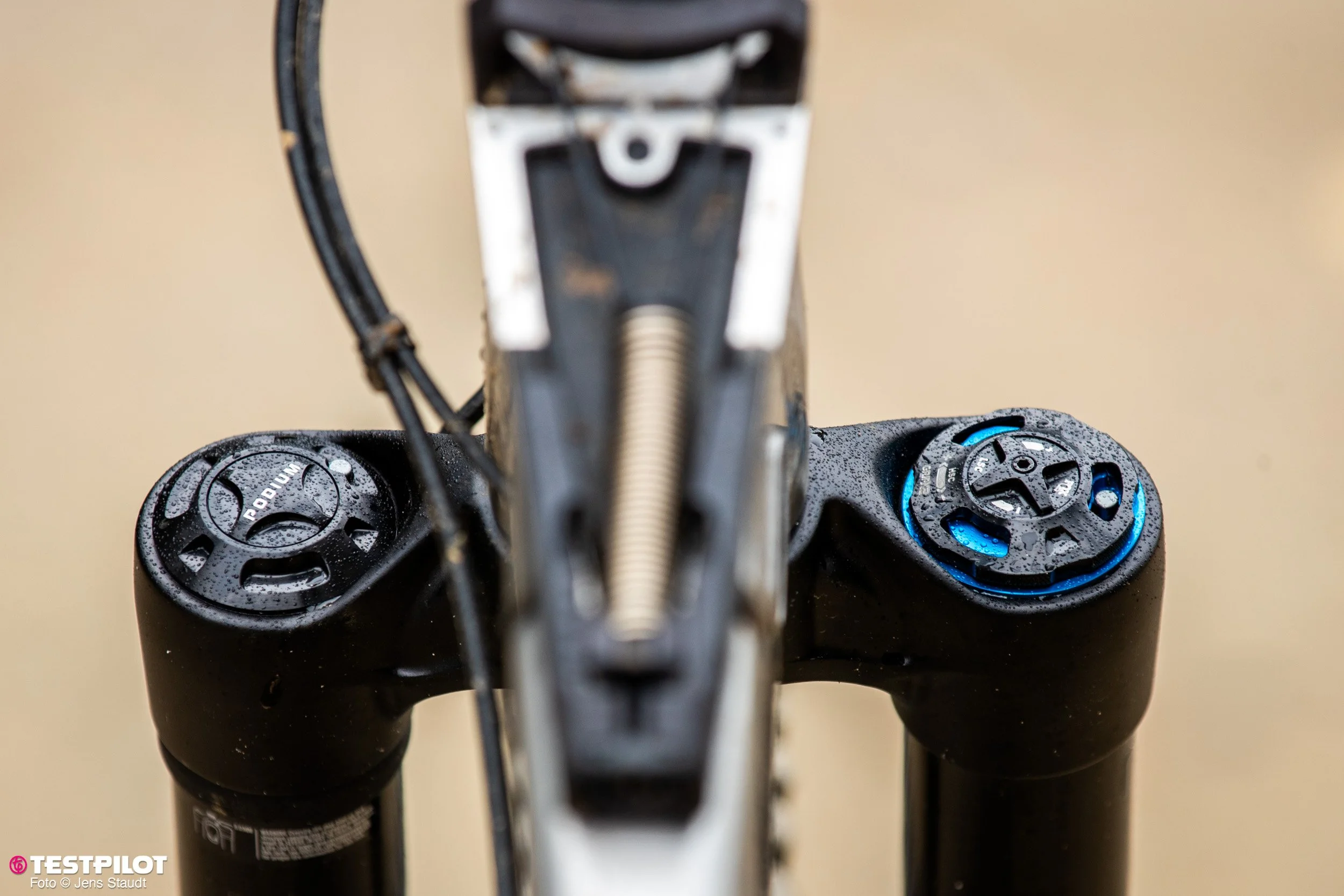
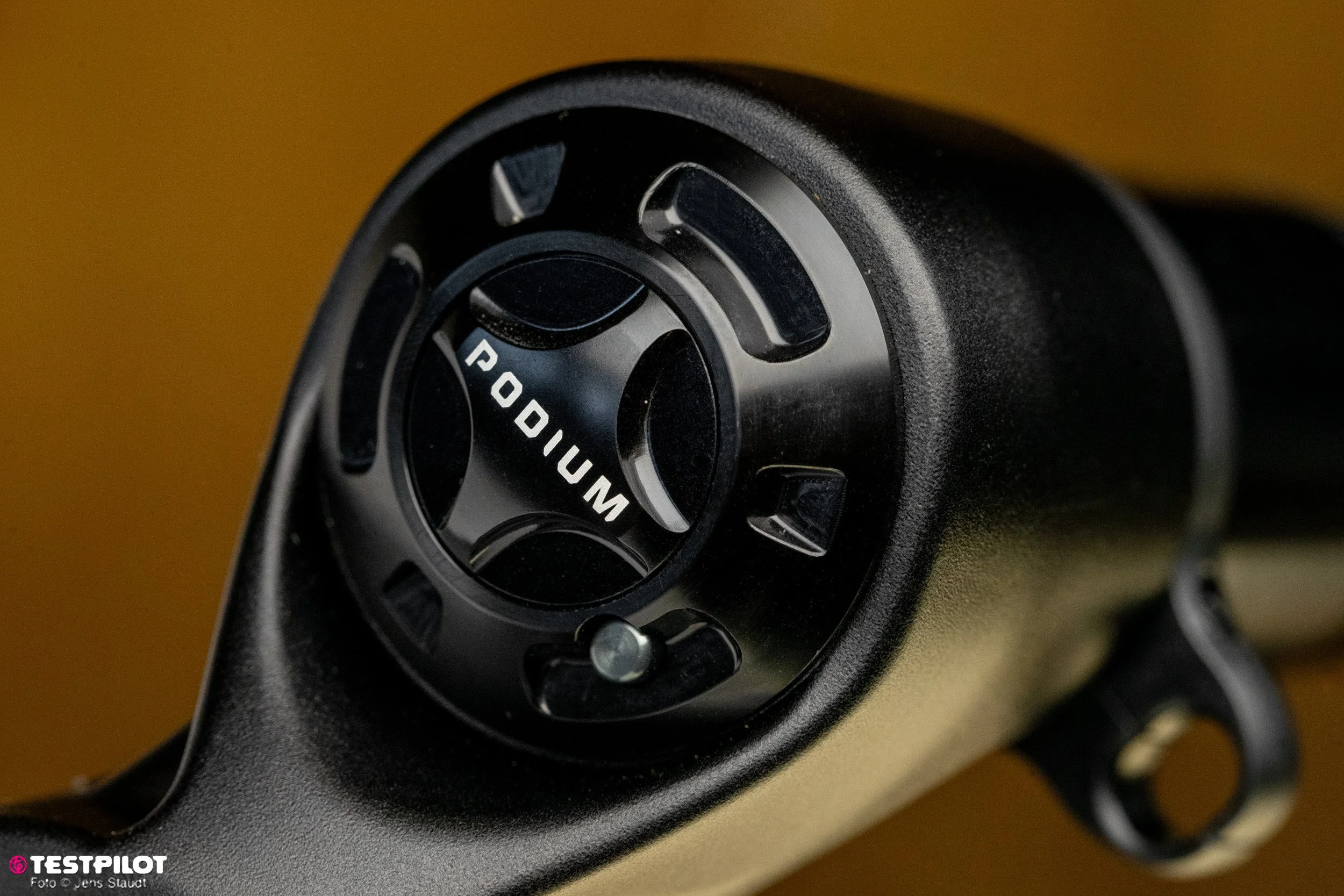
Pressure buildup inside the casting due to many vertical meters or other external influences? Use a pointy finger if you have one; otherwise, a stick will help. You can use the release valve (the small silver button on the left and right on top of each fork leg) to achieve the necessary pressure equalization.
FOX Podium – Damping
The GRIP X2 cartridge is not an entirely new design; the Podium largely draws from its 36 and 38 sisters here. Since an upside-down design creates less friction (meaning uncontrolled damping), the compression and rebound stages as well as the mid-valve piston design have been adapted.
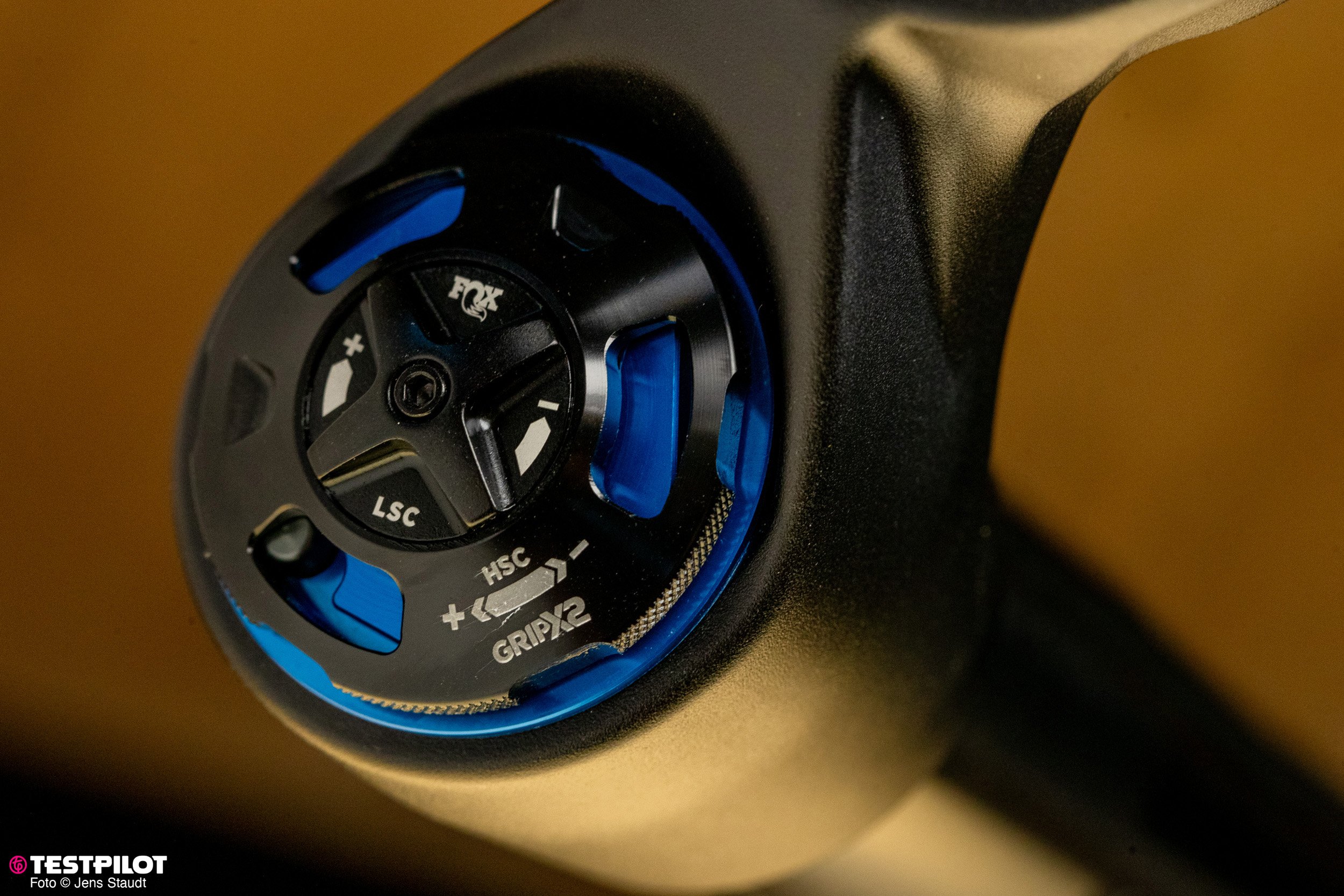
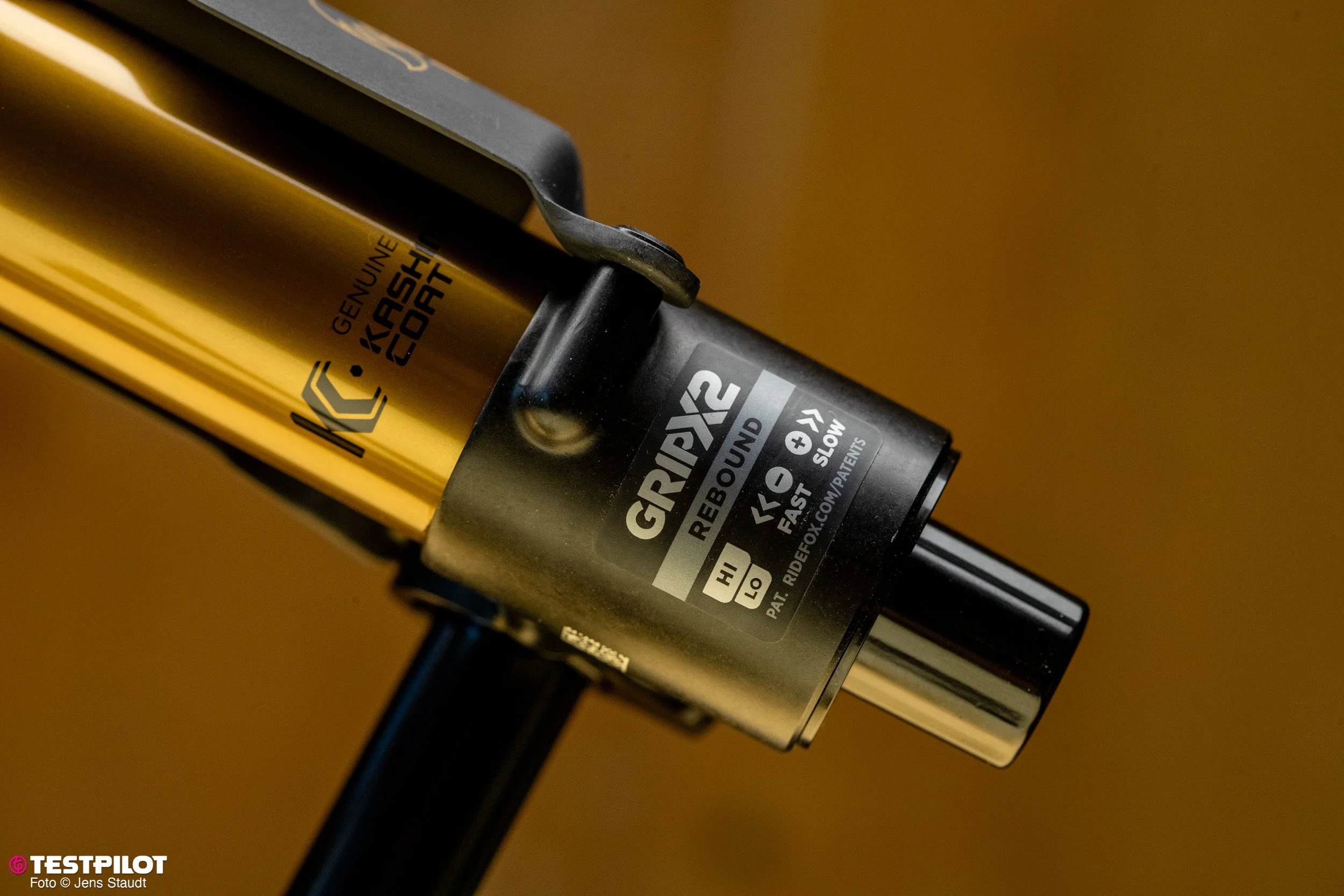
The external adjustment options are typical for FOX: 8 clicks each for High-Speed Compression (HSC) and High-Speed Rebound (HSR), and 18 clicks for Low-Speed Compression (LSC) and 16 clicks for Low-Speed Rebound (LSR).
As with FOX's right-side-up suspension forks, the compression adjusters are on the right top side and the rebound adjusters on the right bottom side, protected by a screw-on protective cap.
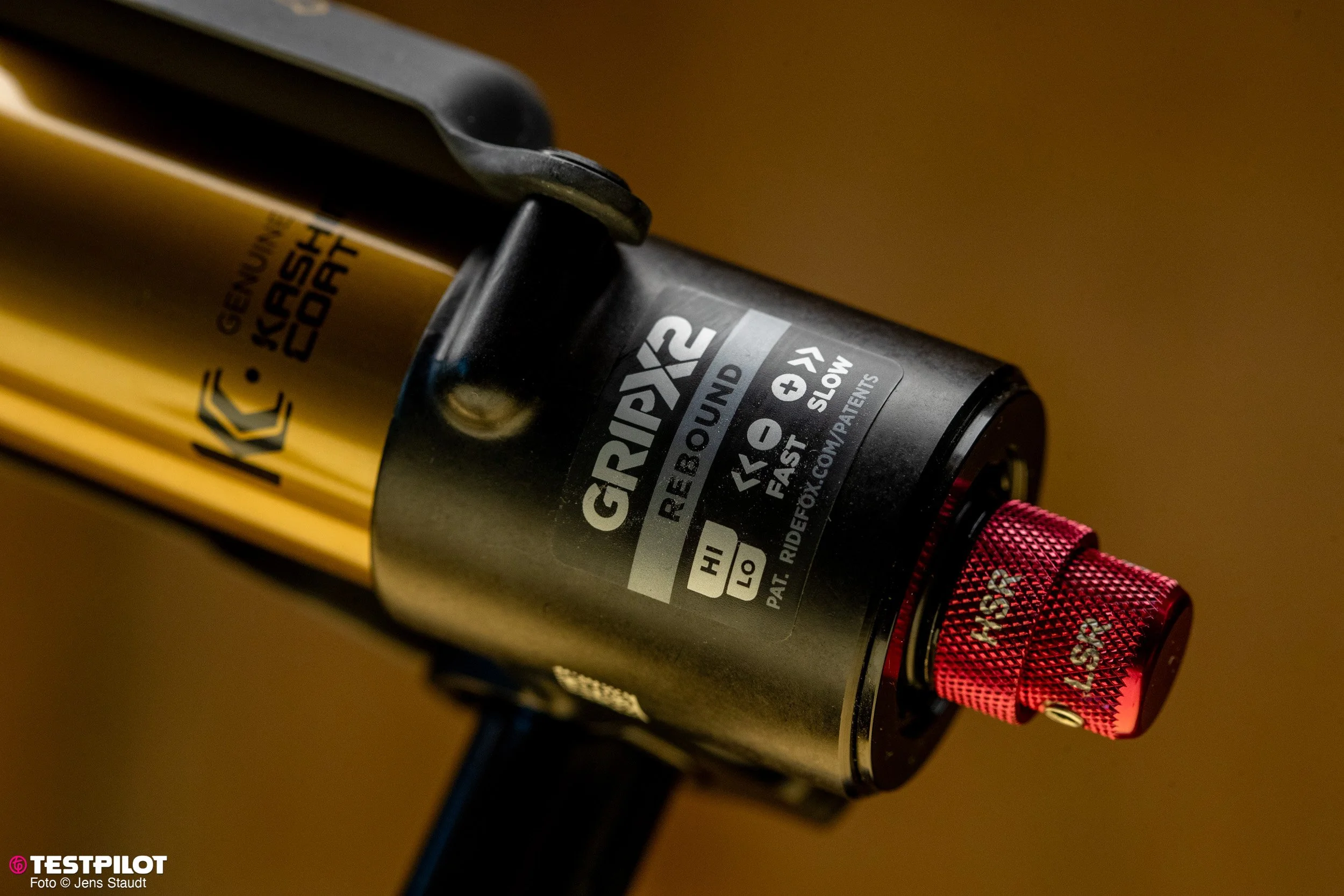
Setup the FOX Podium
Even though everything here is upside down, the setup of the FOX Podium is largely the same as that of other Fox suspension forks. Straightforward and simple.
Depending on rider weight, recommendations for air pressure can be found on the fork's setup sticker, and directly related to that, the number of clicks for high-speed and low-speed rebound.
Whoever takes the time—and one always should—to work through the manual or setup guide on the Fox website will also find the recommendation for the compression settings: HSC 6 (out of 8) and LSC on 8 (out of 18). This remains constant for all rider weights.
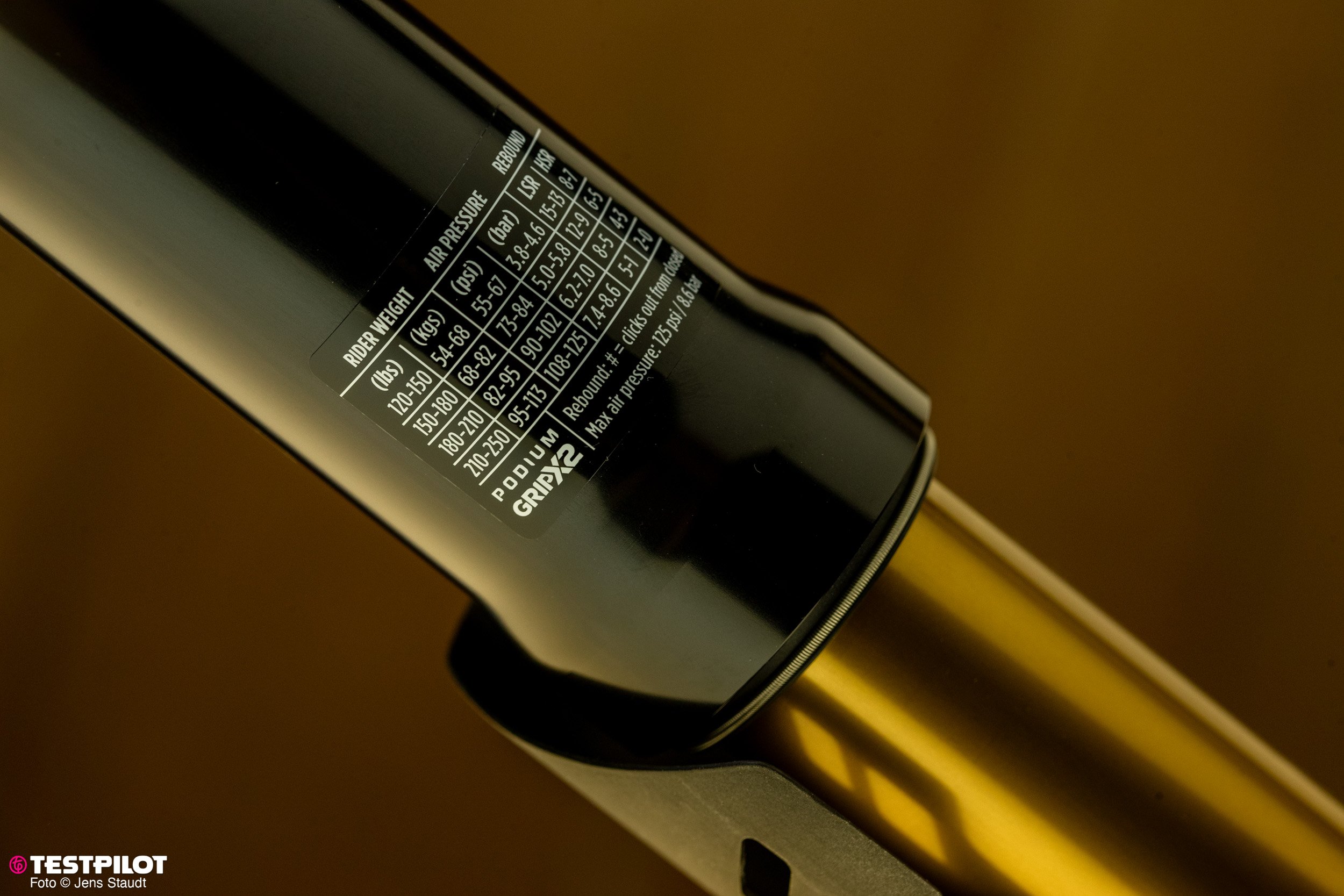
The trusty ol' setup sticker on the fork: air pressure based on weight and the corresponding rebound clicks. The compression settings are in the manual: 6 HSC & 8 LSC.
The starting hole of a FOX: First, turn both dials all the way closed (clockwise), then back to the first click. From here, turn counterclockwise according to the FOX specifications.
For setting the air pressure, it's best to flip your bike upside down; then no lubricant will find its way into your pump hose. Fox recommends a SAG of 15–20%, depending on preference. Caution: The maximum air pressure for the Podium is 130 psi.
| Travel | 15 % SAG (sporty) | 20 % SAG (comfort) |
|---|---|---|
| 150 mm | 22 mm | 30 mm |
| 160 mm | 24 mm | 32 mm |
| 170 mm | 26 mm | 34 mm |
Volumespacer
Our 170 mm Podium came with two volume spacers installed from the factory. Later, we reduced it to one. Anyone wanting to make an adjustment here and add more needs a Podium-specific shape. Your old yellow 38 or orange 36 you found in your toolbox will not fit. A few are usually included in the delivery. With a cassette lockring tool, you can open the air chamber (after releasing the air pressure, of course).
The Podium, or the individual forks, is available in a 150 mm, a 160 mm, and a 170 mm version. All can hold a maximum of 8 volume spacers. The 150 mm comes with 4 installed, the 160 mm with 3, and the 170 mm with 2. The e-bike version of the fork adds one more spacer to every travel variant.
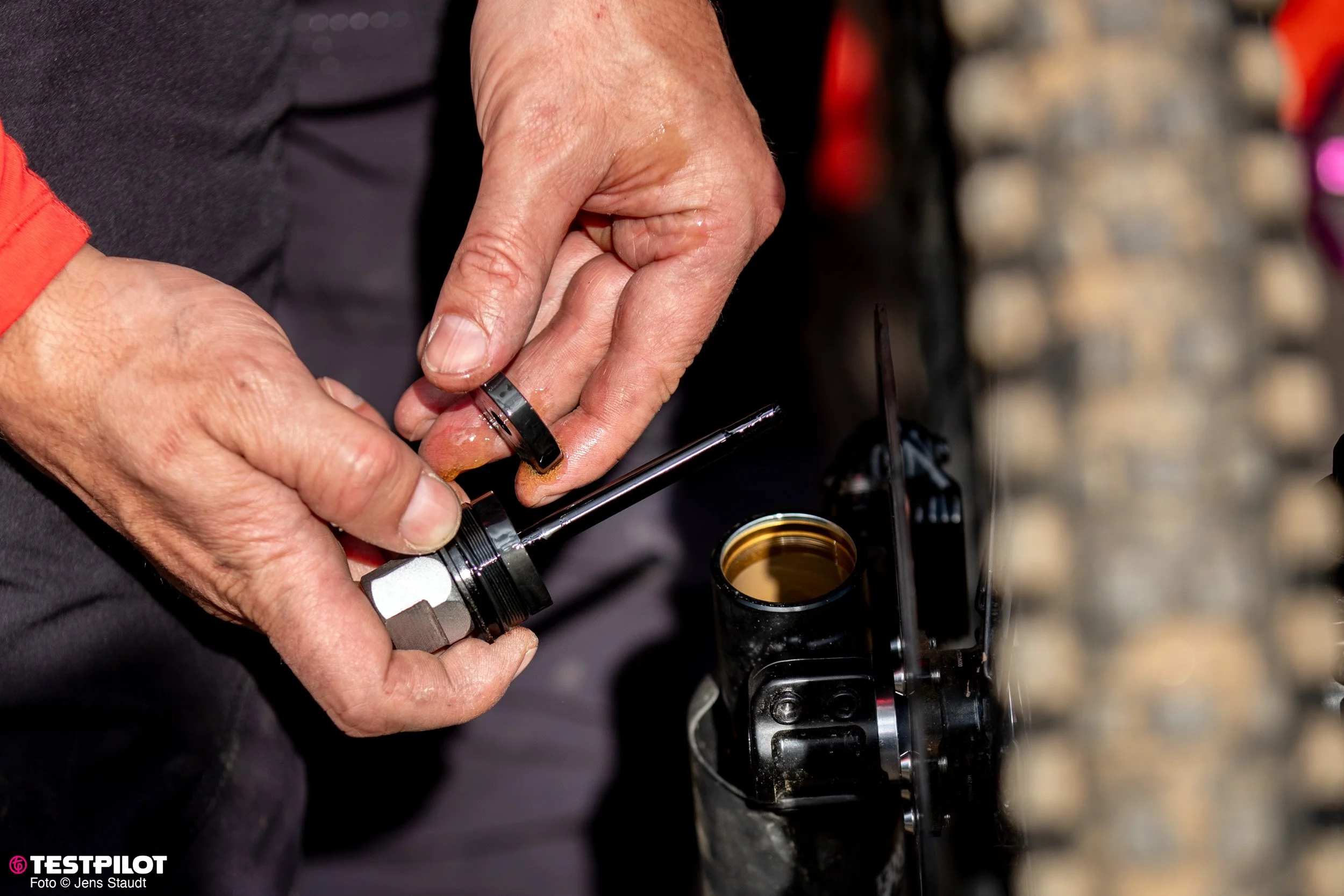
Deflate. Remove cap with cassette tool …
and insert the special Podium-spacer. Watch the brake disc or better remove the wheel first.
FOX Podium thru axle and how to install the wheel perfectly
For a suspension fork to function properly, the chassis should not be twisted. This can happen if, for example, a hub is slightly narrower in its clamping width or if the torque specifications are not followed.
To ensure everything slides smoothly and no unwanted friction occurs in the bushings, the following process must be observed:
CORRECT INSTALLATION OF THE 20 x 110 MM BOOST THRU-AXLE
Insert the front wheel into the dropouts and push the axle through the dropouts and the hub.
Tighten the axle to 13.6 Nm using a 5 mm hex key.
Using a 5 mm hex key, tighten the two clamping bolts on the non-drive side dropout to 6.2 Nm.
Cycle the suspension fork a few times so the lower legs settle into a low-friction state.
Using a 5 mm hex key, tighten the two clamping bolts on the drive side dropout to 6.2 Nm.
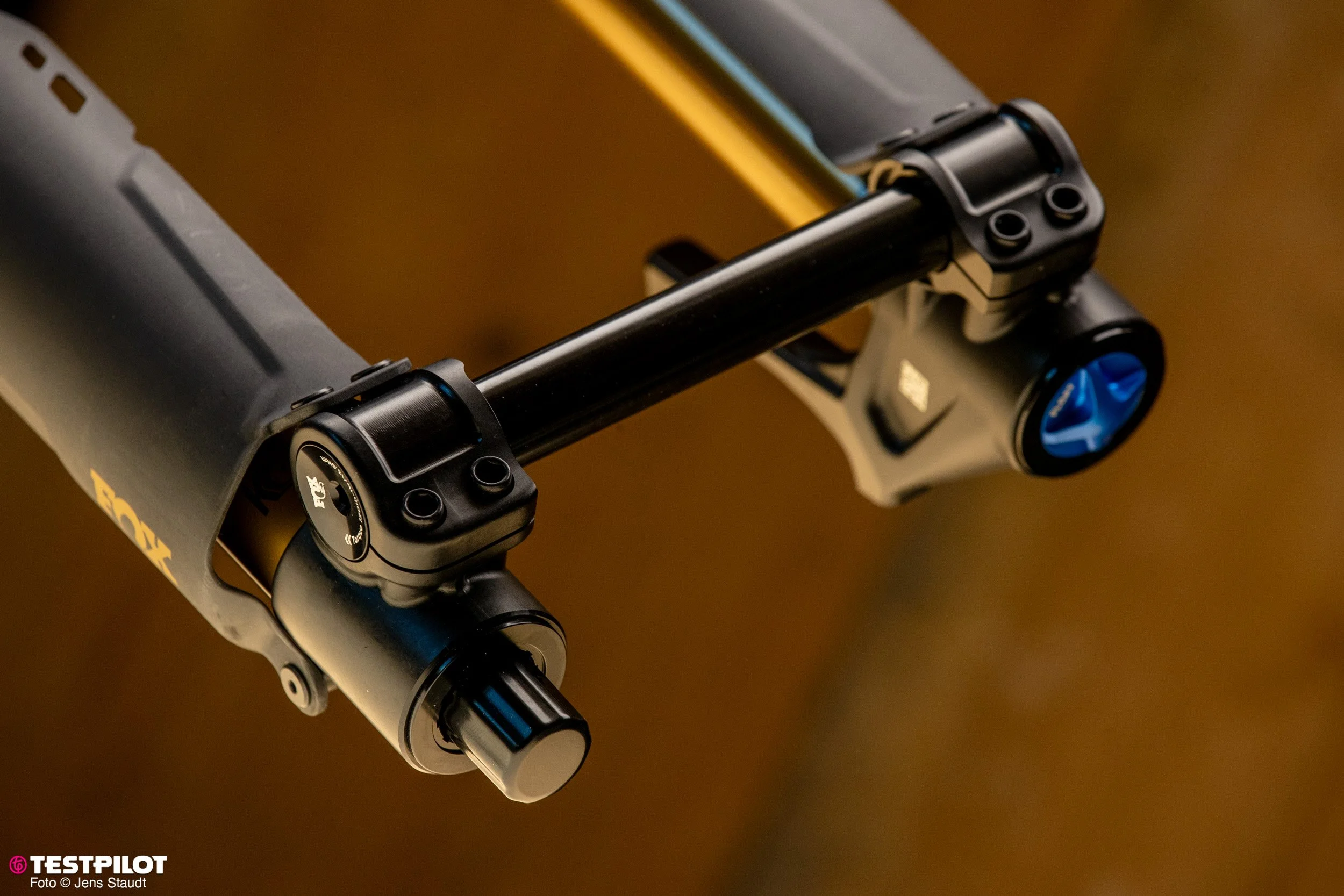
To prevent the fork from becoming twisted during the installation of the front wheel, it is essential to follow the specified tightening sequence of the bolts and the correct torque values.
The process is clear and ensures ideal function. With a bit of practice, it is quickly completed. Nevertheless, one should plan for the slightly higher time investment.
Something special about the Fox Podium is that it uses a 20 mm thru-axle. Nostalgia kicks in. If you are upgrading to this fork, you should be aware that not every front wheel hub can be simply converted with end caps. Overall, the thicker axle helps to increase the stiffness of the entire system.
On the Trail
FOX's setup recommendations for rider weight and rebound have established themselves as a good starting point for the entire portfolio in recent years.
After getting used to the fork and exploring the range of adjustment possibilities, the settings ended up quite close to the starting point.
But what do you feel on the trail? Like a quarterback ready to charge. Still, though, the upside-down design is surrounded by many opinions. While this design still feels unusual for most of us mountain bikers in terms of the familiar FOX appearance, they have still managed to give the Podium a genuine "FOX ride feel."
Anyone familiar with a FOX 38 will therefore settle in quickly and can crank up the pace. The adjusters for compression and rebound respond here as expected.

But first things first: anyone hoping that the FOX Podium squirms around like some forks of this design from the 26-inch days is mistaken. Still, upside-down is fundamentally "different" in feel and requires some getting used to for some. The physically different weight distribution between sprung and unsprung mass leads to better performance. That is, the fork irons out like a pro on the highest heat combined with steam. However, this also means you get slightly less feedback from the terrain.
Not only should you adjust the damping settings accordingly, but tire pressure should also be explored in both directions. Less pressure and thus even more grip, but consequently less feel for the ground? More pressure and therefore more feeling, but less grip? A desire to experiment and openness to a new/different fork feel will be rewarded here with composure and the ability to hold a line.
What stands out is that the Podium rewards additional speed on the trail compared to the 38. The faster you ride it, the more comfortable you feel. The sensitivity is there even at low speeds, yet the fork truly comes alive once you've warmed up and keep those dirty paws on your grips and off the brakes.

Even though the FOX Podium is already sensitive at slow speeds, you are rewarded when you keep those fingers away from your brake levers.
"Upside-down forks are too soft!" A preconceived opinion can always be found quickly on the forums. But does this hold true for the Podium in our test? In direct comparison with RSU forks, the Podium does not feel significantly softer. Compared to lighter examples, it is even partially stiffer, and not just under braking—although that characteristic is one of the most noticeable. Being on the brakes when it gets rough is never good and is something one should generally avoid. If it does happen or becomes necessary, the Podium remains more active than other forks.
In rock gardens and especially in corners littered with rocks, you should maintain some forward pressure. The fork offers steering precision, mixed with compliance. Anyone wanting to force a line away from the common rut, against roots and angled edges, should be willing to apply some force. The Podium's behavior here is sporty, and a decided input helps. Whether it's more power from the rider or the overall weight of the bike and rider. A few PSI less in the tire also improves the success rate here.
Anyone who unweights the front with a high handlebar or a soft rear setup should tune the Podium slightly softer than the recommendation to avoid getting decoupled. A general rule: seriously pushing hard and riding the line with pressure is a riding style that better suits the Fox Podium. Those who don't want that can choose the 38 and achieve wonderful performance with it.
How do we come to this conclusion? We explored its range of use and tested the principle of "rolling along relaxed and just letting the suspension fork do its thing." If this is your cup of tea, on a bike without a motor, then the Podium might be out there enjoying a different kind of (harder) beverage.

An active rider with a determined line choice will benefit from the FOX Podium.
If you dial out the compression, keep the air pressure rather soft, and reduce the volume spacers, the Podium still can be tuned toward an all-absorbing comfort buddy. We approached this click by click and psi by psi until we achieved that sensation. What does it feel like on the trail, you wonder? Every root. Erased. The roughest chatter. Now it's a flow trail. In return, however, you make compromises when things get steep again or if you're actively on the bike, applying pressure from the handlebars. Where it allows direct line choice in the regular setup, the comfort setting lacks precision. It's either one or the other.
If you blast down the trail with appropriate speed and damping, you'll feel significantly more comfortable. The forces acting on the fork increase, and you can use the compression damping to bring corresponding control to the chassis. On the rebound side, the Podium showed its lively best. That is, you shouldn't set it too slow to preserve its activity. Then it can also absorb rapid, successive impacts in a more controlled manner. For personal tuning, it's worth consciously going beyond the setting you would normally ride.
There are always situations where high forces come into play. An overshot landing or a drop that could actually use a slightly steeper landing zone. If you reach the end of the travel on the Podium, you'll be notified at the handlebars. Fox relies on the progression of the air spring, and if even that isn't enough, two rubber bottom-out bumpers protect the chassis from potential damage. So, even with monstrous impacts, there's no metallic CLUNK.

Anyone who is up for hard landings on a higher number of occasions and introduces, in general, brutal forces into the chassis should make corresponding adjustments with the volume spacers. Up to 8 are possible. One could debate whether a fork in this price segment shouldn't also feature a hydraulic bottom-out. Why? This would allow the fork's characteristic curve to remain somewhat more linear, utilize more active travel, and still reach the end gently.
If you increase the number of volume spacers, the fork will sacrifice some of its chunder-chewing qualities, which are precisely what USD fans appreciate.
We achieved maximum traction with a setting that allowed the fork to work a bit deeper in its travel. 3 to 5 psi less than Fox's recommendation significantly improved front wheel grip and grip control. In slippery corners with additional bumps, two clicks less low-speed compression brought the bike into balance. For those who don't often adjust the compression damping settings, they should start doing so with the Podium. The adjustment range is highly usable, and every click makes a difference that can help you find your ideal setup.
Technical report
Over the course of the test period, the FOX Podium began to change its character. Sensitivity was gone, and it became increasingly stubborn.
There was no buildup of air in the casting. A complete setup restart—releasing air and setting it up again—brought no improvement. So, we contacted the German service center, and the fork went on a trip for a checkup.
STATEMENT FOX/COSMIC
"We replaced the dust wipers and checked the air spring; we could not find a defect."
– Mark Senger | General Manager Service Center
After the service by Cosmic, the fork returned to us and was shining again with normal function. What was the cause? At this point, we can only speculate. Based on our experience with other forks, we suspect grease from the initial assembly that may have worked its way to the equalization port between the positive and negative chambers and clogged it. If this port is no longer open, it can lead to the described stubbornness. But there is a multitude of possible causes, so this is and remains speculation.
How does the perfect rider profile for the fox Podium look like?
Riding with intent, in the form of a forceful riding style and active line choice, suits the FOX Podium ideally. But a high system weight, for example with e-bikes, also has a positive effect.
Anyone who is lighter or doesn't want to explicitly hold a rough line to then plow through it without hesitation should honestly ask themselves whether perhaps a Fox 38 might not be the better choice. It, of course, doesn't have the premium pimp factor that the Podium brings along.
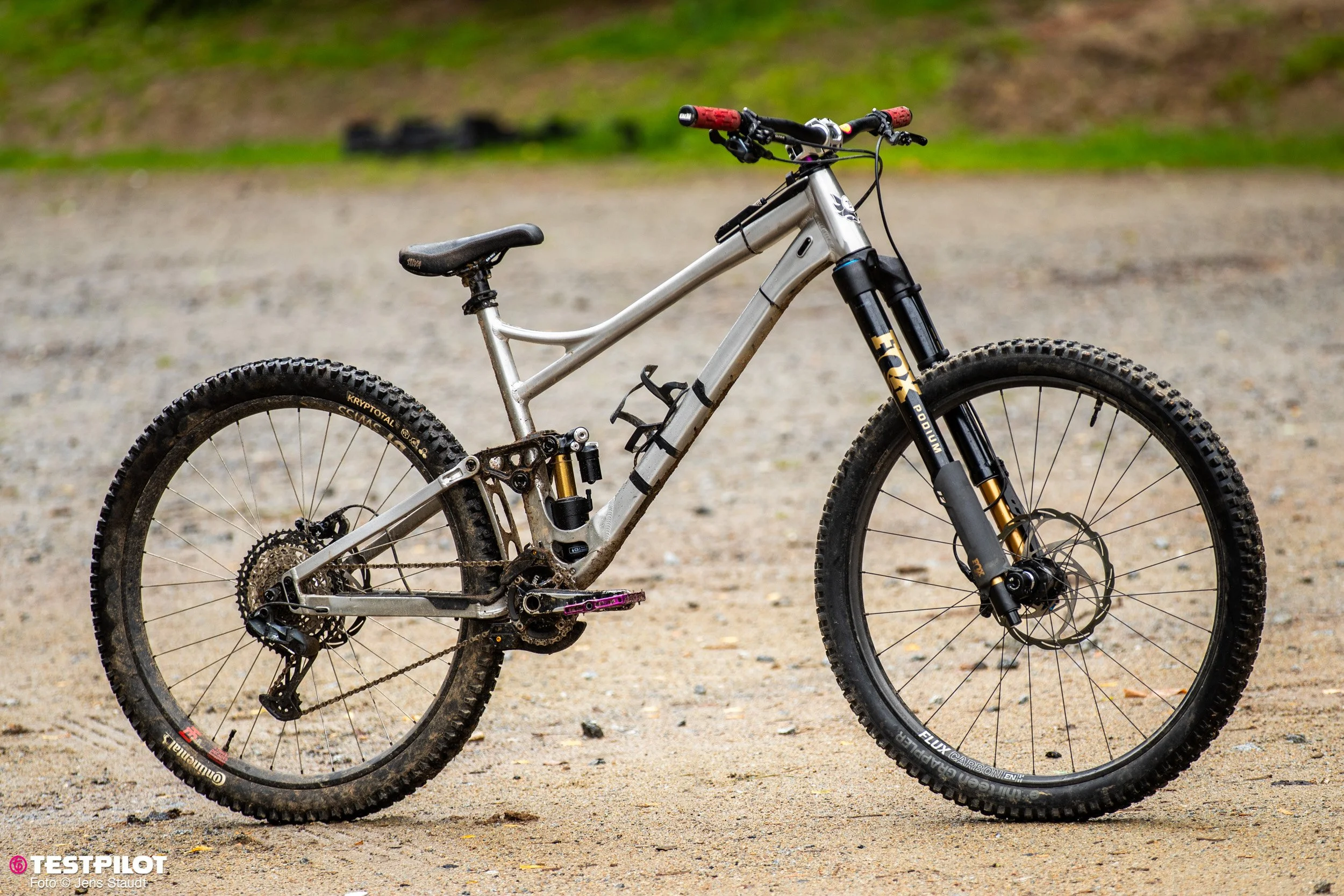
FOX Podium or …
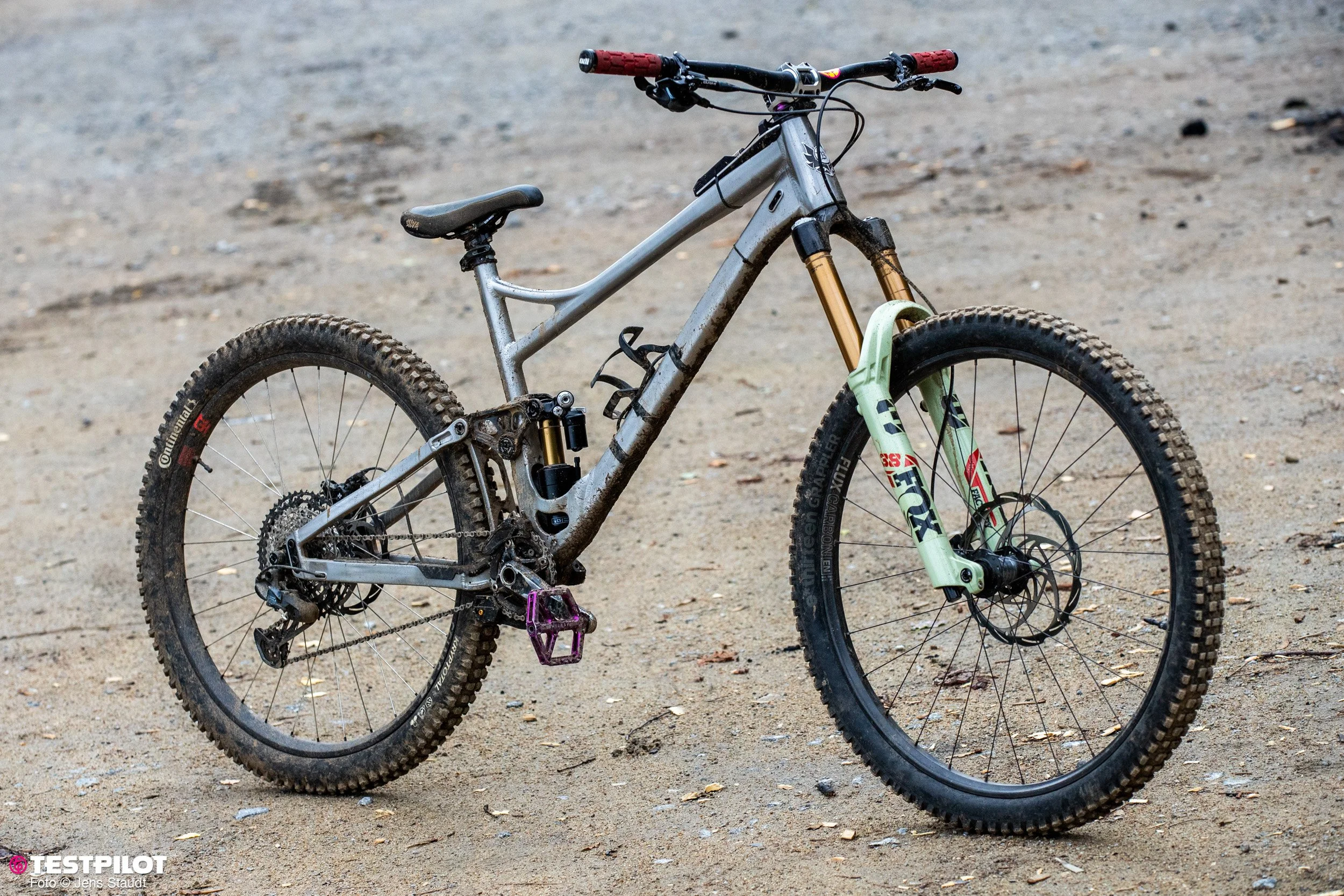
FOX 38? It all comes down to rider profile, track and personal taste.
Conclusion Fox Podium
The FOX Podium perfectly fills the gap between the 38 and the 40. Not just in looks, but also in character. Anyone who doesn't mind the extra effort involved with the axle and whose rider profile also fits between the 38 and the 40 is a match for this fork. Install it. Dial it in. Hold the line. But DO IT!
| What is worth mentioning? | Things to consider. |
|---|---|
|
|


What’s next?
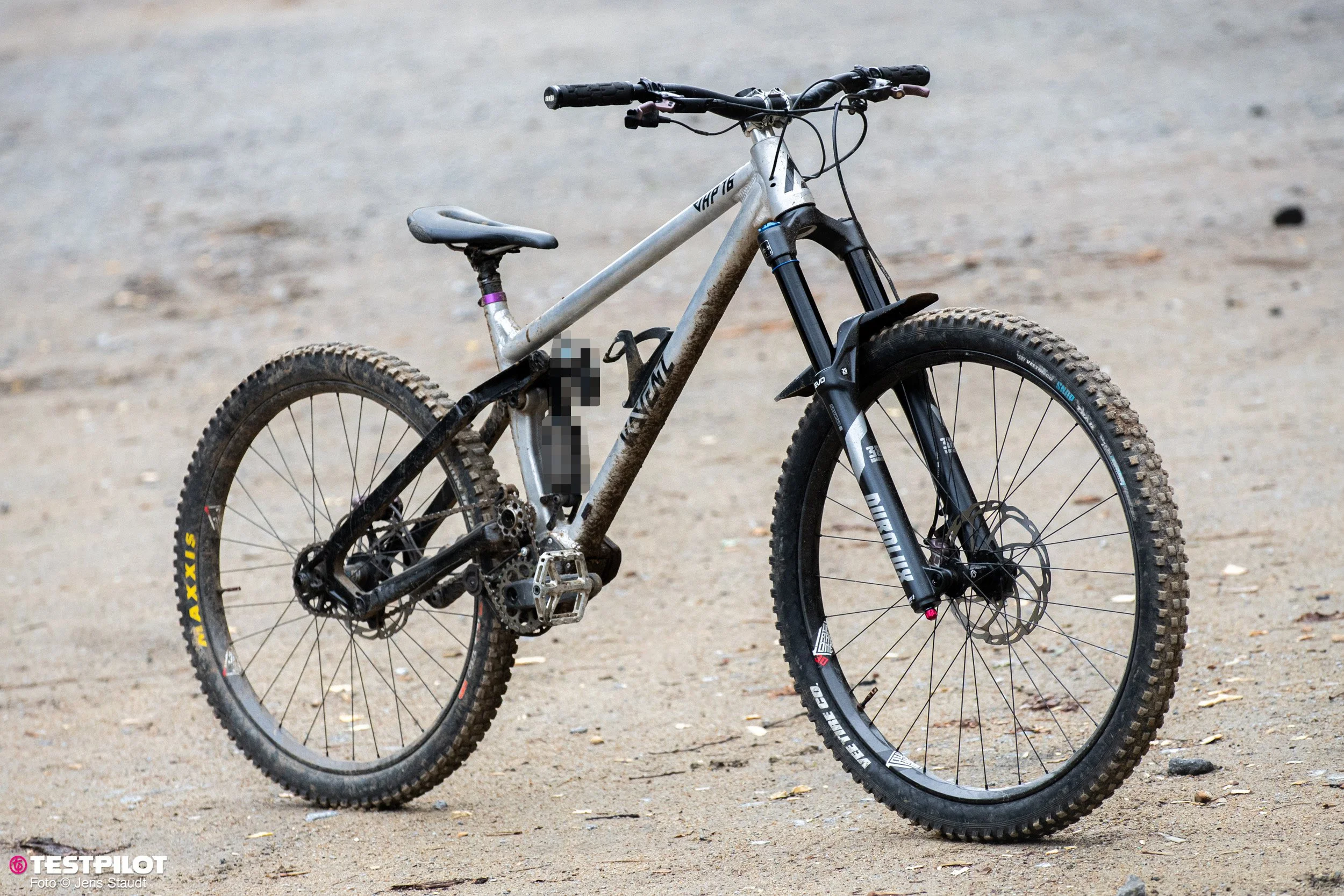
In our next review, we're covering the SR Suntour Durolux. The adjustment options are minimalist. Can it compete with the established heavyweights?
You want more tech and reviews?


Author – Jens Staudt

Height: 191 cm
Weight: 103 kg
Riding style: With his racing background, the lines are planned, even if there is anything bigger in his way. If possible, sections will be jumped over. You should use the entire width of a trail. Others would say - uncompromising.
Motivation: A product should function carefree and for as long as possible. If you have to screw less, you can ride more. He likes to tinker and see how the bike can be optimized.