

What’s different between 36 and 38 mm stanchions?
Contains advertisementReading time: 15 minutes
🇩🇪 Read German version here
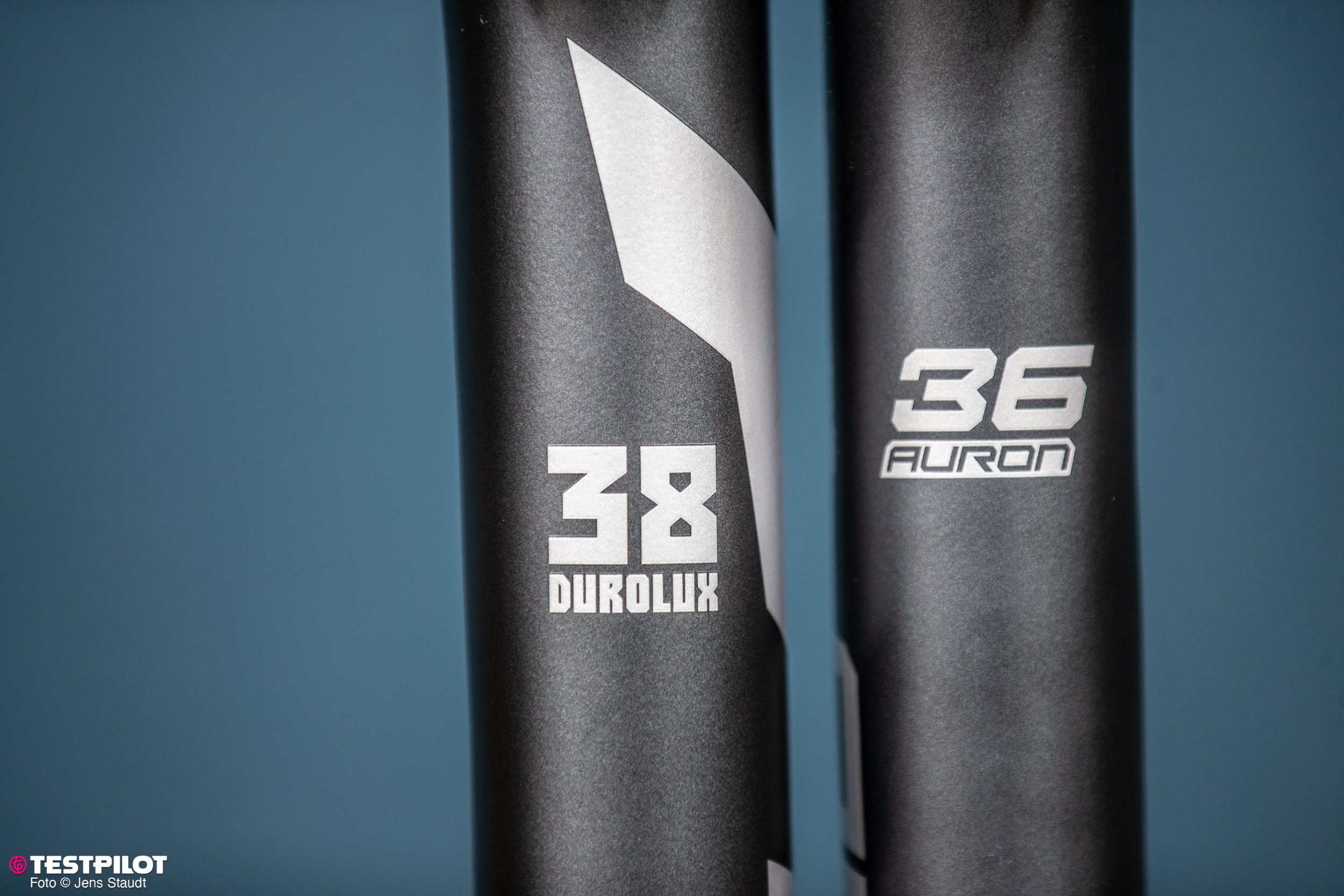
After decades of “stiffer = better,” it seems like manufacturers have finally agreed that defined flex in the frame and components can be a good thing. Among other benefits, it makes the bike more comfortable to ride and provides more grip. It also reduces fatigue significantly. At the same time, flex is not a simple topic. Depending on the intended use, rider profile, and rider weight, the requirements can differ.
In this review, we want to isolate this one factor and take a closer look at fork flex in a practical real-world test. Together with SR Suntour, we took two forks against each other that share the same damper cartridge and the same travel but use different chassis. Welcome to the review, which will help you to decide which size of stanchions you really need. A back-to-back test between the DUROLUX and the AURON.
Key Facts
Specification for the Test
- 1. Two forks with different stanchions
- 2. Same travel
- 3. Same damper cartridge
- 4. Same wheel size
- 5. Different rider weights
- 6. Trails with different demands
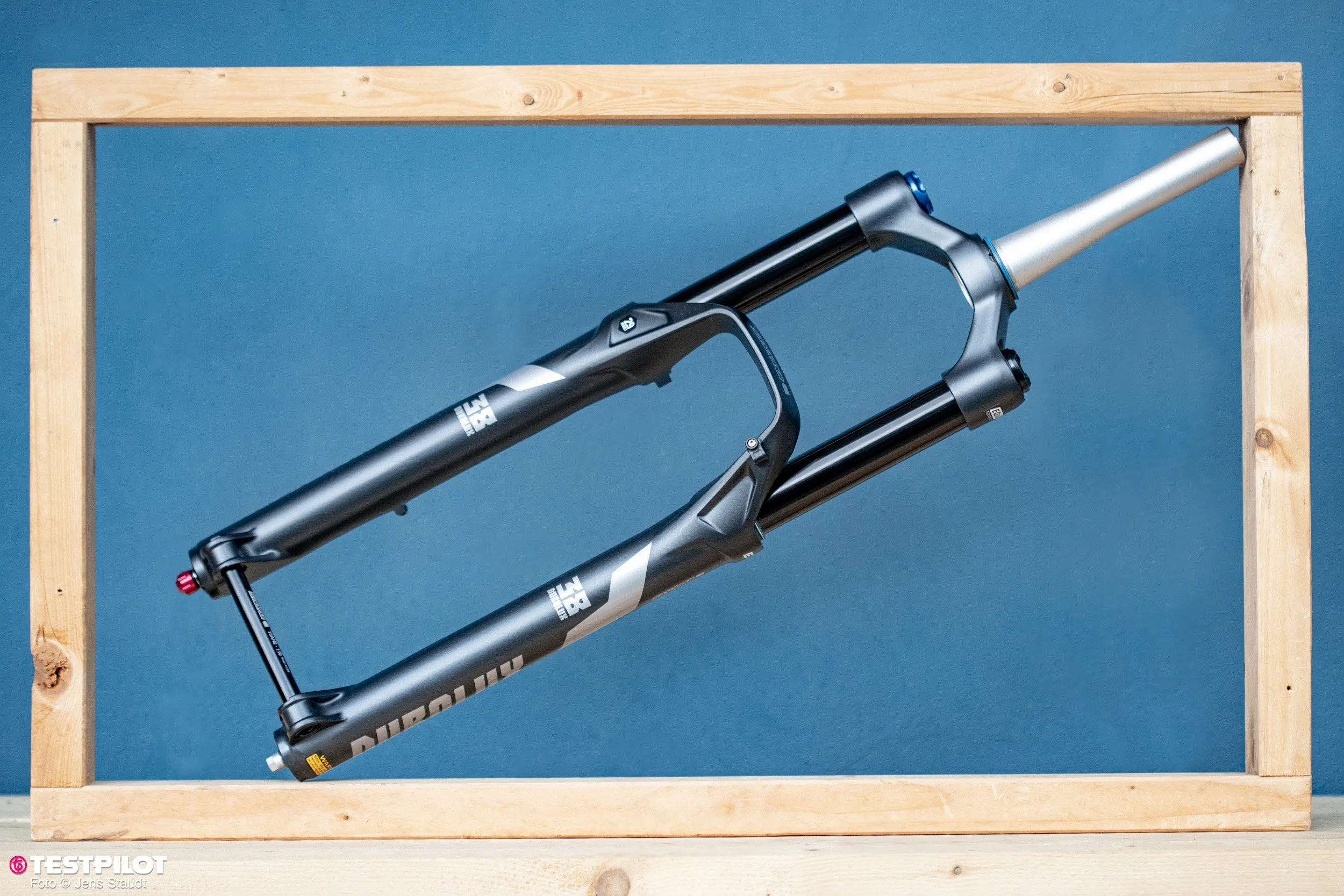
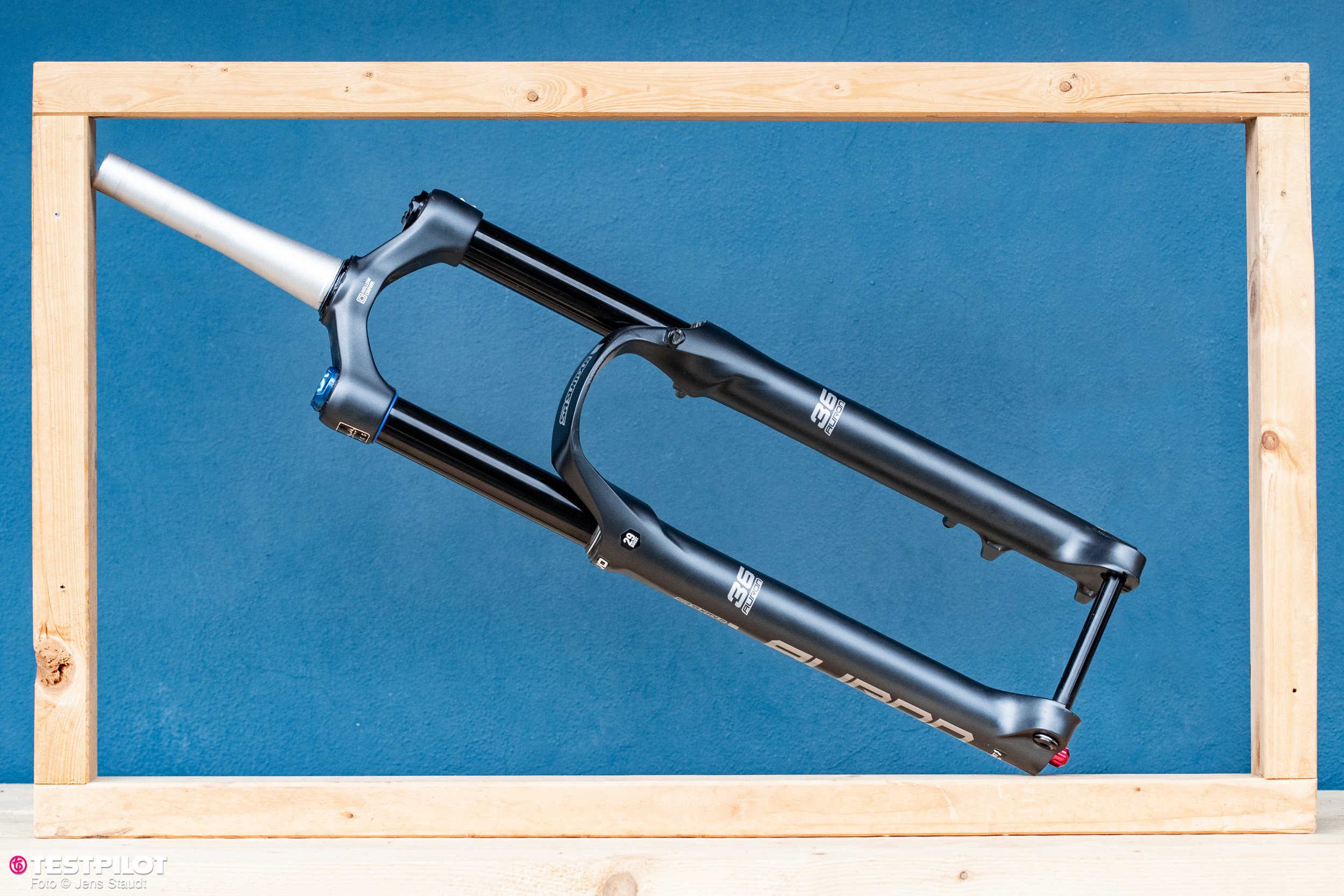
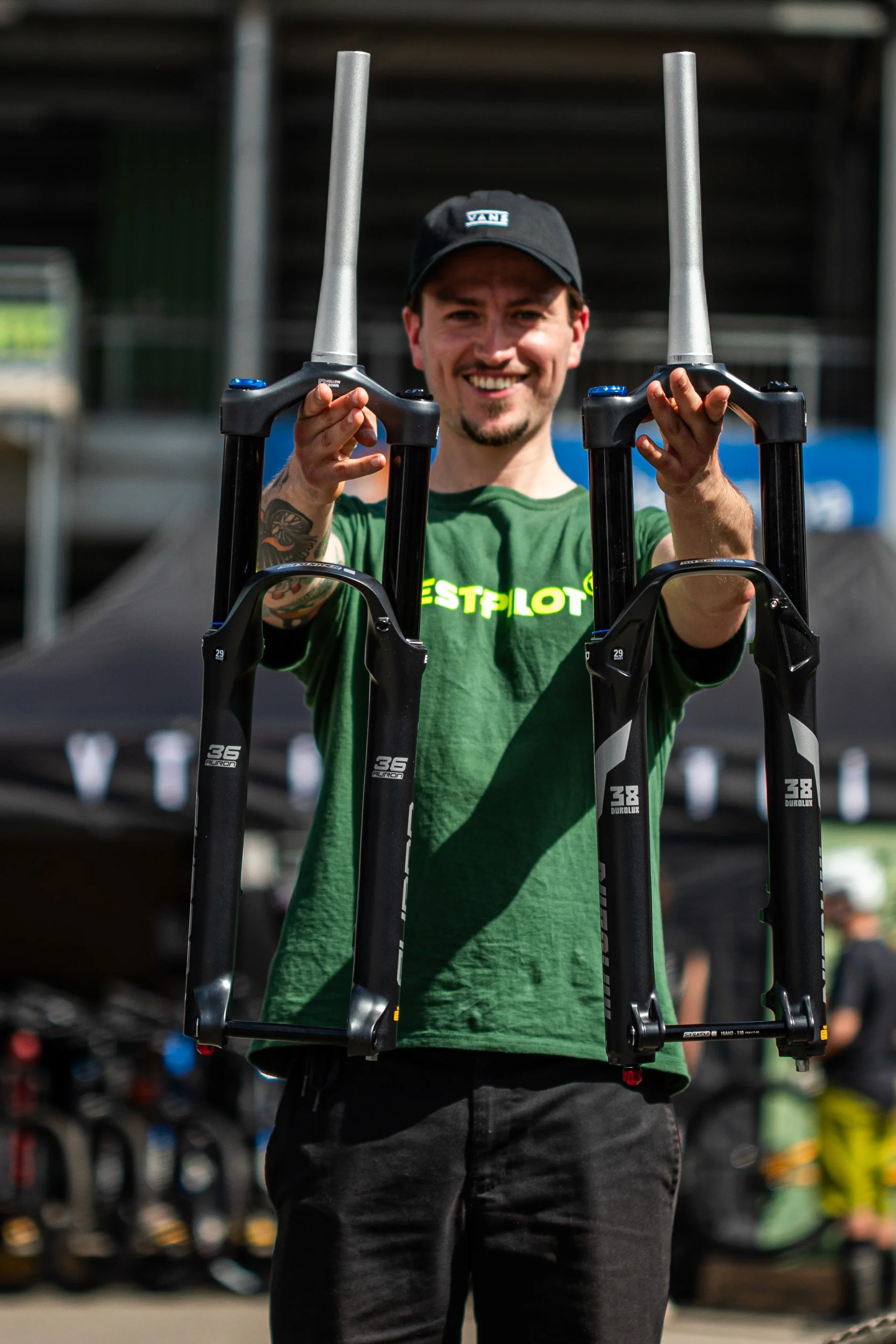
Teaming up with SR Suntour on this test allowed us to directly compare two suspension forks that differ solely in their chassis. In their case, both forks use identical damper cartridges and air springs and are each available with 160 mm of travel. The SR Suntour AURON is the more compact model with 36 mm stanchions, while the DUROLUX enters the test as the bigger sibling with 38 mm stanchions.
For our test, we even had access to the even stiffer DUROLUX38 in the X version, designed for extreme loads and the demands of e-MTBs. The crown and casting feature additional material to further increase stiffness. This is particularly useful for e-bikes due to the higher system weight: the DUROLUX38 X is approved for a system weight of up to 150 kg. The e-MTB version also includes mounting points for ABS systems.
With the DUROLUX38 and the 38X, SR Suntour covers the gravity segment just below dual-crown forks. Offered in 10 mm increments, it provides travel options from 160 to 180 mm, suitable for heavy-duty e-MTB applications all the way up to freeride setups. The AURON is positioned as an all-mountain and trail fork and delivers 140, 150, or 160 mm of travel depending on the airshaft.
Both test forks were equipped with the RC+ damper cartridge in identical form. The differences lay in stanchion diameter, crown and casting construction, and the dimensions of the air chamber. For the test, both forks were set to 160 mm of travel.

The DUROLUX and AURON cover specific ranges of travel depending on their intended use from 140 to 180 mm. At 160 mm, you are positioned right in the middle of that spectrum and an overlay between two worlds. In other words, you have options for choosing your stiffness.

Suntour keeps it subtle: while the DUROLUX and AURON differ significantly in the details, their look is very understated with all-black styling.
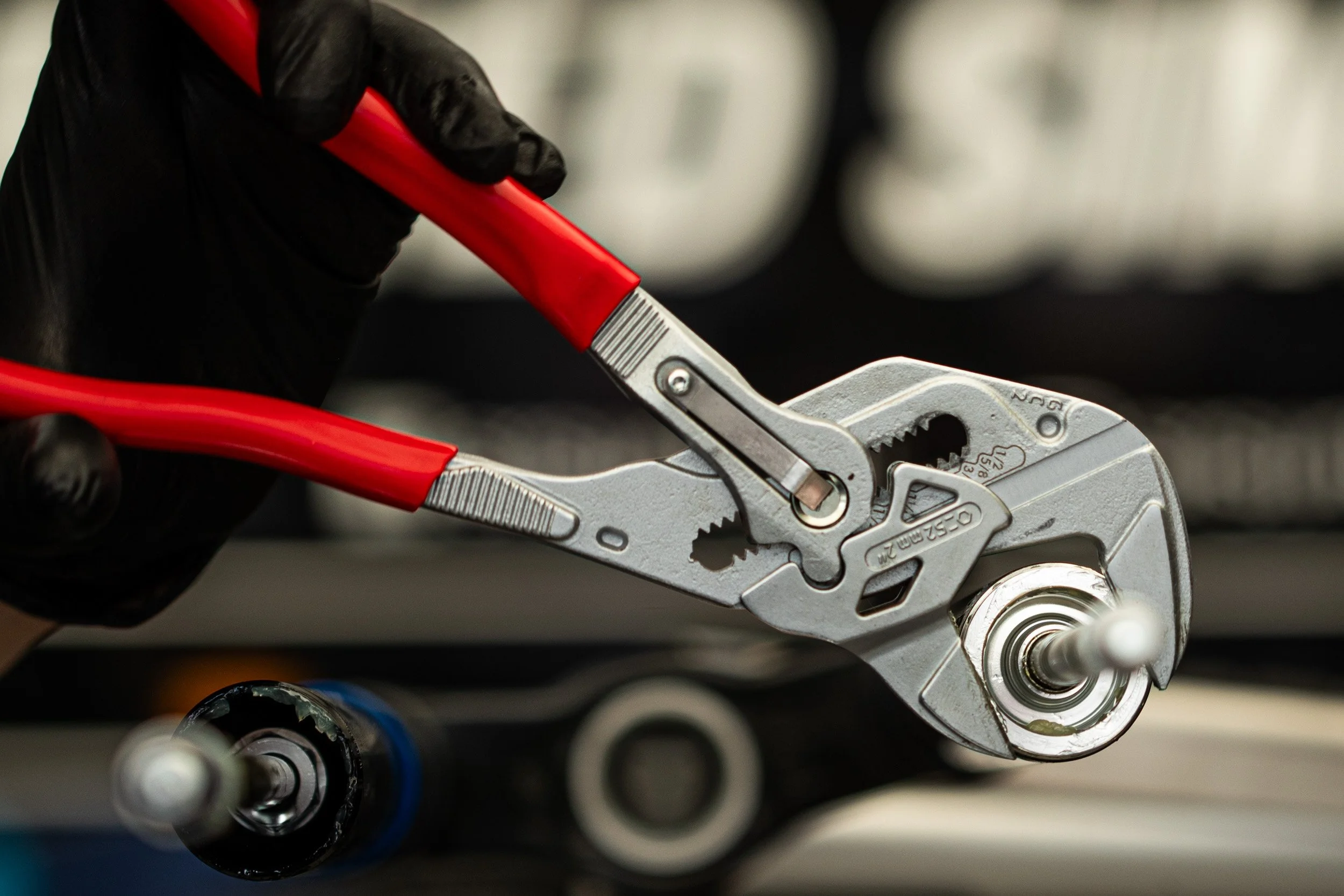
At the Bike Festival in Freiburg, we received the two suspension forks and were able to watch as the Airshaft of the DUROLUX was swapped in the SR Suntour Race Truck. An experienced mechanic can do this at home as well—and if you know how, thanks to the semi-open oil bath, it doesn’t even require an oil change. Christoph disassembled the fork while it was lying on the workbench, which kept the oil in the casting and saved us a mess. If the fork has already been ridden, you can also give it fresh oil at the same time. But—that’s just a side note. Let’s get back to the main topic and first take a look at the technical features of the two suspension forks.
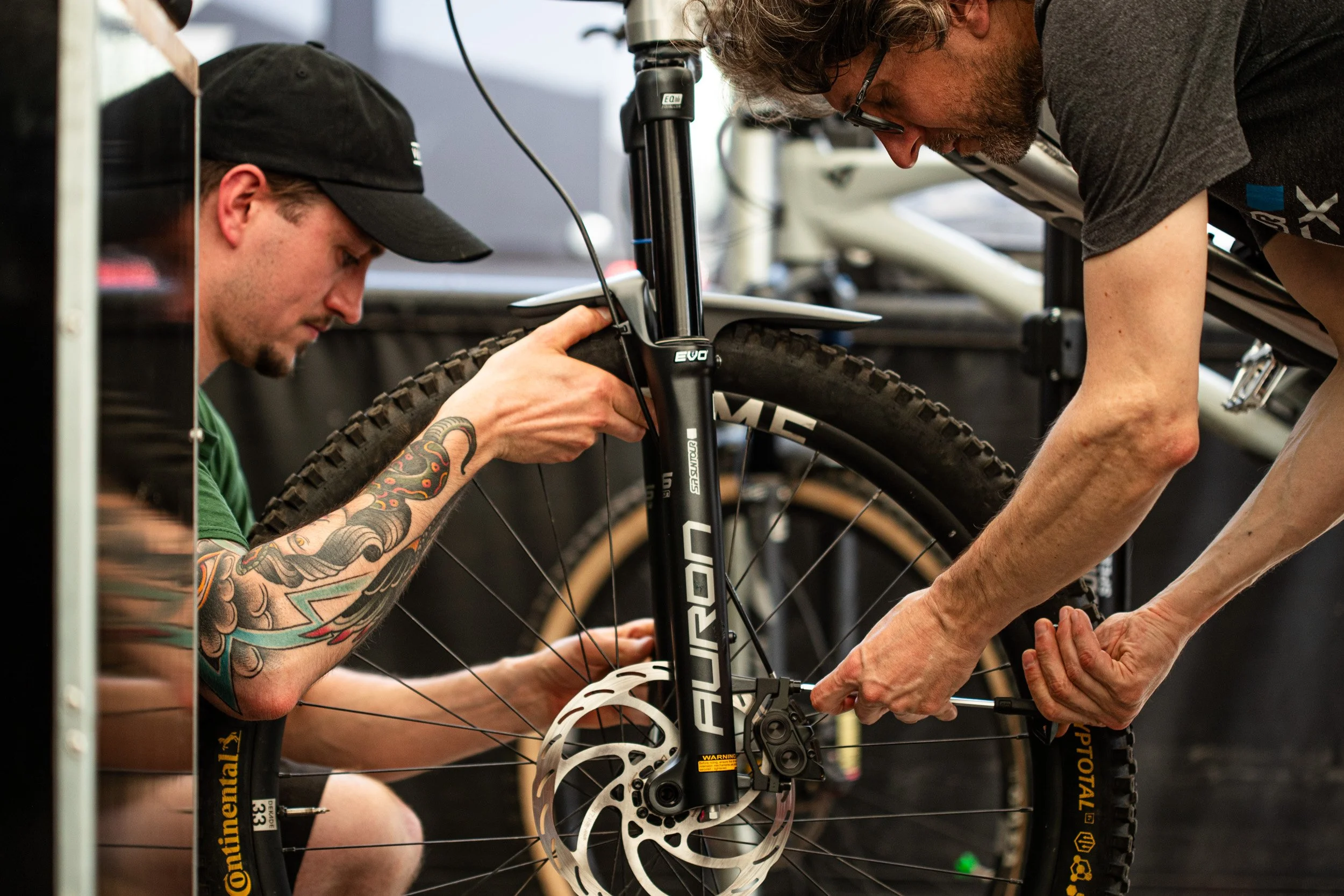
Here are both models in a detailed side-by-side comparison:
| SR Suntour DUROLUX38 EVO | SR Suntour AURON36 EVO | |
|---|---|---|
| Intended Use | Enduro (DUROLUX38); E-Enduro (DUROLUX38 X) | Aggressive Trail Riding / All-Mountain |
| Stanchion Diameter | 38 mm | 36 mm |
| Travel | 160 / 170 / 180 mm – adjustable via Airshaft | 140 / 150 / 160 mm – adjustable via Airshaft |
| Adjustments | Air pressure, Lowspeed compression, Lowspeed rebound, Volume spacers | Air pressure, Lowspeed compression, Lowspeed rebound, Volume spacers |
| Spring | AIR EQ | AIR EQ |
| Damping | RC+ PCS | RC+ PCS |
| Wheel Sizes | 29″ | 29″ / 27.5″ |
| Max Tire Width | 2.6″ | 2.6″ |
| Axle Standard | 15 x 110 mm Boost | 15 x 110 mm Boost |
| Brake Mount | Postmount 203 mm (max. 220 mm) | Postmount 180 mm (max. 220 mm) |
| Offset | 44 mm | 44 mm |
| Axle-to-Crown | 580 mm at 160 mm travel | 580 mm at 160 mm travel, 29″ |
| Steerer | Tapered 1.5–1 1/8″ | Tapered 1.5–1 1/8″ |
| Casting | Magnesium | Magnesium |
| Seals | SKF | SKF |
| Fender | Long and short versions; bolt-on | Long and short versions; bolt-on |
| Color | Metallic Slate; Gloss Black | Metallic Slate; Gloss Black |
| Weight |
DUROLUX38 = 2,450 g (manufacturer) DUROLUX38 X = 2,656 g (test measurement) / 2,680 g (manufacturer) |
AURON36 29″ = 2,245 g (test measurement) / 2,120 g (manufacturer) |
| Warranty | 2 years | 2 years |
| MSRP | €899.00 | €889.00 |
| Website | https://www.srsuntour.com/ | https://www.srsuntour.com/ |
Technology
RC+
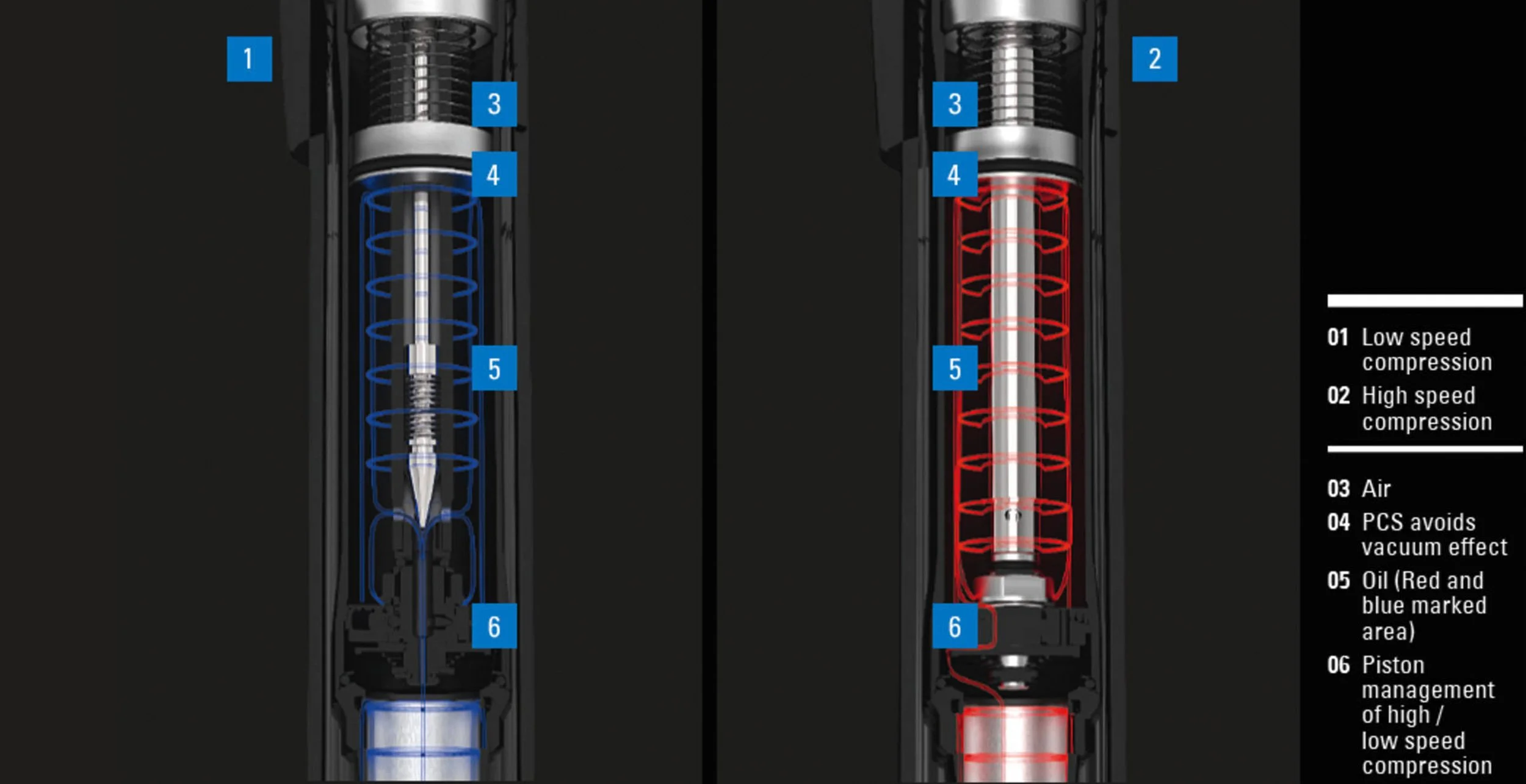
With the introduction of the 2025 models, SR Suntour unveiled their new RC+ cartridge. It was developed in conjunction with the SR Suntour WERX program. The cartridge features increased oil flow and larger valve openings, which shall reduce internal flow resistance. With this damping unit, Suntour has done away with the external high-speed adjusters, leaving only one low-speed compression and one rebound knob—the rotary knobs control a traditional needle valve inside. High-speed adjustments are now handled internally via a fixed shim tune, optimized for fast and hard impacts. A step toward simplicity for the rider.
Piston Compensator System
The Piston Compensator System, or CPS, is a well-known feature from Suntour. A spring-preloaded separating piston displaces the oil during compression. At the same time, the damping oil and the air are kept separate—this prevents cavitation. Cavitation occurs when air bubbles form in the damping oil. This happens when the pressure in the oil changes very quickly, for example during:
fast, hard hits
multiple consecutive bumps
long descents under high load
When air mixes with the oil, pressure builds up in the oil, the damping becomes uncontrollable, and the fork suddenly feels soft, spongy, or unstable. Has your fork or shock ever made squelching noises? That’s cavitation.
Semi-Open Oil Bath (SOBA)
As part of the redesign, Suntour’s developers are now using a semi-open oil bath. The SOBA system combines the sealed RC+ PCS damping cartridge with an additional, defined lubrication bath in the stanchions. Damping oil and lubrication oil do not mix. This allows the damping to operate independently while the oil in the stanchions lubricates the bushings and seals. The result is reduced friction, better heat dissipation, and consistent suspension performance—even on long descents. Through the Lubrication Bleed Ports on the back of the stanchions, the fork can be easily topped up with a small amount of oil.
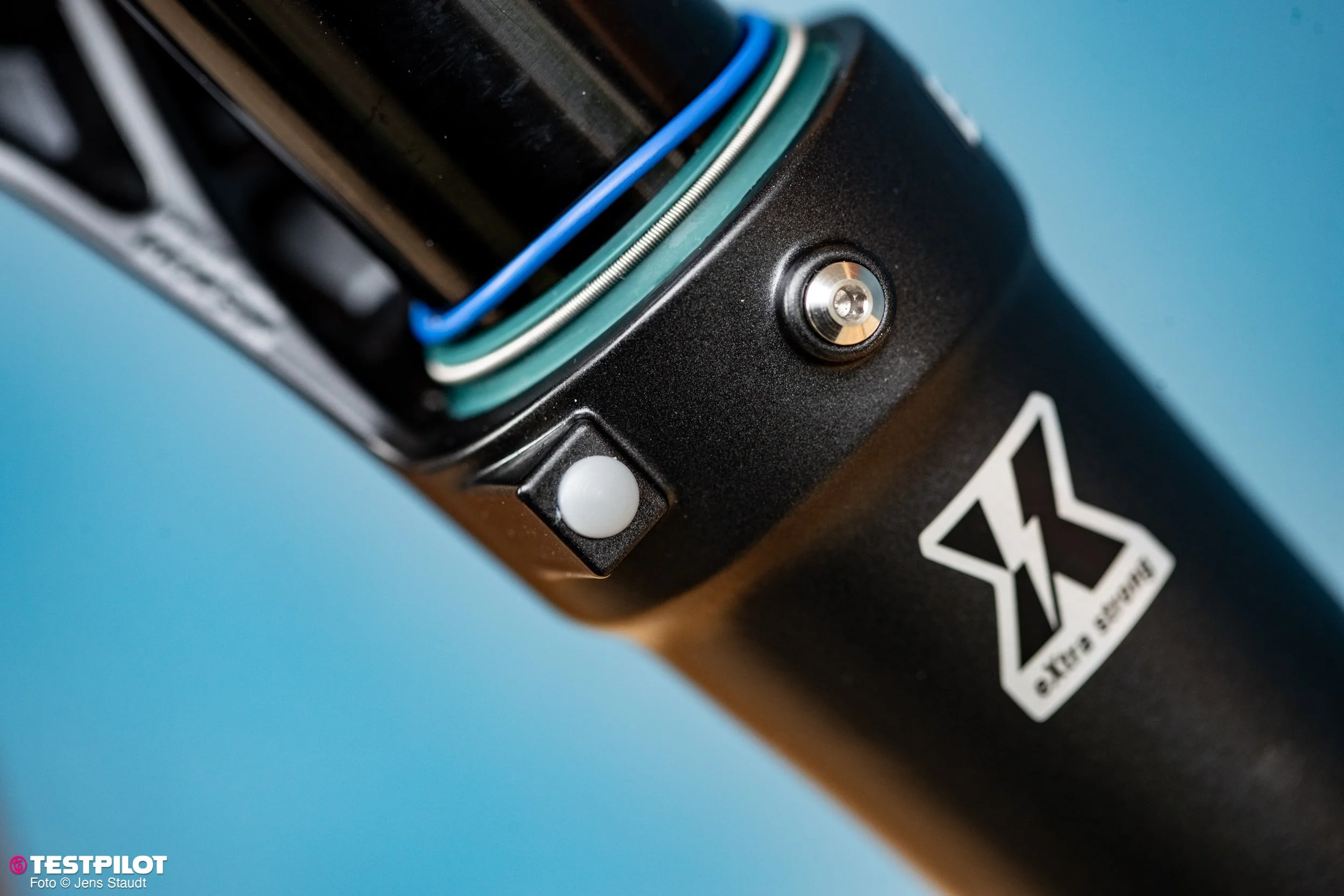
The screws can be removed using a 2.5 mm Allen key. A syringe can then be inserted directly into the opening.
EQ Equalizer™ System
The EQ Equalizer™ system is nothing new from the Taiwanese manufacturer and was already found on previous models. It provides automatic pressure equalization between the positive and negative air chambers. The two air chambers are separated by the air spring piston. During compression, this piston moves over the transfer port (see image below, #2).
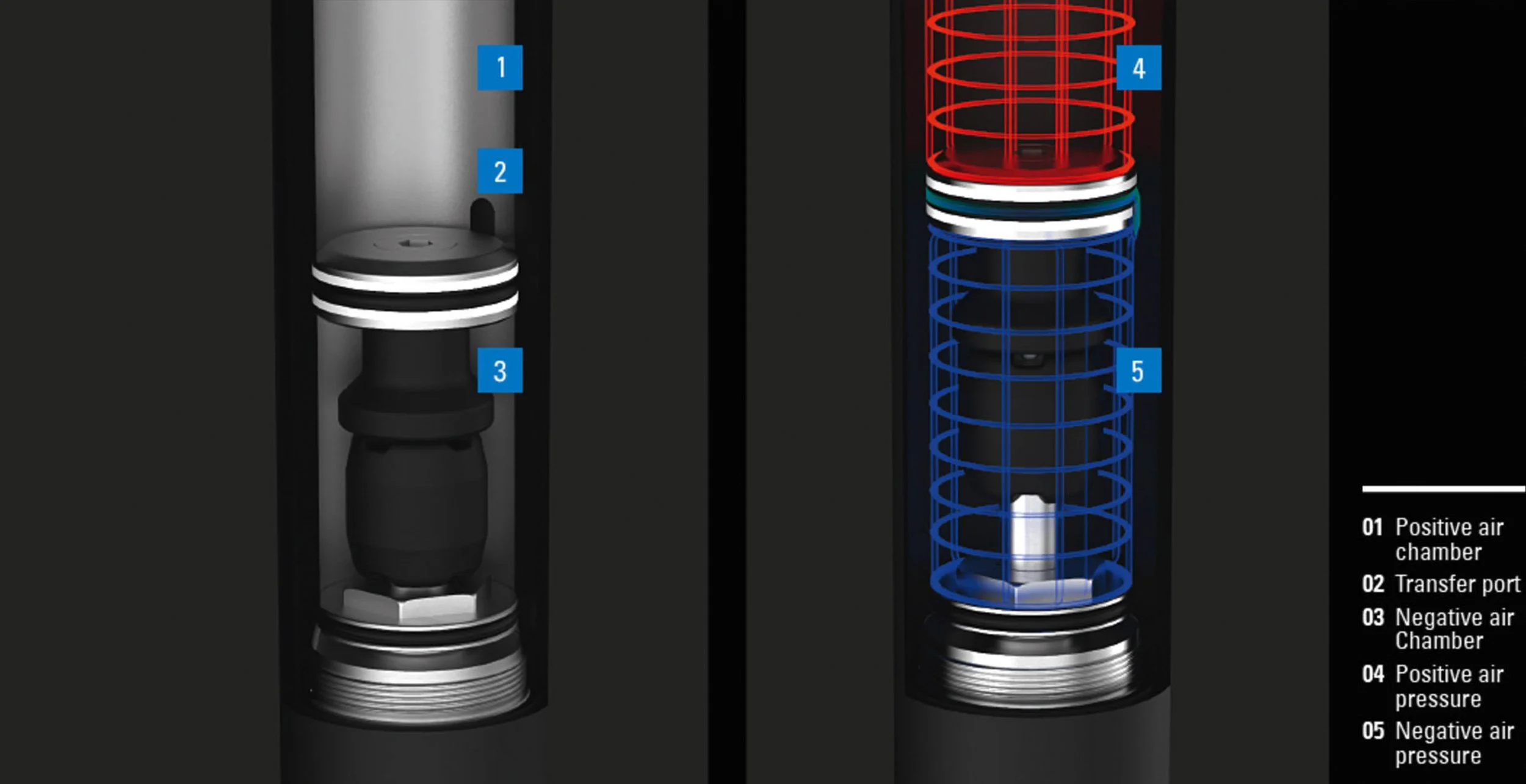
The transfer port is a small recess in the stanchion that connects the positive and negative air chambers. When you sit on the bike, every compression triggers a pressure equalization. This allows the air spring to automatically adjust to the rider’s weight and sag. Manually equalizing by repeatedly compressing the fork is no longer necessary. This reduces setup errors and ensures an individualized negative spring force.
Flex, Comfort, Safety?
When a force is applied to a component, that force has to go somewhere. We have suspension forks and shocks to absorb impacts—but if something gives, it should ideally only be the suspension, right? Unfortunately, it’s not that simple, because the force doesn’t always go exactly where you expect. Braking twists the fork chassis, and even your comfort-providing components flex significantly toward the bottom bracket. Your smartphone’s slow-motion function can capture some impressive footage of this!
When you first dive into this topic, it quickly becomes clear that its complexity is often underestimated. A mountain bike is a sophisticated piece of sports equipment, and every component contributes to the overall riding experience.
It’s not just the suspension fork and shock that provide comfort and safety. Tires, their casing, and tire pressure also play a crucial role in maintaining control on the trail.
After the tires, rims, spokes, and hub come into play. This chain continues through the head tube, handlebars, and grips. Together, combined with the setup of your suspension components, all of these elements ultimately define what vibrations and forces reach your hands and feet.
In general: What is Flex about?
Flexing in front of the mirror or popping the hood at the gas station? Nope—that’s a different sport and involves a different kind of flex.
Warning: in the following segment, the description gets technical.
In mountain biking, we define flex as the controlled, elastic deformation of a single component (such as the frame, handlebar, stem, seatpost, or even wheels) under load. Braking, steering inputs, and impacts are examples of such forces.
Under these forces, the structural parts of a suspension fork twist and bend depending on their dimensions, wall thicknesses, materials, and so on. This can lead, among other things, to unwanted friction in the bushings, seals, and other moving parts.
Flex = bad? Not always. It can be desirable because it cushions small impacts and provides comfort. This compliance effect should not be confused with the movement of a suspension element like a shock; it is a material- and construction-induced bending softness.
Optimizing flex behavior is therefore a central aspect of component and frame design, balancing efficiency, comfort, and control.
In sum, flex affects the rider’s interaction with the terrain and contributes to the feedback of impacts through the handlebars to the hands. And—flex is independent of your fork’s damping. However, if the suspension fork twists under load, it can result in uncontrolled damping in the form of additional friction in the bushings.
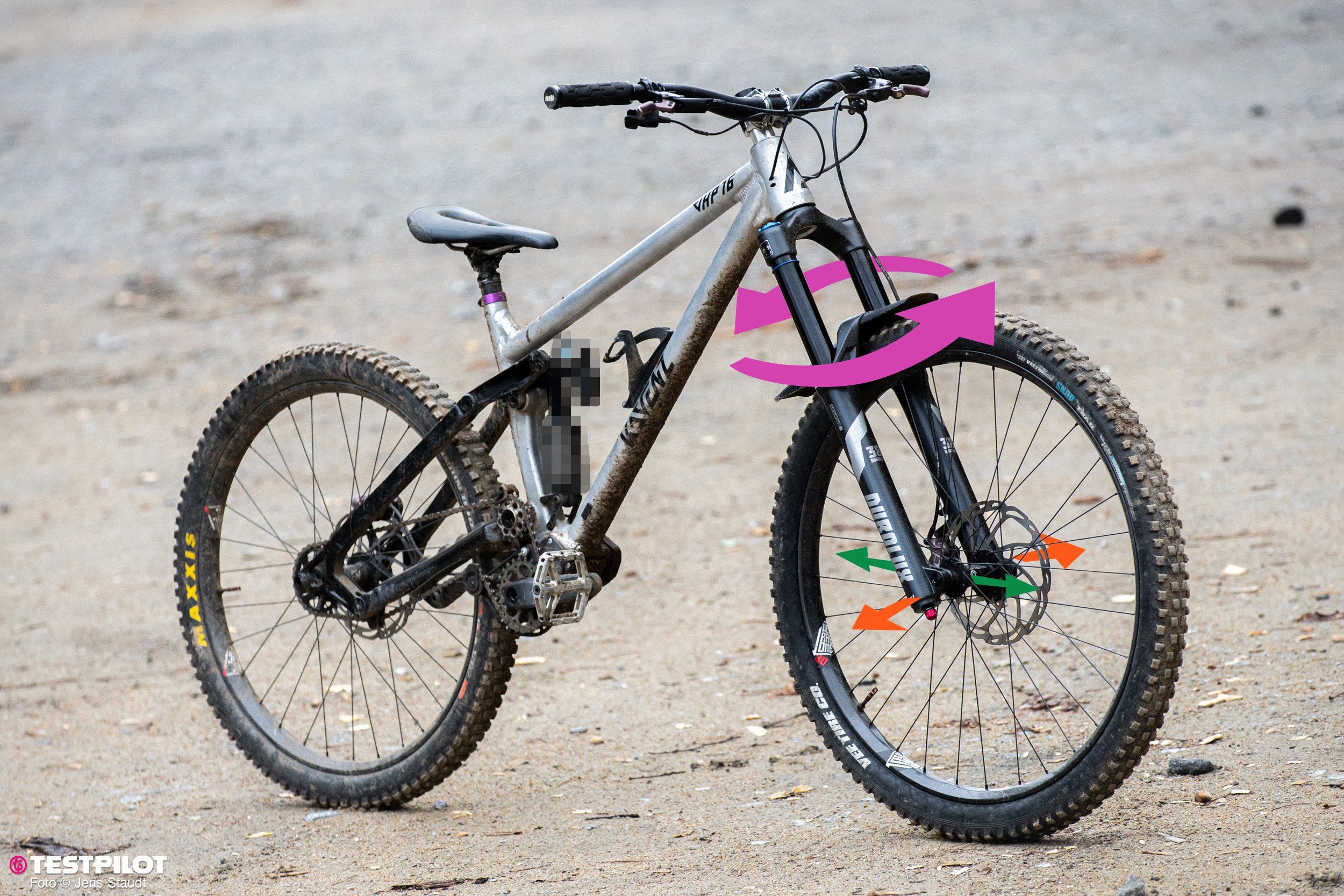
On the trail, a mountain bike fork doesn’t compress in a perfectly linear fashion. Forces from all directions act on it.
Lateral Flex (side bending) – ORANGE IN THE IMAGE
The fork bends left or right when lateral forces are applied—for example, during hard braking in corners or when the tire hits an obstacle from the side.
Axial Flex (longitudinal / front-back flex) – GREEN IN THE IMAGE
The fork “moves” forward and backward when forces act along the direction of travel—such as hitting a root or during heavy braking.
Torsional Flex (twisting around the longitudinal axis) – MAGENTA IN THE IMAGE
The stanchions twist against each other when different forces act on the left and right—for example, if the front wheel enters a hole at an angle or one side has more grip.
How you actually notice Flex on your Bike?
Understanding how much a fork twists under lateral forces isn’t always straightforward. Raw numbers from a test rig give an idea and help during development, but the complexity of real-world riding can’t be fully captured. It’s not an exaggeration to imagine a fork twisting under braking while simultaneously reaching the end of its travel, or how lateral hits on the wheel pound the fork and make it literally start to vibrate.
The rider also plays a role: imagine your friend is riding a bike with a fork that has 36 mm stanchions, while you’re on a more robust platform with 38 mm stanchions. Depending on body weight and riding style, you’ll apply different forces.
So, can you simply swap bikes to figure out which fork feels better on the trail? Unfortunately, no. Ideally, you should keep the following parameters constant and only swap the fork:
Travel
Tires
Tire pressure
Wheels
Frame
Stem
Handlebar
Grips
…and set up the fork to match your riding style and body weight.
What are the positive sides of Flex on the trail?
A suspension fork that can “twist a little” can increase comfort on the trail. Think of different trail tools or garden implements. The thicker the handle, the harsher it can feel when you hit a rock. Different types of wood—or even the metal handles on some tools—can make a big difference.
You don’t need to carve a fork chassis out of ash to protect your hands from fatigue-inducing vibrations. Metal works just fine as well. Manufacturers optimize the components for this purpose. Thinner wall thicknesses and sophisticated FE (finite element) calculations help determine where more material is needed and where material can be reduced. Less material is easier to flex. This allows the factory to tune the ride characteristics accordingly.
The way the rider applies force also matters. Someone who rides very actively and powerfully might prefer a fork that translates that input more directly—that is, the stiffer option. A rider tackling long descents and seeking help against premature fatigue may prefer a bit more compliance. As already mentioned, this is a complex topic, and other components such as wheels (see: e*thirteen FLUX test review) also play an important role. Today, however, we are focusing solely on the suspension fork.
Are there any downsides regarding Flex on a mountainbike?
As is so often the case with anything on a bike, there are always pros and cons. Everything is a compromise. Higher flex can make handling unpredictable and imprecise. Rider input does not reach the contact point between the ground and bike—the tire—directly. During braking, the fork twists additionally to the left.
Lightweight and therefore softer suspension forks do not transmit steering inputs directly, and you end up fighting vague steering behavior. To a certain extent, the handlebar and the front wheel do not actually point in the same direction. The basic function can also suffer if the stanchion-and-lower-leg assembly bends to such a degree that the bushings generate the unwanted friction mentioned earlier.
For this reason, the stiffer fork is not automatically the better choice. Its rigid construction can transmit significantly more vibration, which may cause you to fatigue faster.
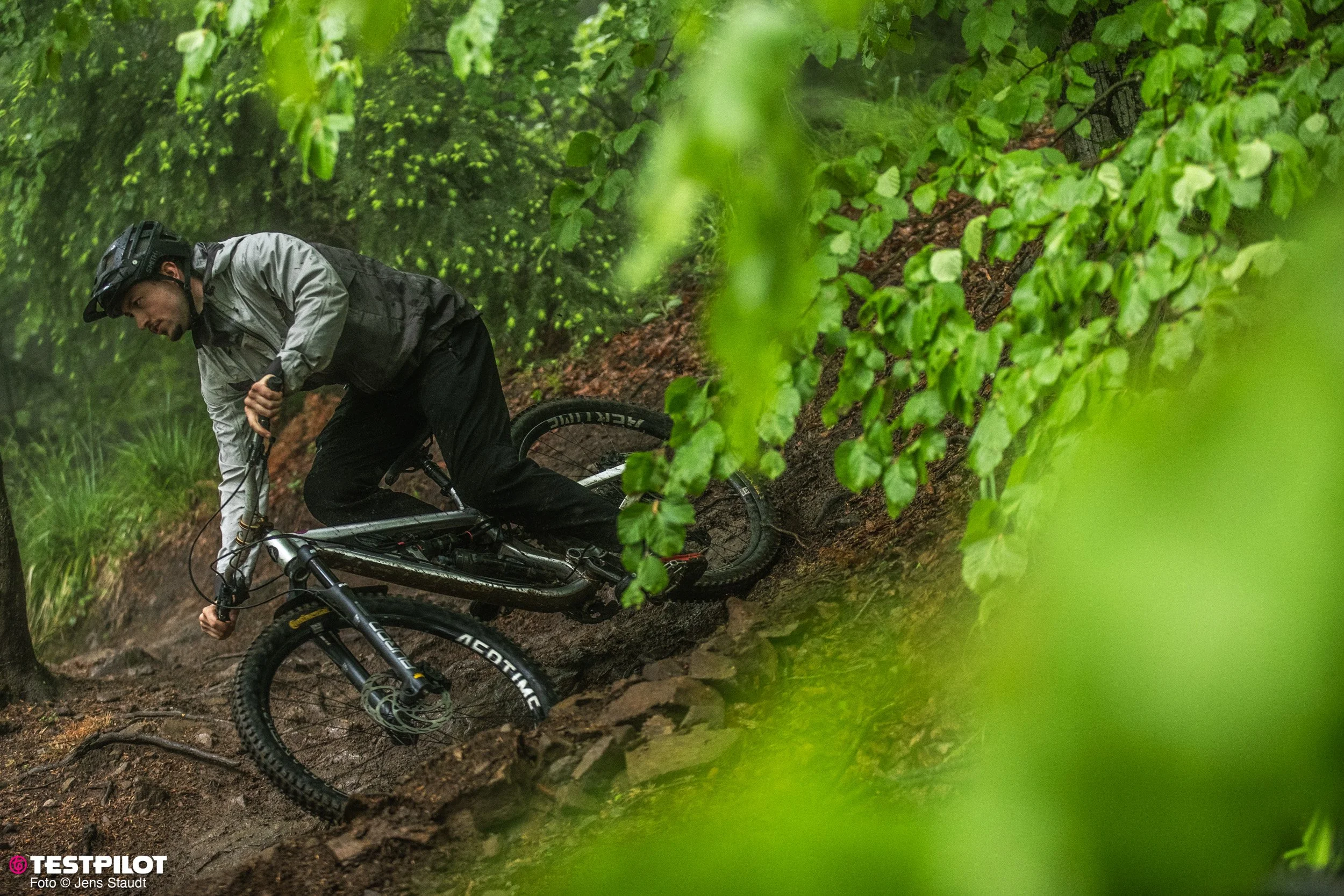
Antigrip. Roots. Clay. A stiff frontend can fighting for grip harder.
Suspension forks are not the only components affected. Frames also flex. In the past, they were even more common, but for several reasons there are now fewer of them: frames with so-called clevis designs—particularly when paired with shocks that use thin damper shafts—often led to premature material fatigue. Increased flex likewise accelerates wear.
Anyone who is now beginning to take a more in-depth interest in this subject should look into the concept of “fatigue limit.”
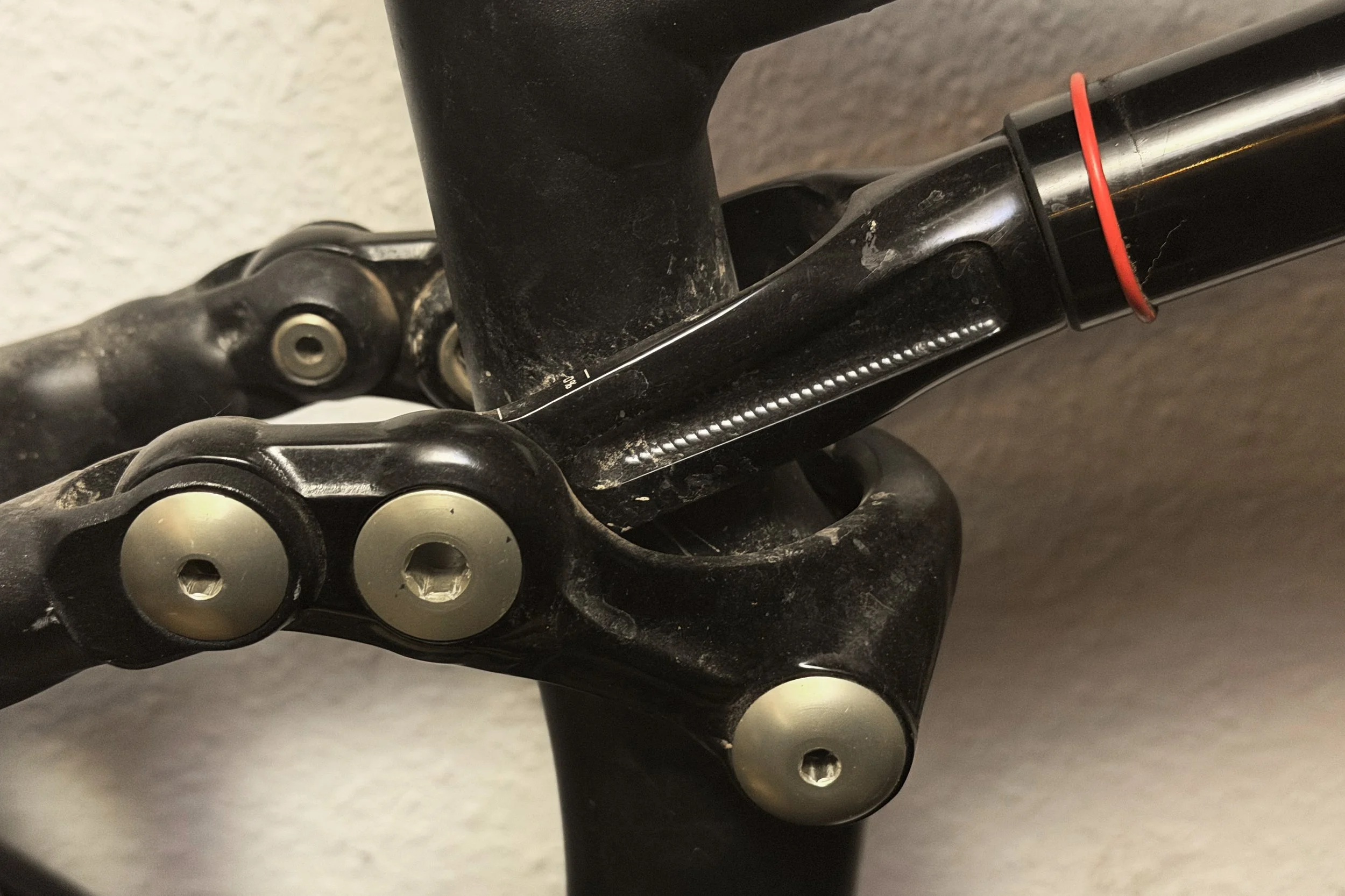
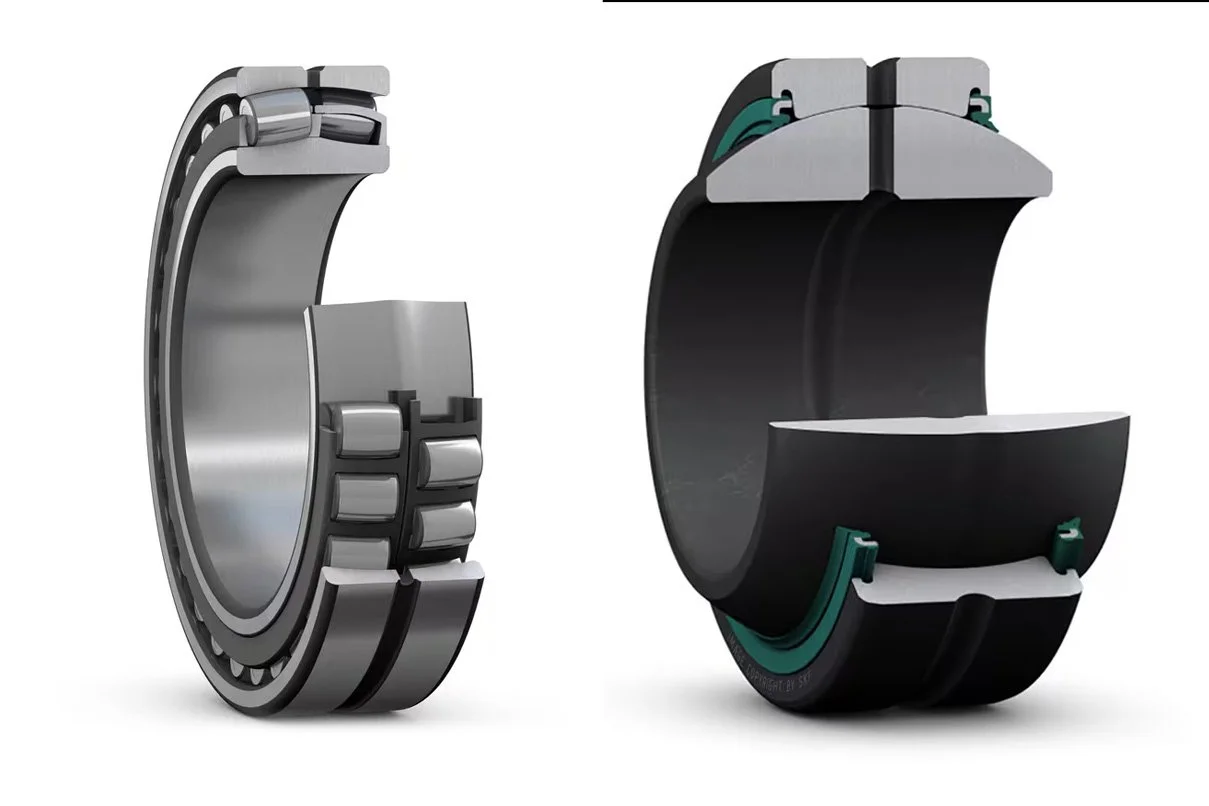
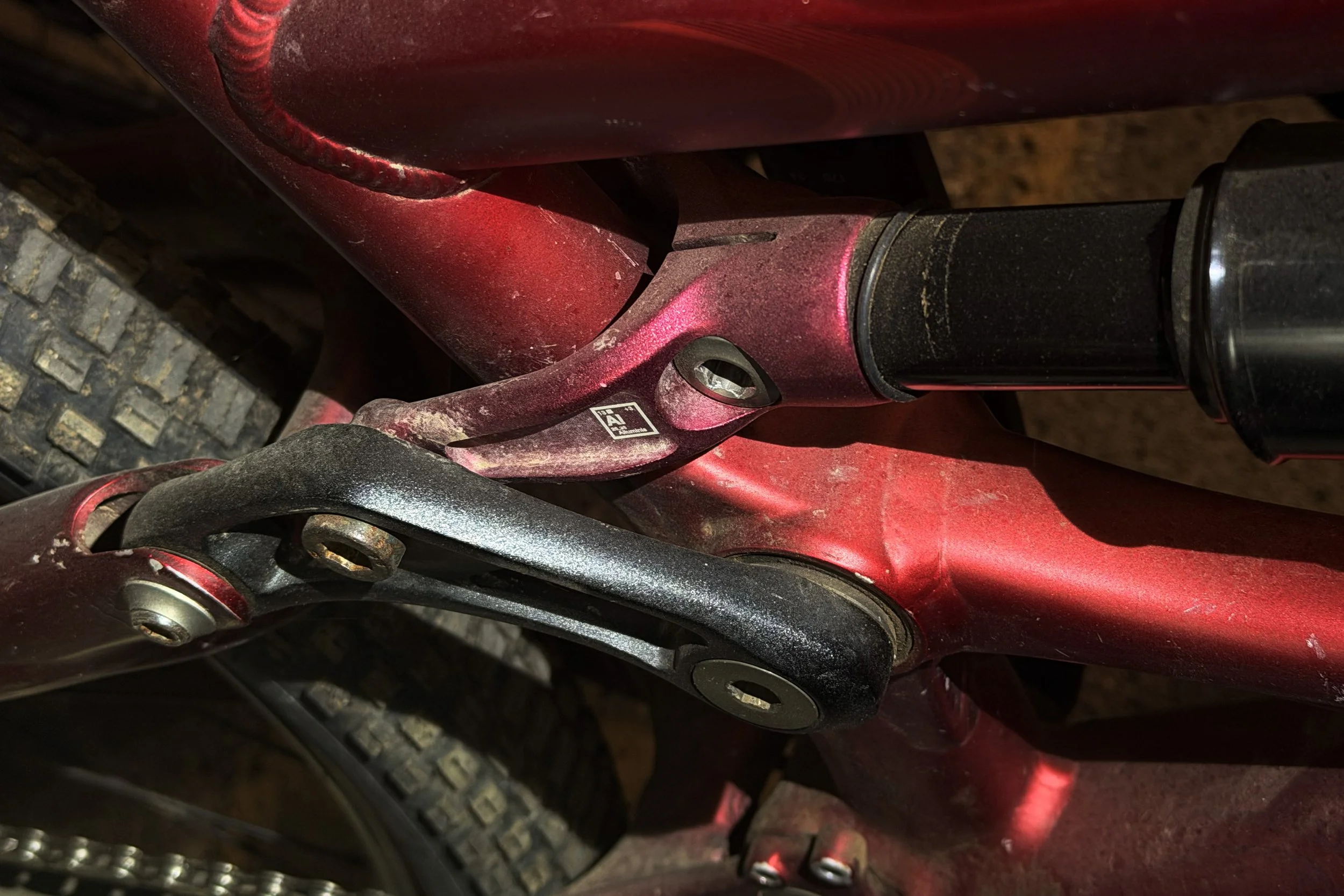
On the left and right, you can see various older solutions for suspension kinematics and shock linkages: when a shock is actuated via a yoke or a clevis (fork-style linkage), it can introduce elevated loads that the shock is not necessarily designed to withstand. In the center, you see sectional views of spherical SKF bearings. These help isolate rotational forces from the shock. However, the frame design must be engineered to accommodate this. (Illustration: SKF)
What acutally happens on the trail if a fork flexes?
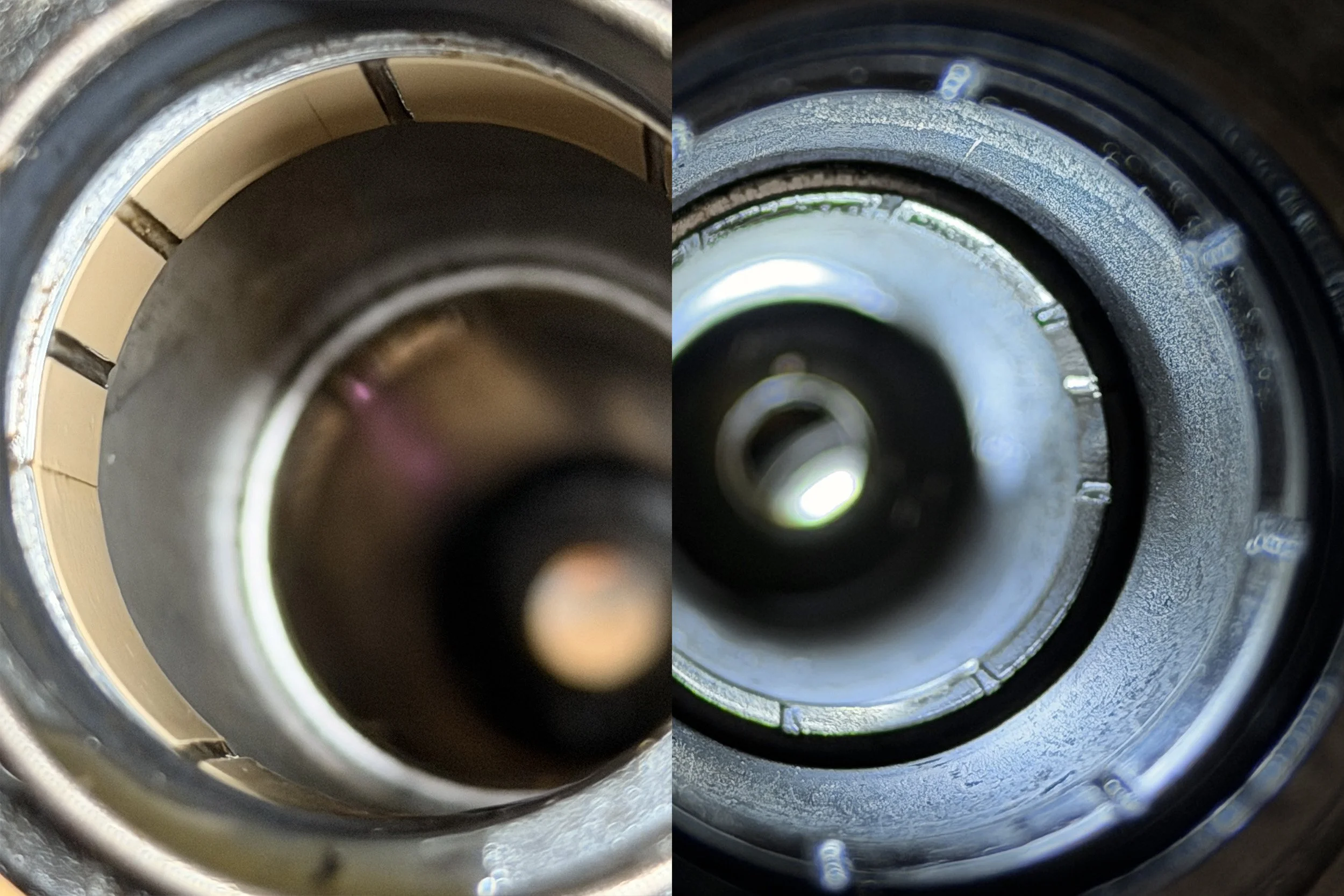
A view from an older decommissioned suspension fork, shown here as an example. The two rings are called bushings. They ensure that the stanchions run straight when the fork compresses. Now imagine the lower part of your fork twisting. As a result, the bushings no longer align perfectly with the stanchions. Unwanted friction occurs. Your fork can no longer absorb impacts optimally.
Over the past decades, head tube angles have become progressively slacker, allowing the fork to absorb impacts from rocks or edges coming directly from the front more effectively. However, because we mountain bikers like to rumble over crisscrossing roots and rocks, the forces acting on the bike do not come only from straight ahead.
The front wheel is subjected to forces from many directions, and if you do not hold the handlebar firmly enough, control can quite literally be knocked out of your hands. Naturally, we do not want that, so we counteract these forces. The result: the fork twists to the extent that its structure allows.
Sounds like an unwanted behavior? It is not. This twisting can help the fork filter out forces coming from the ground. Of course, it is essential to strike a healthy balance. Your handlebar should not remain perfectly straight while the fork rotates 10° away from your intended line.
Manufacturers follow different philosophies regarding how much axial and lateral twist is acceptable for a given application. Because this strongly depends on how the rider rides and what they weigh, there are also different fork models with varying overlap in suspension travel.
Fieldtest – SR Suntour AURON36 versus Suntour DUROLUX38 X
You still haven’t had enough of the nerdy details? Excellent. Then let’s dive into real-world riding. Flex is a highly complex factor. Test rigs cannot replicate all directions of force and load cases that occur on the trail—meaning in the real world.
To shed more practical light on the subject, we teamed up with SR Suntour to examine how the forks behave where it truly matters: on the trail.
On the Trail
We mounted the forks on a Banshee Titan, Pivot Firebird, Kavenz VHP, and Reichmann Senduro. Rider weights ranged from 70 to 100 kg. The forks were tuned in detail to match the respective rider weights and preferences. In this review, we focus on the chassis. A comprehensive test with impressions of the damping performance will follow.
Moderate Trails
The DUROLUX X weighed in at 2,656 g. The AURON stopped at 2,245 g. That results in an additional 407 g between the DUROLUX X and the AURON—and you could feel that at the handlebar, especially during direct back-to-back runs. Popping off every roller and doubling transitions? With the lighter AURON, motivation increased thanks to the lower weight.
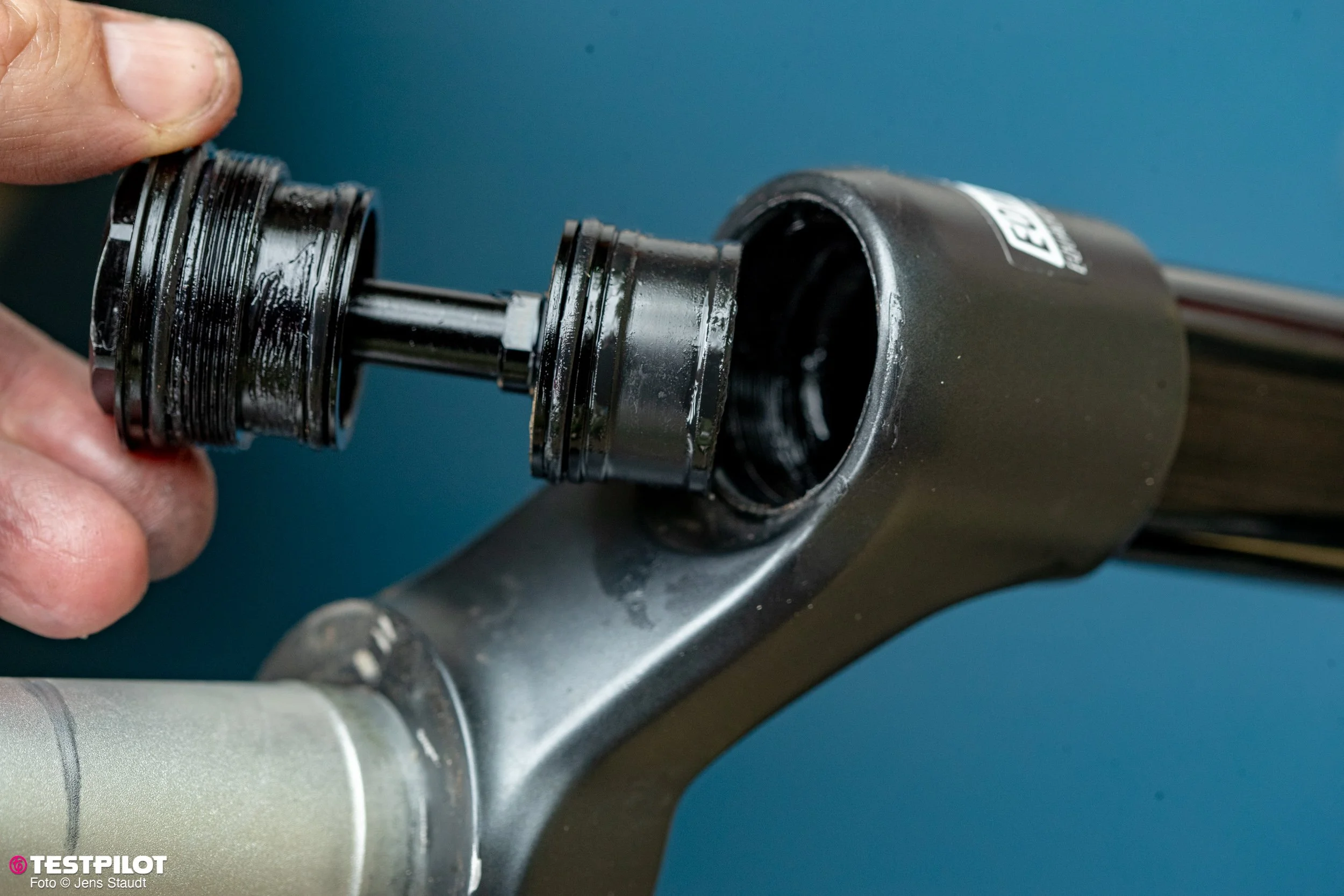
Putting in volume spacer is an easy task.
You will achieve the same riding sensation with a heavier fork, but only with more emphasis and physical input. As long as we were riding the trail with minimal force, the DUROLUX38 X almost seemed bored. “What are we even doing here?” it seemed to ask—so the solution was to ramp up the speed. Those who can and want to do that will be rewarded by the DUROLUX X with precision. And if you need more support in the corners, you can simply add volume spacers to the air chamber while keeping the same air pressure.
What is impressive in this comparison is the AURON and how it still delivers solid and predictable ride quality even under heavier riders. It is indeed softer than its big sister, though the term “softer” should not be misunderstood here, because the fork is in no way overwhelmed when things get rough. Suntour’s competitor FOX has continued to push the weight of the 36 down over the years. That shift also changed its intended use, moving it away from enduro and more toward trail. Weight reduction always impacts ride dynamics and flex. Where a FOX 36 rider may now prefer to move up to a 38, according to our impressions, in the SR Suntour portfolio, you can still confidently stay with the AURON in Suntour’s lineup.
Flowtrails
Berms, rollers, everything is predictable. No roots or rocks. Flow trails don’t necessarily have to be boring. They still place a certain demand on your suspension components.
More speed means higher forces–you will notice it on your fork too.
Pushing into corners and pulling them while riding on the verge of the grip through a flat berm, the DUROLUX38 X was barely challenged. You clearly benefited from the precision with which every input was translated, and you could feel exactly whether the grip would hold even on sections contaminated with loose sand.
The extra weight of the DUROLUX38 X compared to an AURON was equally noticeable here. Repeatedly surfing over rollers and pulling out of shark fins cost energy. Imagine training with a dumbbell and lifting it 50 times. Then you add 0.4 kg (the weight difference between the two forks) and lift it another 50 times. That’s essentially what you’re doing on the trail when you pull on the handlebars.
So did we prefer the lighter AURON? It’s not that simple. The AURON literally responded more easily to every input that involved lifting. On rocky terrain, however, it was more easily deflected and twisted. And that brings us to the next point…
How AURON and DUROLUX reacted to rocks and roots?
Twisting of a fork? Sounds dramatic! While riding a mountain bike, though, it’s completely normal. Remember our recommendation to use your smartphone’s slow-motion function? Here’s another reminder to try it. Slam on the front brake or film a rocky section on your home trail—you might be surprised at how much a bike and all its components twist in different directions when things get intense.
A fork that twists and bends more also returns to its original position. You feel this at the handlebars, and you have to hold them firmly. Over time, this can be fatiguing, just like the extra effort required when the fork briefly drifts out of line.
So if you blast over rocky sections with the stiffer fork, it CAN be less taxing on your strength because the fork holds the line and works without unwanted friction. But since you also get lateral impacts, these can be transmitted to your hands if the fork doesn’t “twist away” enough.
Can it be less taxing? Maybe—but not necessarily. At this point, it’s important to emphasize: you can also benefit from a fork’s flex. If the fork manages to “wrap around” rough hits instead of forcing the line, it can be easier on your forearms. Cue the objections: “I want my front wheel to follow exactly the line I steer!” And here we quickly arrive at the key point: preference. Opinions will vary widely, and there is no “right” or “wrong” that can simply be justified by “more is better.”.
It depends– as for the compression damping– on your trail, your riding style and weight (yours and the weight of the bike).
Regarding SR Suntour, we found that the DUROLUX38 X demanded noticeably more physical effort from the lighter testers during long descents and lap days in the bike park. The AURON, however, was still impressive, given its lighter and thinner appearance. In direct back-to-back rides, it was indeed more compliant than its bigger sister, but it made up for this with the energy saved during active riding that involved many maneuvers requiring pulling on the handlebars.
This became particularly evident in direct comparisons: after spending the morning in the bike park with the DUROLUX X, swapping to the AURON in the afternoon suddenly gave the bike a newfound lightness and agility. Every input was executed faster, and changes of direction came more easily.
Could you feel the lighter construction? Yes—but the AURON never became unpredictable, even under heavy loads or with heavier riders. Similar to a frame with healthy flex, the AURON helped the rider lean into sweepers and use the “rebound” to more easily lift the bike out of the turn.
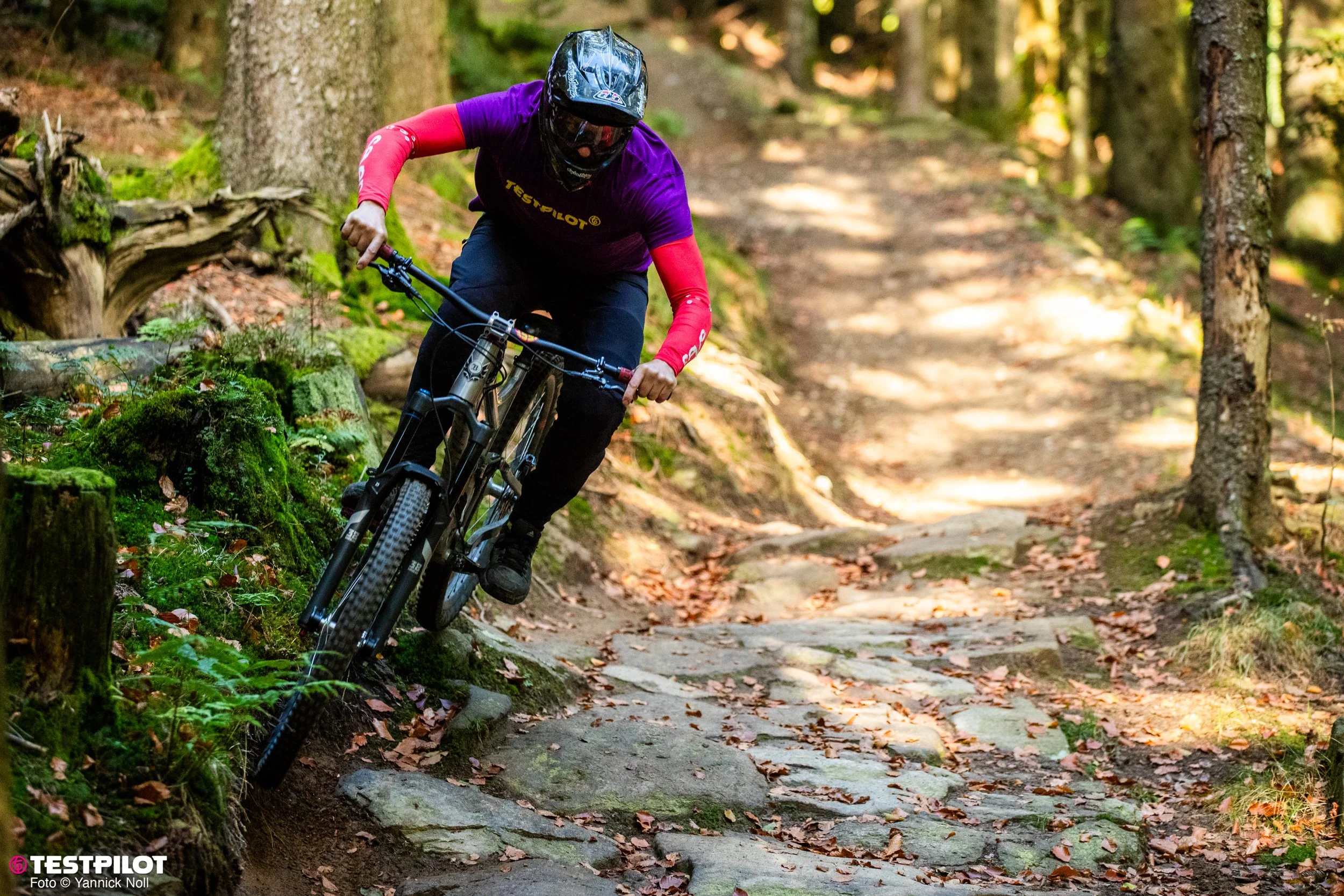
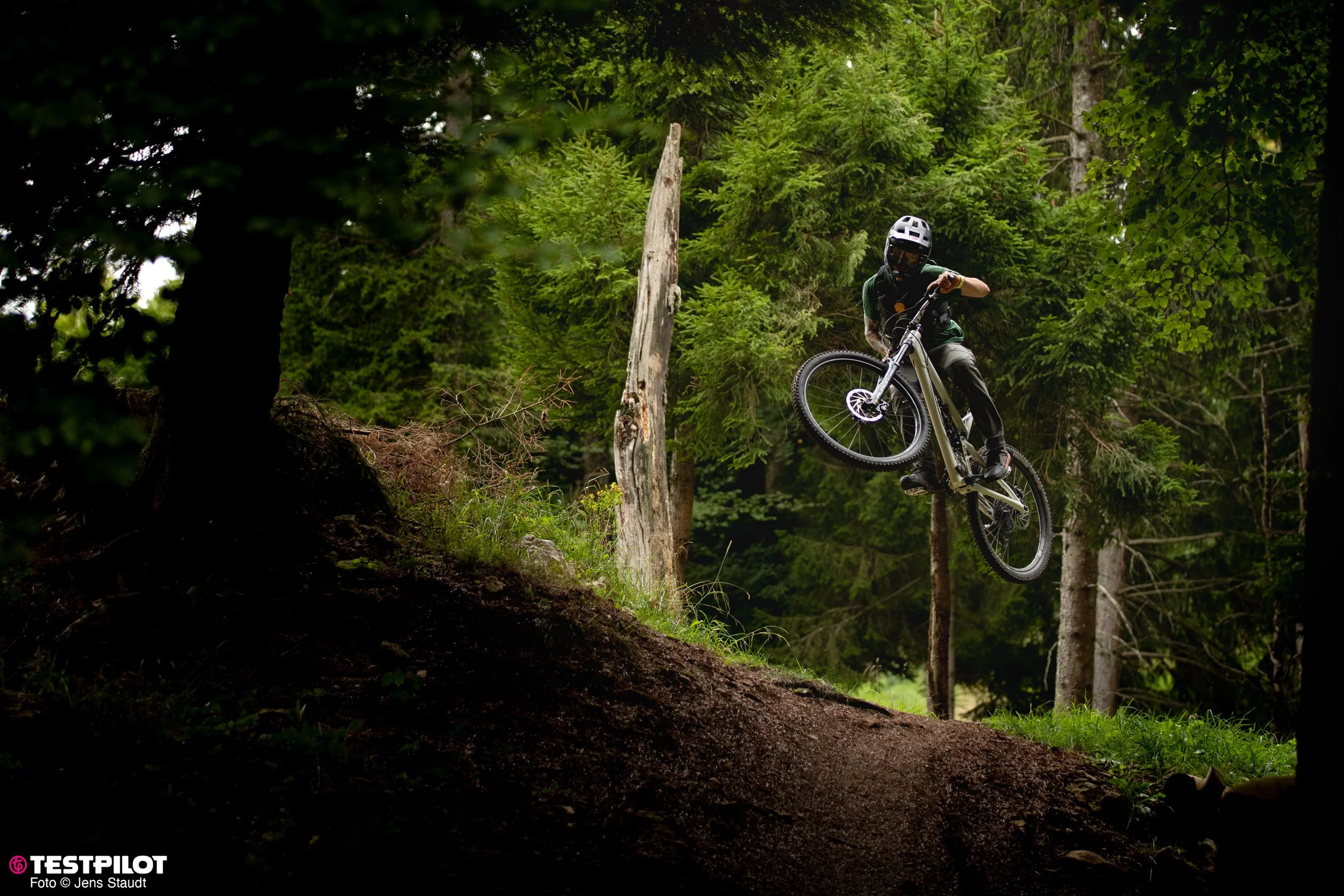
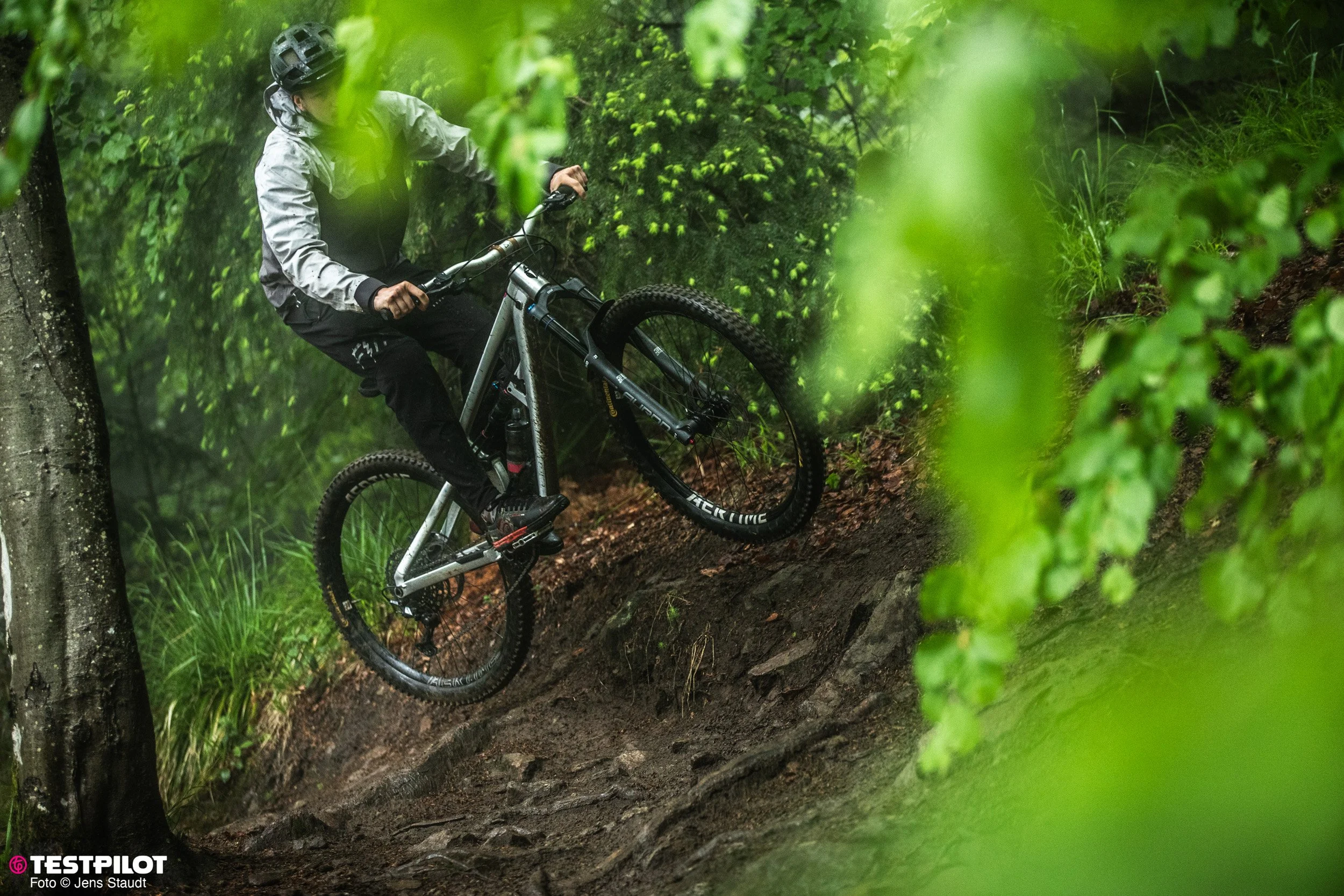
If you run 160 mm of travel up front, you don’t need to hold back on line choice in the bike park, even with the lighter AURON.
Technical Trails
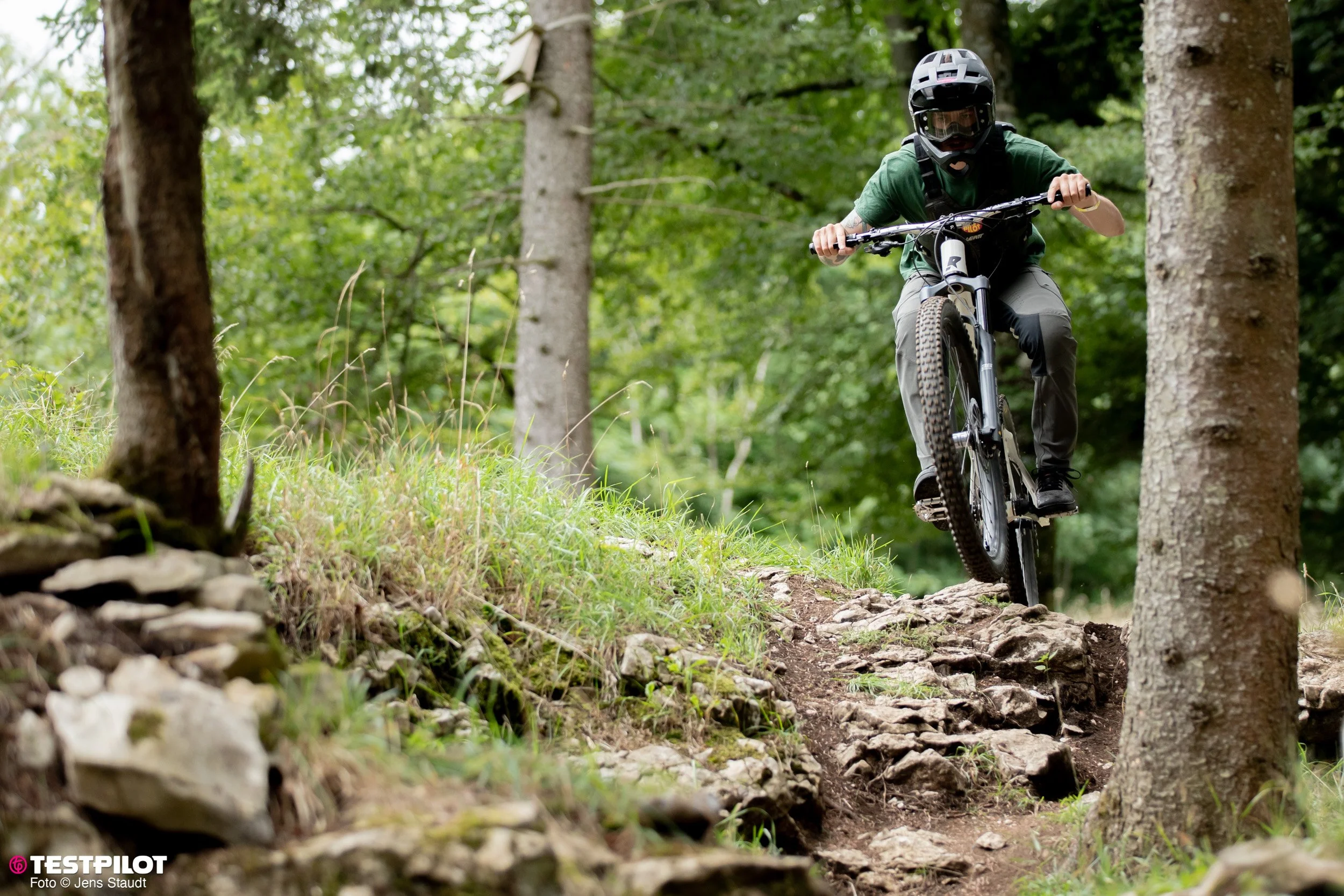
Smashing rocks and roots at high speed is one thing. Heavy braking eventually comes into play as well. Here, upside-down forks have the advantage, since the highest bending forces occur at the top, where the stanchions are most robust. Even a DUROLUX38 X can’t quite match that, but in a right-side-up design, it performs up front—discreetly. Even under strong braking, the fork maintained solid function, and impacts were absorbed cleanly.
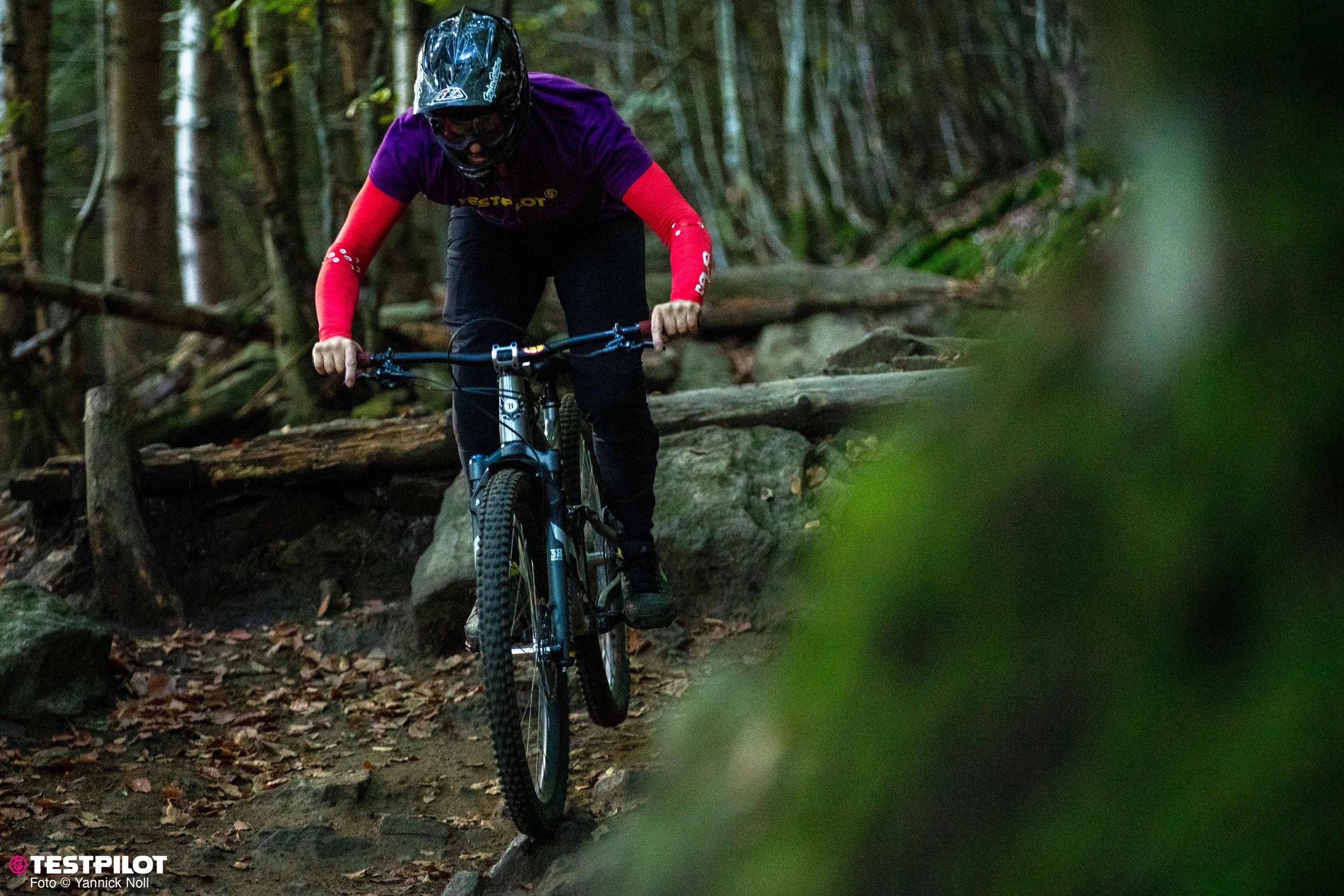
Braking hard into a switchback with the AURON so that you can pivot around it on the front wheel? This maneuver isn’t perfectly repeatable every day (even for us), but the 36 mm platform demonstrated its compliant side here. The 38X clearly had the edge in this scenario.
Which fork and which stanchion diameter should I choose?
After digesting the whole article, you understand flex or compliance is one of the most complex topics on a bike. We hope we were able to show that there is no standard solution. Which fork works best for you depends on the factors we described in this write-up.
SR Suntour offers two fundamentally solid forks with the DUROLUX and the AURON, which differ significantly despite overlapping travel ranges. In our tests, the AURON impressed with a surprisingly broad range of use and still performed very well in demanding terrain. Its chassis even impressed heavier riders with a balance of precision and energy-saving compliance. For us, this clearly positioned the DUROLUX38 X in areas like super enduro, freeride, or long-travel eMTB—basically anything from 170 mm upward. For riders who only occasionally hit bike parks with a 160 mm bike, we believe the AURON is a perfectly suitable choice.
SR Suntour delivers with an understatement: the DUROLUX and AURON differ noticeably in the details, and when looking closely at the chassis. Yet the all-black-on-black look remains very discreet. On the trail, they offer a clearly defined spectrum from trail to freeride. In the overlap range, you can choose according to personal preference, though the AURON’s ride quality—even in rough terrain—should not be underestimated.
| SR Suntour AURON36 | SR Suntour DUROLUX38 X |
|---|---|
| You’re relatively light and want to keep your bike light too | You ride an e-MTB or your body weight is close to 100 kg |
| You value maximum grip | Your line choice can be described as fairly aggressive |
| You want plenty of comfort to avoid premature fatigue | Steering precision is more important to you than comfort |
| Your riding mostly takes place on trails rather than in bike parks | Fast, rough descents, bike parks, and big freeride lines are your playground |
Will there be more on this topic?
This article, along with the CTS article on suspension damping, paves the way for the upcoming suspension comparison test. There, we will examine the damping performance, chassis, and construction of each individual fork—including the Suntour DUROLUX38 X. Of course, we will also address the topic of upside-down suspension forks.
Author – Jens Staudt

Height: 191 cm
Weight: 87 kg
Riding style: With his racing background, the lines are planned, even if there is anything bigger in his way. If possible, sections will be jumped over. You should use the entire width of a trail. Others would say - uncompromising.
Motivation: A product should function carefree and for as long as possible. If you have to screw less, you can ride more. He likes to tinker and see how the bike can be optimized.
AUThOR – YANNICK NOLL

Height: 178 cm
Weight: 75 kg
Riding style: As a former racer, it should be fast and flowing. Bigger jumps and steep ramps are also a must. The bike is tuned a bit firmer and quicker so that it responds promptly to rider input.
Motivation: It should be fun. A bike shouldn’t be boring, just flattening everything. The character can be a bit livelier – both in its setup and in the riding style. The product should be durable and function reliably even on longer bike trips.