

Reading time: 10 minutes

In a world dominated by four-bar layouts, mountain bikes can quickly start looking like an endless sea of same-same designs. Don’t get me wrong: many of these bikes look phenomenal and perform brilliantly. Have we truly reached the absolute pinnacle of "good enough," and do we need to settle on one specific design? Some people certainly don’t think so. They carry a vision that takes place far outside the conventional box—rethinking not just shock kinematics but also what suspension should actually achieve on the trail.
Matt Lessmeier is one of those people, and he brought his radical idea to life in the form of the Telepathy OPUS. It’s a bike with an uncompromising approach that might not be for everyone but will undoubtedly captivate a few. I took it for a proper spin on the rugged trails of Whistler. This is our review of the Telepathy OPUS.
We had been trying to organize a test ride for quite some time, so when Matt pinged me about his spontaneous trip to Whistler while I was there too, the decision was instantaneous: we needed to get some laps in together.
What stood before me was a hand-built steel frame—the eighth iteration of Matt’s relentless development. A bike engineered specifically so that its rear axle path matches the fork angle, keeping the effective wheelbase balanced through the stroke. It represents a single-minded vision brought to reality, and these are my unfiltered first impressions.
Matt Lessmeier, the man behind Telepathy & the Idea
Before dissecting how this chassis behaves on the trails, we have to look deeper into Matt Lessmeier’s background and the core philosophy driving the OPUS project. Holding a degree in mechanical engineering from Montana State University, Matt didn’t approach frame design purely as an enthusiast; he analyzed it through the cold lens of vehicle dynamics. Frustrated by the inherent geometric trade-offs of traditional mountain bikes, whose wheelbases constantly expand and contract dynamically, Matt set out to build a machine with superior high-speed stability and unwavering balance.
“I am just a crazy dude out of Montana. I’m a cowboy.”
– Matt Lessmeier, Founder of Telepathy Bikes
By utilizing a high-pivot steel framework welded in Bozeman, Montana, Matt spent years refining prototype after prototype to solve the front-to-rear load shifts caused by standard suspension compression. According to Lessmeier’s design thesis, matching the rear axle trajectory to the front fork’s travel vector allows the frame to absorb impacts without destabilizing the rider's center of mass. While these performance claims sound impressive on paper, our job as test riders is to see whether this sophisticated theoretical dynamic translates into real-world speed when the dirt gets steep and unforgiving.


The tech behind the "Parallel Axle Path"

To understand why the OPUS behaves unlike anything else on the market, you first have to grasp the concept of a parallel axle path. This is what Telepathy calls Sync Link. On a conventional mountain bike, as the rear suspension compresses, the rear wheel moves along an arc dictated by its main pivot or virtual linkage.
Sounds complex? Here are some basic explanations:
The way a mountain bike's rear suspension reacts to impacts is largely determined by the axle path, which is shaped by the location of the main pivot point. While many modern full-suspension bikes use complex linkages to create a “virtual” pivot point, the foundational physics can be understood through single-pivot principles, shown on the simplified graphic on the right.
A: Low Main Pivot (Bottom Bracket Pivot)
When the main pivot is placed coaxially or very close to the bottom bracket shell, the rear axle describes an arc that moves forward or almost strictly upward during the initial part of its travel.
The Drawback: When the suspension compresses into its sag point or hits an impact, the axle moves forward. This shortens the distance between the bottom bracket and the rear axle (rear center), causing the rear wheel to move into the path of oncoming obstacles rather than away from them. This resistance can stall the bike's momentum, push the rider forward over the bars, and make it difficult for the suspension to recover quickly from consecutive hits.
B: High Main Pivot
When the main pivot is positioned significantly higher and further forward than the bottom bracket, the rear axle swings in an arc that moves predominantly backward as the suspension compresses.
The Benefit: As the rear wheel hits a bump, moving backward allows the wheel to get out of the way of the obstacle rather than fighting against it. This rearward travel effectively lengthens the rear center temporarily, maintaining forward momentum, smoothing out square-edge impacts (like rocks and roots), and preventing the bike from hanging up.
How are you affected as a rider? We moved and settled on head tube angles from ~63.5° to 64.5° on most enduro bikes. For the younger fellas out there—this was not always the case, and it resulted in some changes in bike behavior. Because with these numbers the front axle moves (even more) rearward on impact while many traditional rear ends arc forward past their initial sag point, the distance between the two axles (your wheelbase) contracts significantly under heavy compression.
Your bike will shorten, and this creates a much less stable ride feel. To compensate, you will adjust your center of gravity (COG) to compensate and even out weight distribution between the front and back wheel. Most of this happens without you thinking about it. You will just notice on bikes having a more drastic change in front-center and/or rear-center that you have a hard time feeling safe on the them.
| Component | Conventional Suspension Compression | Telepathy "Parallel Axle Path" |
|---|---|---|
| Front Axle | Moves Up & Rearward ↗ (along head angle) | Moves Up & Rearward ↗ (along head angle) |
| Rear Axle | Arcs Up & Forward ↖ (wheelbase SHRINKS, pitch destabilizes) | Moves Up & Rearward ↗ (wheelbase STAYS BALANCED, chassis remains level) |
Every manufacturer approaches mountain bike kinematics as a complex puzzle of compromises. Some brands prioritize maximum pedaling efficiency for climbing prowess, others chase an ultra-supple feel for root-strewn descents, and a third group tunes for agility and playfulness. This balancing act creates each bike's unique ride personality, ensuring that every rider can find a machine tailored to their specific trail preferences.
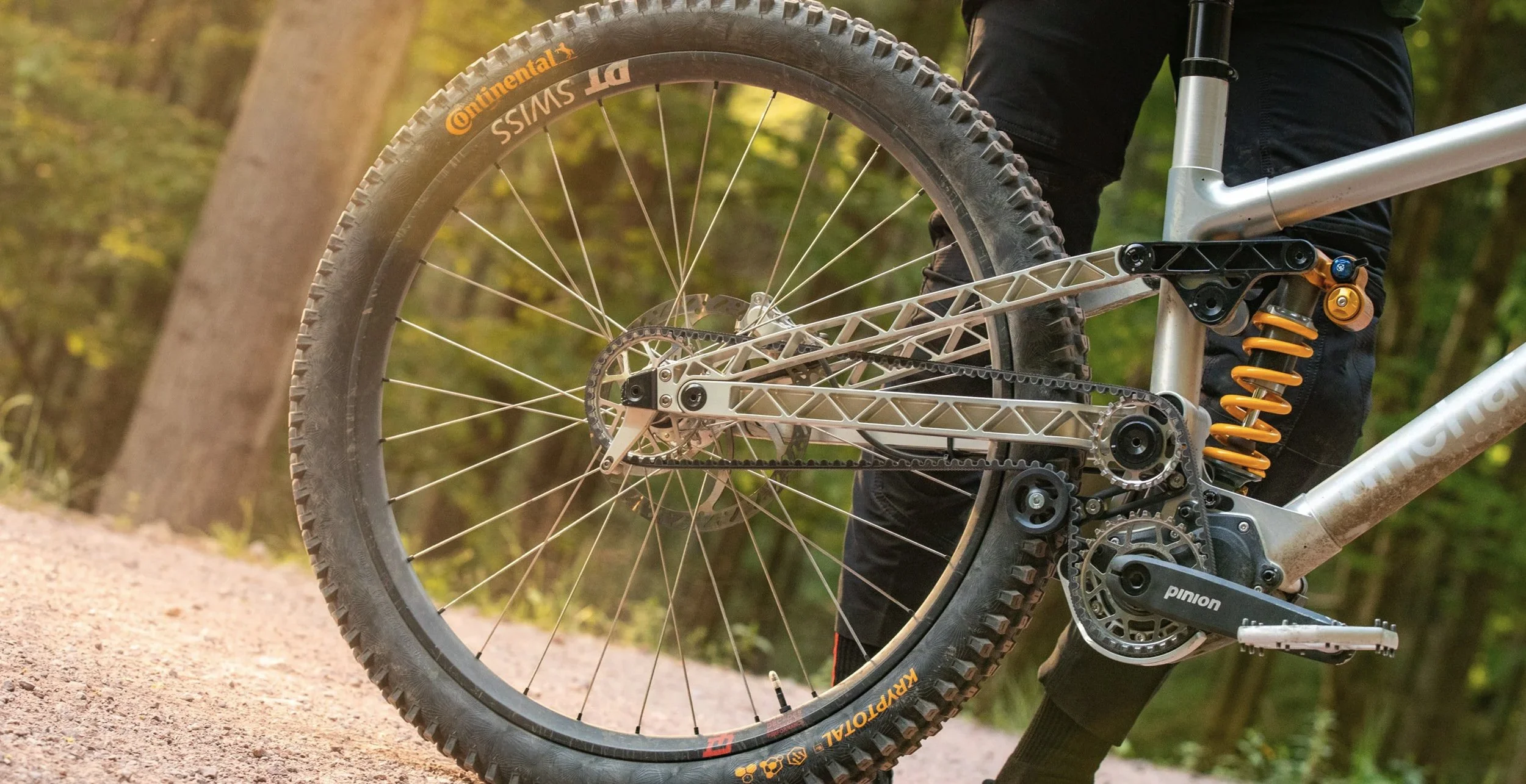
Telepathy’s solution uses an intricate high-pivot multi-link arrangement designed so the rear axle travels along a path roughly parallel to the front fork's movement. In theory, as both wheels absorb bumps simultaneously, they retreat in the same relative direction. This design aims to eliminate the dynamic wheelbase shortening that can throw off a rider’s weight distribution. By keeping the chassis level and maintaining a constant dynamic contact patch distance, the mechanism is engineered to minimize chassis pitch and still isolate the rider from harsh trail chatter.

It may look complicated first …

… but is quite a straight forward design.
Matt could have put the pivot point up high and called it a day. But he went for the extra mile (pun intended) rearward. If you take a look at the overlay below, you can get a better understanding of what is going on in the rear end.
We teamed up with Matt to create this graphic. This aims to introduce you to the idea and the principles of different axle paths. If you want to know the exact numbers, refer to the axle path graphic further down.
Let us assume there are some single pivot points at X1 and X2. This would make for a regular single-high-pivot frame. According to those points, we would generate the axle paths B1 and B2. Both designs would move rearward too via the link under it. On the OPUS there is an additional link marked as X3. This one will rotate rearward during compression, combining our theoretical points of X1 and X2 to a virtual instant center (IC) slightly up and in front of X2 marked with the +. From there you would get a single pivot path forming C, but with the IC moving backwards during compression, the path moves even more backwards. Please don’t forget this is simplified and the movement is more complex than just a segment of a circle.

Taking on the burden of more pivots and a more complex design, which also puts on more weight, to achieve this extreme change for the rear center makes his approach rather unique in the world of bike kinematics. Nothing that hasn't been tried before to some extent (think of Balfa or the interpretation of Forbidden bikes), but Matt takes it rather extreme.

Technical Details
The Telepathy OPUS is a hand-crafted steel machine built around a high-pivot platform designed for maximum durability and unique suspension design. Below are the key specifications, build options, pricing, and availability details:
Frame Material: TIG-welded custom steel front and rear triangles (made in Bozeman, Montana)
Rear Wheel Travel: 180 mm
Recommended Fork Travel: 180 mm Single Crown or 190–200 Dual Crown
Wheel Configuration: Mullet (29" Front / 27.5" Rear) for optimal clearance and maneuverability
Linkage System: High-Pivot Sync Link / Parallel Axle Path with integrated idler pulley
Shock Dimensions: 230 × 65 mm (Coil or High-Volume Air)
Rear Axle Spacing: 148x12 mm Boost
Headset: ZS56/ZS56
BB: BSA threaded
Dropouts: UDH compatible
Seat Tube: 31.6 mm
Maximum Dropper Insertion: ~400 mm (the seat tube is straight and unobstructed)
Frame Weight: ~6,3 kg / 14 lbs (without shock)
Pricing: Framesets with shock starting at $5.600 USD
Availability: Small-batch production runs built to order directly through Telepathy Bikes

Geometry
| Size | M/L – 0% Sag | M/L – 30% Sag | L/XL – 0% Sag | L/XL – 30% Sag |
|---|---|---|---|---|
| Reach | 450 mm | 450 mm | 480 mm | 480 mm |
| Chainstay Length | 420 mm | 449 mm | 436 mm | 465 mm |
| Wheelbase | 1222 mm | 1228 mm | 1268 mm | 1274 mm |
| Stack | 658 mm | 658 mm | 658 mm | 658 mm |
| Head Tube Angle | 64° | 64° | 64° | 64° |
| Bottom Bracket Drop (27.5" Rear) | 18 mm | 67 mm | 18 mm | 67 mm |
| Seat Tube Angle | 76° | 76° | 76° | 76° |
| Seat Tube Length | 400 mm | 400 mm | 420 mm | 420 mm |
| Head Tube Length | 120 mm | 120 mm | 120 mm | 120 mm |
Build Options
| Spec | Full Build | Frame & Shock |
|---|---|---|
| Price | $9.600 USD | $5.600 USD |
| Fork | Fox Factory 38 – 180mm, 44mm Offset | — |
| Shock | Fox Factory DHX – 230x65 | Fox Factory DHX – 230x65 |
| Spring | Fox SLS Coil Spring (spring rate of your choosing) | Fox SLS Coil Spring (spring rate of your choosing) |
| Drivetrain | TRP EVO 12 | — |
| Brakes | TRP EVO PRO | — |
| Wheels | DT Swiss EX 1700 Cla | — |
| Inserts | Cushcore Pro (front and rear) | — |
| Tires | Maxxis Assegai 29"x2.5" DH, MaxGrip, TR (F) DHR II 27.5"x2.5" DH, MaxTerra, TR (R) |
— |
| Bars | Chromag Fu 40 – 31.8mm, 800mm Länge | — |
| Stem | Chromag Hifi BSX – 31.8mm, 31mm Länge | — |
| Saddle | Chromag Trailmaster LTD Chocolate | — |
| Seat Clamp | Chromag NQR black 35 | — |
| Grips | Chromag Squarewave black | — |
| Dropper Post | One Up V3, 240mm | — |
| Pedals | Not included | — |
On the Trail
The core idea behind Matt’s kinematic is to make the rear wheel move in the exact same rearward trajectory as the front wheel. If you skipped the explanation part above, we strongly recommend to read it first. It makes the riding sensation way easier to understand.
The OPUS comes in at 480 mm of reach on the combined L/XL size. Static and unweighted, the chainstays measure a surprisingly compact 436 mm. Why did I feel right at home at 6'3" (191 cm)? And why did I feel such unmistakable similarities to custom long-geometry prototypes right after the first couple of turns?
With the decade-long trend of head angles getting progressively slacker, taller riders often struggle with front-to-rear balance as the fork slacks out. Matt was frustrated by this inherent imbalance and wanted a predictable ride feel, so he started to tinker.
When you hop on the OPUS, the chainstays immediately lengthen as you compress into SAG, gaining 29 mm at 30% compression to sit at 465 mm. On almost any standard bike, the wheelbase contracts under impact. Not here. The OPUS actually gains 6 mm of total wheelbase at SAG, sitting at a planted 1274 mm. Matt points out that traditional layouts can suffer a dynamic wheelbase shift of 50 mm to 80 mm throughout their travel cycle, drastically changing the bike’s footprint mid-corner. The moment your weight makes the bike squat via the centripetal force.
Why is this geometric behavior critical to how the bike rides? First off, the Telepathy OPUS feels far roomier on the trail than it appears on paper because it refuses to shorten when weighted. In practice, that static 480 mm reach feels more like a generous 520 mm reach on a standard chassis. Drop into a rough section, and the bike retains its long, stable stance instead of collapsing inward beneath you.
Dropping into the trail, I felt instantly comfortable. It reminded me of a custom geometry project I built years ago. It shares that same locked-in, carving sensation, only backed by vastly more suspension depth. A massive 180 mm of rear travel helps you plow through whatever sits in your way, and on Whistler’s technical double-blacks, there are plenty of square-edged obstacles ready to hang up a lesser bike.

There is even more to this design, both literally and figuratively. By nature of its axle path, the rear wheel moves back and away from the root or rock you just smashed into. Paired with plenty of travel, almost nothing translates to your feet or hands. The OPUS simply gathers speed as if you were coasting down a paved flow trail rather than picking through a chaotic, boulder-strewn descent.

Matt is a wild one. He doesn’t hold back on any feature or any gnarly line.
Making the front and rear wheels move in parallel backward trajectories requires a slight adjustment to your riding technique. As the suspension compresses, your relative center of mass naturally shifts forward over the cockpit. On standard bikes, you have to proactively throw your weight over the front wheel in aggressive turns to keep the tire loaded. The OPUS drives you into that balanced attack position automatically without requiring active weight shifts. On consecutive high-speed hits, this auto-centering feel can seem unusual at first, requiring a short adjustment period. I found it best to stay centered on the bike and push firmly with my palms into the bars, just as you drop your heels over rough terrain. Positioned like that, the frame swallows even the most brutal lines you plow it trough.
Flat, loose corners often present a challenge when trying to maintain front-end traction. However, the OPUS's automatic forward weight transfer during chassis compression makes you feel like a cornering god. Instant confidence boost. Just be mindful to stay balanced so you don't unweight the rear tire in dusty, low-grip conditions. Even if the rear breaks out sideways, the longer rear-center gives you a forgiving recovery zone to catch it. Though you’ll want to respect the immense carry-over speed this bike generates.


Slowing down, however, can get a bit spicy. Heavy braking before a corner shifts your mass forward and unweights the rear end, which grows longer as it works through brake bumps. As a result, scrubbing speed doesn't feel like it does on a traditional short-chainstay bike. The combination of an expanding rear center taught me to clean up my braking technique, making sure I set my entry speed before leaning into the turn rather than dragging the levers mid-corner. Remember folks. You also have a front brake and it will help you to slow down more quickly if you use it right (e.g. not while cornering).
When pumping through rollers and popping off Whistler's jump lips, the OPUS flies far lighter than its weight numbers suggest. Looking at the robust steel frame and experiencing its steamroller traction might make you expect a sluggish tanker, but that assumption is wrong. Keeping the dynamic wheelbase balanced makes the bike exceptionally predictable in the air, allowing you to pop off lips and adjust lines mid-flight with remarkable ease.

The OPUS also likes to catch air.


Verdict of the first review of the Telepathy OPUS
First ride impression Telepathy OPUS
Matt Lessmeier is a pinner, and his Telepathy OPUS is built in his image. The core concept of balancing the dynamic wheelbase works, delivering a high-speed, rail-like ride feel that holds its line through the roughest terrain. You need to be comfortable with a chassis that encourages you to carry outright speed, because scrubbing pace on a dime isn't always effortless with this bike if your braking technique is sloppy.
Make sure you get a test ride before picking a size, as the dynamic reach and long rear end mean you may prefer a shorter reach than your usual setup. What you get in return is a ride experience unlike almost anything else on the market: an unshakable sense of stability, supreme square-edge compliance, and the confidence to charge faster than ever before.
You want more Reviews?

Author – Jens Staudt

Height: 191 cm
Weight: 101 kg
Riding style: Drawing on a racing background, his lines are deliberate and fast, keeping momentum through rough sections. If possible, he looks to gap obstacles whenever the trail opens up and likes to use every bit of trail width. Some would say—uncompromising, direct and hard-charging.
Motivation: Values gear that just works and stands the abuse over over time. Less time in the workshop means more time riding. As someone who enjoys tinkering, he appreciates smart design, straightforward maintenance, and sensible ways to optimize setup.