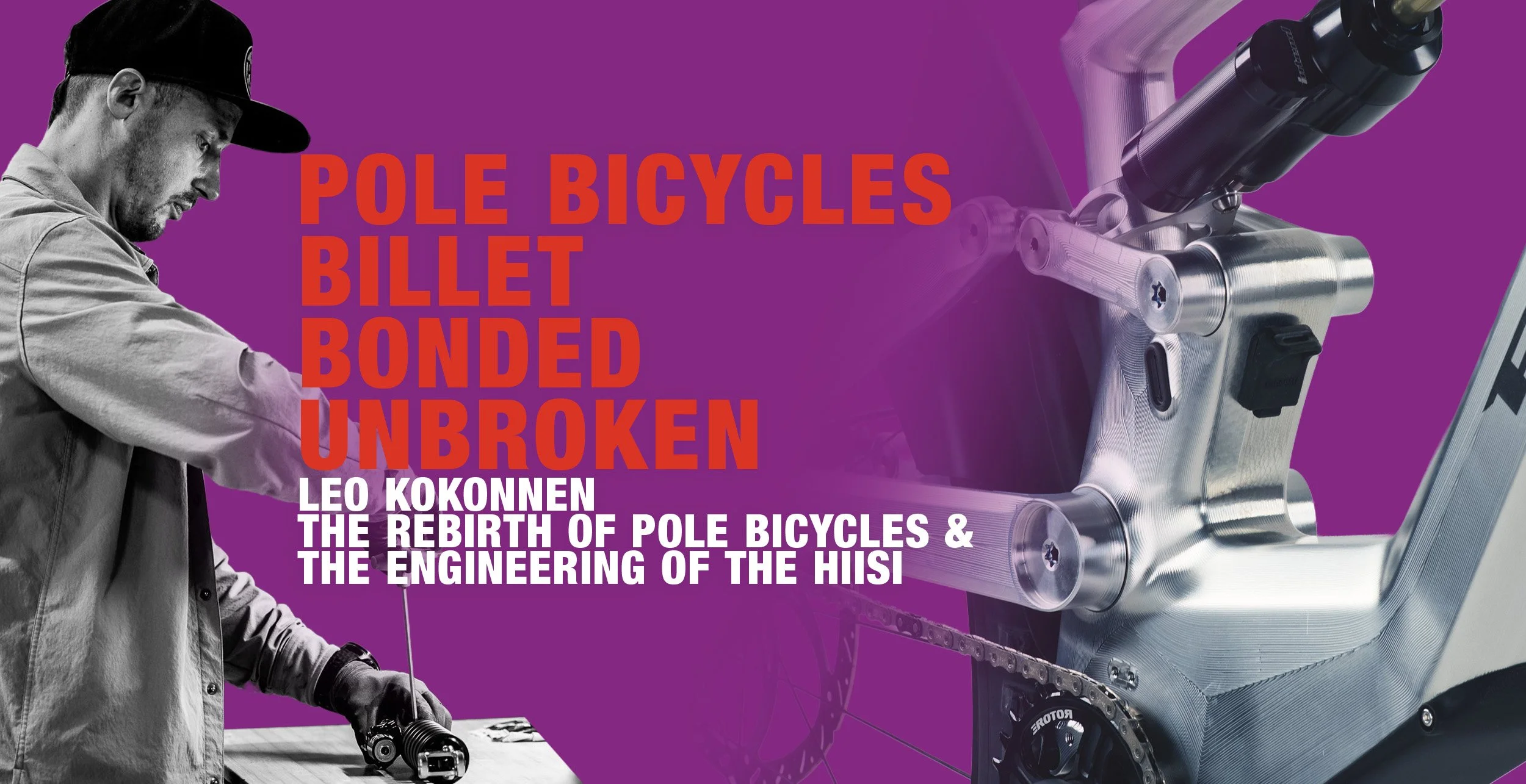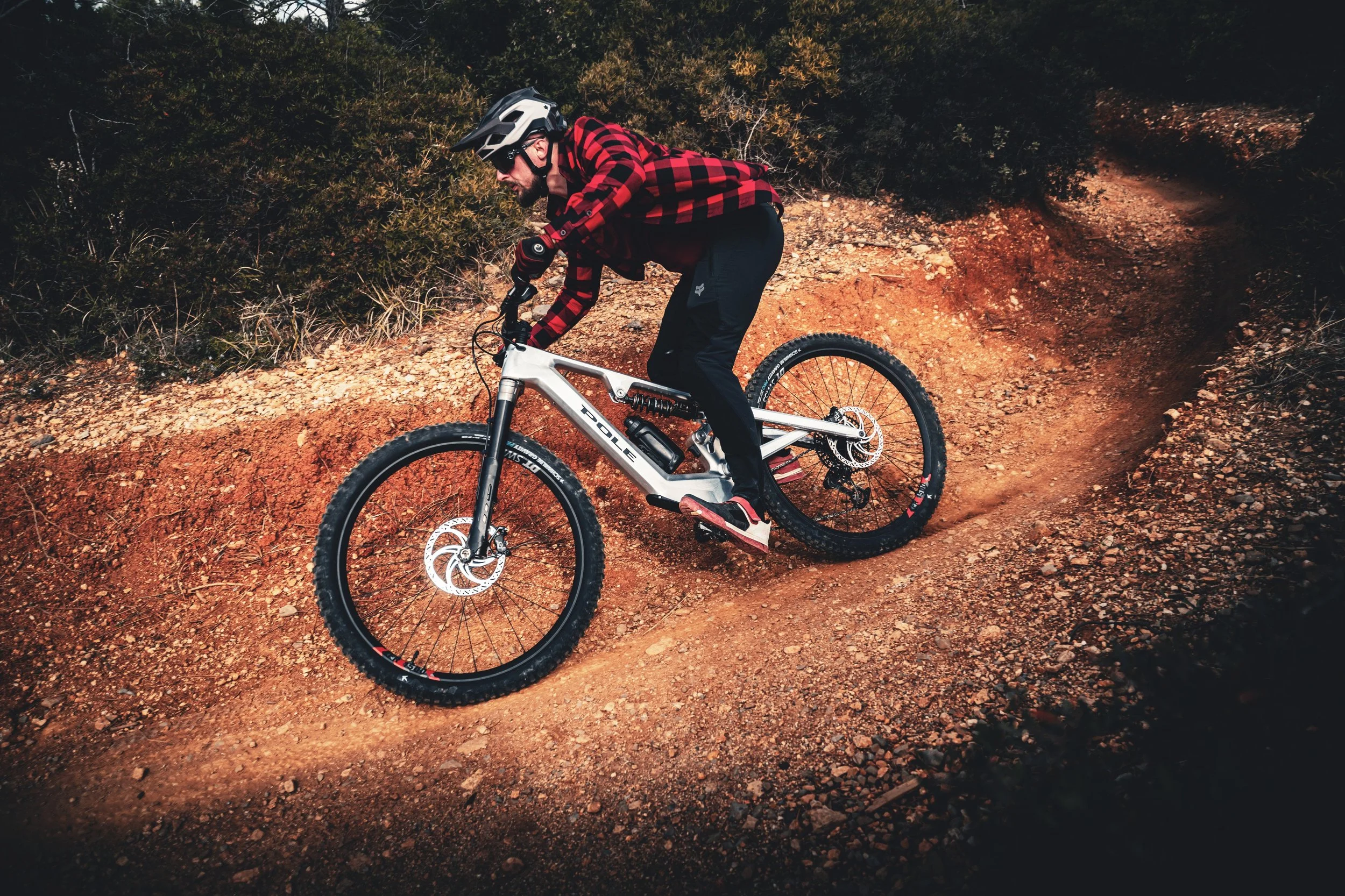
The mountain bike industry loves a disruptor. To question the status quo and also debate the ideas in comment sections. Pushing boundaries comes with pushbacks. Leo Kokkonen faced the storm and kept going like a Viking holding on to the drakkar. From being one of the first outspoken people for ultra-long, slack wheelbases to abandoning carbon fiber for bonded, CNC-machined aerospace alloy, the founder of Finland’s Pole Bicycles has never chosen the path of least resistance.
After navigating a highly publicized corporate restructuring and bankruptcy cycle, Kokkonen is back like Lemminkäinen. But this isn’t a return to mass production. It is a calculated pivot to ultra-premium, boutique manufacturing where frame building mirrors aerospace engineering, and “one-bike-to-rule-them-all” in a modular engineering approach. Enjoy the podcast and the following article, which may give you more insights in this episode.
Listen to the full conversation with Leo Kokkonen on the TESTPILOT.bike Podcast to learn about what drives Pole and how they approach their idea of building the best bespoke bike.
If you use Spotify or Apple Podcast, you may also subscribe to our channels there. Easier to put the episodes on your speaker while driving to the riding spot.
Using another podcast app? Select your streaming app here.
The podcast has time marks to make it easier for you to relisten or jump directly to the part you are most interested in.
Podcast Chapters
00:00 – Introduction & Racing Background
01:33 – Origins of Modern Geometry & Evolink 140
04:30 – Ditching Carbon Fiber for Recyclability
06:34 – Structural CNC Machining & 7075-T6 Alloy
08:42 – The Bike Industry Downturn & Market Challenges
12:01 – Rebirthing Pole as a Boutique Brand
13:08 – Clamshell Bonding vs. Monocoque Construction
23:56 – Controlling Frame Flex & Ride Quality
33:39 – E-Bikes & The Maxon BikeDrive Air S
41:01 – Battery Management & The Manual Converter Kit
44:24 – The Pole Hiisi & Modular Suspension Travel
49:36 – Future Plans & Direct Customer Consultations
1. The Geometry Renaissance: From “Unrideable” to the Industry Benchmark
The Historical Shift
In the early 2010s, the burgeoning enduro scene was forced to adapt to geometry platforms still somewhat rooted in cross-country architecture. Trail bikes were short, steep, and inherently unstable at high gravity speeds. Kokkonen, drawing from his downhill racing background, realized that a fundamental paradigm shift was required to make an enduro bike descend fast without sacrificing its climbing posture.
The Dynamic Geometry Equation
Pole’s breakthrough came with the welded Evolink 140, a frame that boasted a wheelbase roughly 20 centimeters longer than its contemporaries. While some critics in the media world claimed it “couldn't get around a tree,” Kokkonen’s geometry predictions proved prophetic. Today, those dimensions form what we could consider the industry-wide baseline.
Traditional 2013 Trail Geo = Short Reach / Slack Seat Angle
Pole Evolink Paradigm (Modern Standard) = Long Reach / Steep Seat Angle / Slack Head Angle
However, as Kokkonen emphasizes in this episode of the TESTPILOT-Podcast, static geometry charts are a secondary metric: “Geometry is not static; it’s dynamic on a suspension bike. You cannot judge a bike solely by its static numbers. You must look at how the kinematics alter those numbers dynamically under load.”
A pretty straightforward quote from Leo. Even clearer it becomes the moment you realize that the bigger your rear travel becomes, the more the actual geometry will change once you reach the point of sag. Less travel, less displacement, less geometry change.
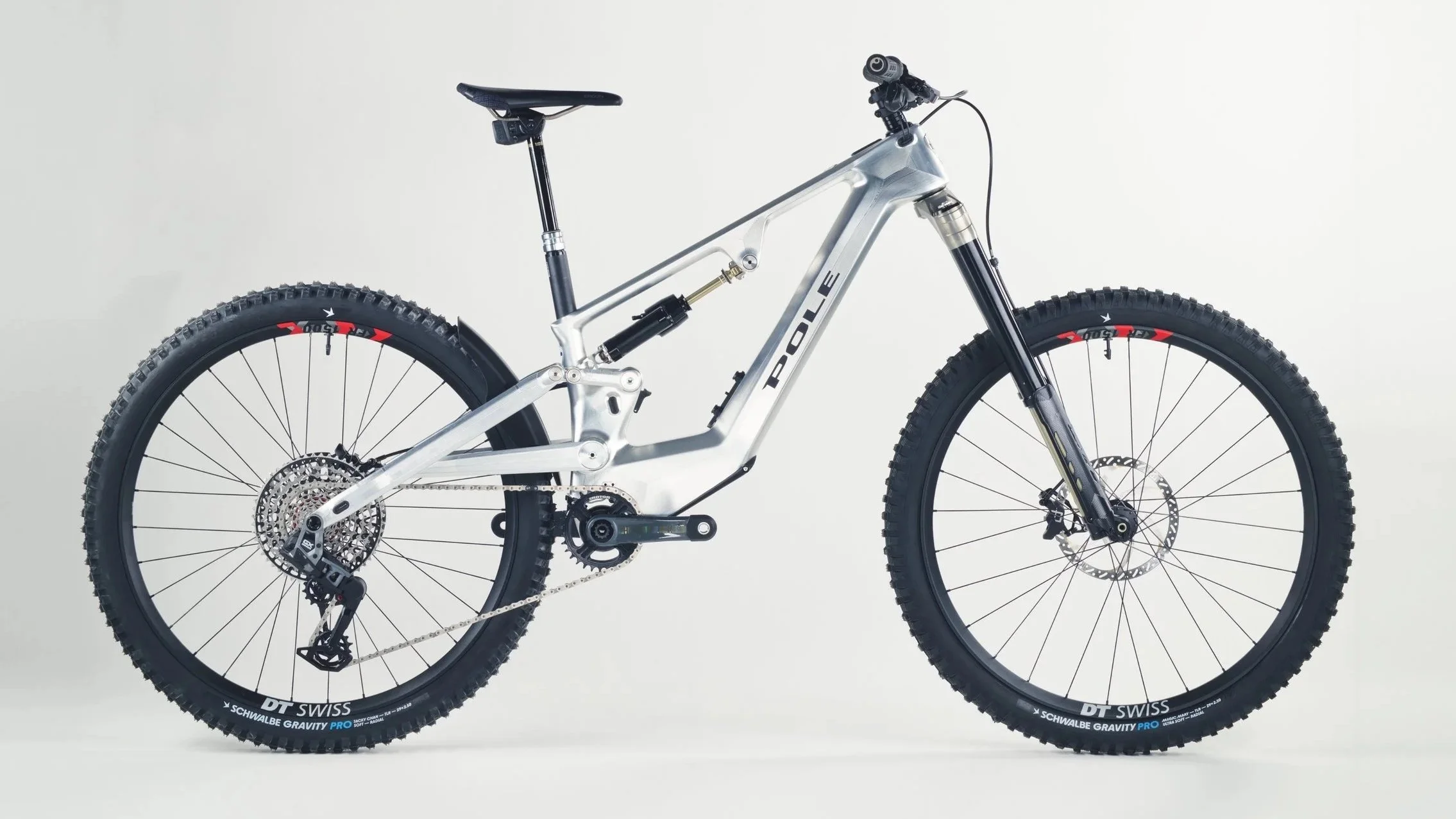
The latest brainchild of Leo – Hiisi
Geometry of the Hiisi
| Dimension / Parameter | K1 | K2 | K3 |
|---|---|---|---|
| Rider Height (cm) | 157–170 | 171–182 | 183–198 |
| Head Angle (°) | 64 | 64 | 64 |
| Seat Angle (°) | 80 | 80 | 80 |
| Reach (mm) | 444.7 | 474.7 | 504.7 |
| Stack (mm) | 631.0 | 631.0 | 631.0 |
| Front Center (mm) | 790.8 | 820.8 | 850.8 |
| Chainstay Length (mm) | 451.1 | 451.1 | 451.1 |
| Wheelbase (mm) | 1241.9 | 1271.9 | 1301.9 |
| Effective Top Tube (mm) | 549.5 | 579.5 | 609.5 |
| Head Tube Length (mm) | 110 | 110 | 110 |
| Seat Tube Length (mm) | 343 | 343 | 350 |
| Bottom Bracket Drop (mm) | -15.56 | -15.56 | -15.56 |
| Bottom Bracket Height (mm) | 356.6 | 356.6 | 356.6 |
| Fork Offset (mm) | 44–51 | 44–51 | 44–51 |
| Rear / Front Travel (mm) | 173 / 180 | 173 / 180 | 173 / 180 |
| Shock Size (mm) | 65 × 230 | 65 × 230 | 65 × 230 |
| Fork Axle-to-Crown (mm) | 596 | 596 | 596 |
2. Structural Metallurgy vs. The Carbon Myth
The Hidden Environmental Cost of Carbon Fiber
The cycling industry has long romanticized carbon fiber as the ultimate premium material. Kokkonen's shift away early from composite manufacturing occurred during a research trip to mainland Chinese factories. The reality he experienced in person was business-changing.
Carbon manufacturing is defined by massive prepreg cutting waste. Unlike traditional metal frames, which enable CNC scraps to be recycled, the structural epoxy matrix of cured or uncured carbon composite cutting scraps cannot simply be melted down. In the last couple of years, it actually became a topic in the bike media, and some customers turned away from the unrecyclable waste destined for landfilling.
7075-T6: The Un-Weldable Super-Alloy
To build an advanced, high-performance alternative, Pole turned to 7075-T6 aluminum (AlZnMgCu1.5).
| Property | 6061-T6 Aluminum (Standard Bike Alloy) | 7075-T6 Aluminum (Aerospace Billet) |
|---|---|---|
| Yield Strength | ~276 MPa | ~503 MPa |
| Tensile Strength | ~310 MPa | ~572 MPa |
| Welding Suitability | Excellent | Poor / Non-Weldable |
Because 7075-T6 undergoes massive microstructural degradation and micro-cracking when subjected to the localized heat-affected zones (HAZ) of traditional TIG welding, it must remain unheated. The solution? Machining the frame components directly from solid billet blocks and utilizing advanced structural bonding.
3. The Clamshell Monocoque: Sculpting Wall Thickness
Every Hiisi frame starts with a 100 kg raw billet block, undergoes 24 hours of CNC machining, and ends up as a 3.9 kg finished monocoque half frame. Then the halves are bonded together. 100% of the swarf is recyclable.
Eliminating Parasitic Torsional Flex
Traditional pocketed frame machining leaves deep internal structural channels but utilizes a flat single plate as a closure, which can suffer from compliance issues unless heavily reinforced. Pole’s process utilizes a mirrored clamshell construction. Two symmetrical halves are carved inside and out with a tolerance tighter than ±0.05 mm.
This allows Pole to execute continuous variable wall thickness, thickening the structure at highly stressed junctions like the bottom bracket shell and head tube taper, while tapering down to fractions of a millimeter along low-stress spans.
The Secret is in the Surface Preparation
An adhesive bond is only as resilient as the chemical interface layer. To ensure lifetime structural durability, Pole executes a strict multi-stage surface treatment process before applying aerospace-grade epoxy:
Solvent Degreasing Bath: Complete removal of hydrocarbon lubricants and machining coolants.
Acid Etch: A sulfuric acid dip removes embedded impurities and alters the surface roughness profile on a microscopic scale.
Passivation/Chemical Conversion: An oxidation barrier prevents raw aluminum corrosion, locking the bond interface into a stable state.
4. Lateral Stiffness vs. Radial Compliance: Engineering the System
The modern engineering narrative has shifted away from absolute frame stiffness toward compliance. A frame that cannot deflect laterally under extreme cornering loads deflects the work to the tires and rims, breaking traction abruptly.
The Bridge-less Swingarm Architecture
Unlike standard rear triangles that rely on structural bridges between the seatstays and chainstays to manage torsional loading, Pole's new platform uses a massive, oversized axle interface at the lower suspension pivot links.
Standard Swingarm: [Arm–Bridge–Arm] ► High-stress concentration at joints
Pole Architecture: [StrongAxle–PivotHub] ► Engineered lateral compliance without local stress
By altering the internal boring profiles, material density, or wall thickness of this central axle unit, Pole can tune the exact lateral flex profile of the rear wheel path, allowing racers a stiffer, tracking-critical rear end. When more forgiving compliance is wanted, riders can opt for a softer wheelset to balance everything out.
5. The “Hiisi” Concept: One Modular Platform
Named after an unpredictable, sacred force in Finnish folklore, the new Pole Hiisi embodies Kokkonen’s vision of category-defying hardware. Rather than buying an Enduro bike, a Trail bike, and a Downhill rig, the Hiisi uses interchangeable shock mounts and modular links to shift through a spectrum of configurations:
Rear Wheel Travel: 152 mm to 200 mm
Wheel Options: Dedicated 29er or Mixed (Mullet) 29"/27.5" setups
Fork Configuration: Optimized for single-crown 160–180 mm setups or full 200 mm dual-crown gravity builds.
► 152 mm Travel (Trail Setup) [Hiisi Frame Platform]
► 173 mm/180 mm Travel (Enduro Configuration)
► 200 mm Travel (Full Dual-Crown DH)
6. Powertrain Integration: The Swiss Precision Factor
The Maxon BikeDrive Air S System
For the Hiisi, Pole did not jump on the bandwagon of more and maximum power motors in favor of the Maxon BikeDrive Air S system. Engineered in Switzerland by the company responsible for interplanetary rover drive motors, the Air S drive unit bridges the gap between full power output and lightweight integration. In the end, the ride feel and staying a bicycle rather than a motorbike played an important part in Leo’s decision.
Drive Unit Weight: 2.03 kg
Torque Output: 90 Nm
Peak Power: 620 W
Maxon Air S: 2.03 kg / 90 Nm
► Internal Planetary Gearbox
► Over-25 km/h Cutoff
► Ultra-silent operation
► Zero drag
► Natural pedaling
Advanced Dual-Battery Thermodynamics
The Hiisi incorporates an integrated 600 Wh main downtube battery paired with an optional 250 Wh range extender. In conventional systems, a range extender bypasses the main cell, straining the smaller battery under high-current draw and dropping overall peak system power.
Maxon’s architecture runs both power sources in a parallel thermodynamic loop. The range extender acts as a continuous charger for the main battery. When a rider encounters a high-torque tech climb, the system pulls current simultaneously from both cells, keeping power high and operating temperatures low.
The Manual Converter Kit
In a creative engineering move, the Hiisi includes a Manual Converter Kit. By unbolting the ultra-compact Maxon drive unit, riders can bolt in a structural machined aluminum block placeholder. This fills the motor cavity, converts the bike back into a standard acoustic mountain bike for bike park trips or commercial airline flights, and adds only roughly 500 grams over a dedicated non-motorized chassis.
7. The Future of Pole Bicycles
The post-pandemic market crash left warehouses bloated with overproduced frames, resulting in extreme fire sales from industry giants. Pole’s response is a total retreat from the traditional mass-market dealer supply chain. The Hiisi is strictly limited to an in-house production run of roughly 50 bespoke builds per year.
Each purchaser enters a one-on-one digital engineering consultation directly with Leo Kokkonen to fine-tune geometry configurations, suspension kinematics, and components based on biometric and terrain data. No dealer markup, no warehousing, and no compromises, just raw, unadulterated engineering straight from the mills of Central Finland.
To see the structural layout and the zero-washer serviceability design of the frame mentioned by Leo in the podcast, you can watch the Inside the Pole Hiisi Frame Video, where he demonstrates the teardown process of this unique machined e-bike platform.