

Reading time: 9 Minuten
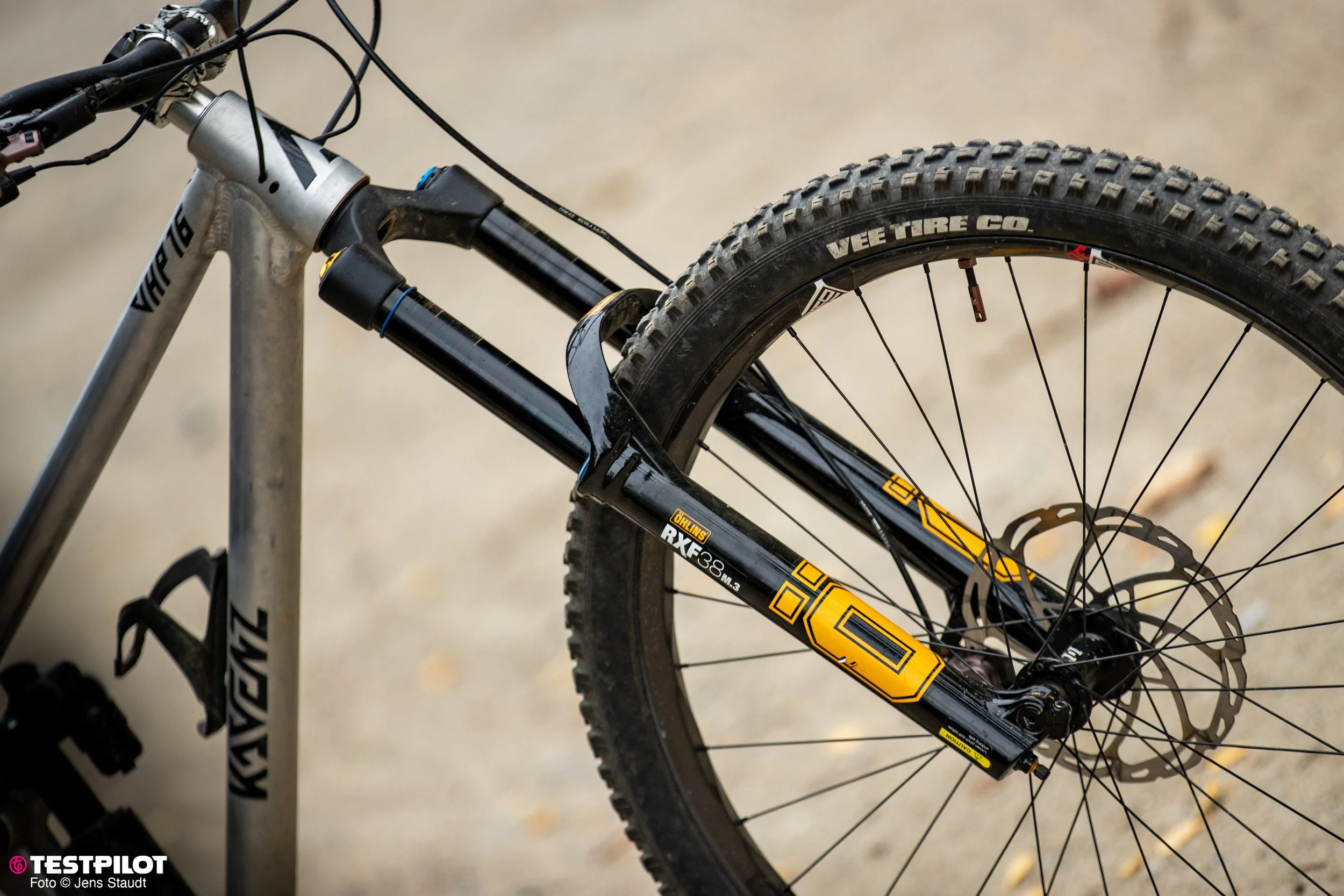
Öhlins earned its spot in the MTB world. It is known for high-quality suspension components. The Swedish specialist, deeply rooted in motorsports, has been transferring its expertise to the MTB product line for years. With the RXF38 m.3 Air, they present a fork built for the extremes: enduro, e-enduro, and freeride. With the update to the m.3, however, it's said to no longer be quite as race-oriented as its predecessor. The fork stands out from the crowd with its twin-tube design and a three-chamber air system.
What kind of adjustability does this offer? How do you set it up? And what updates are there from the m.2 version to the new m.3? We tested the fork for you and explained the technology behind and in it.
Technical info – Öhlins RXF38 m.3 Air
| Application | Trail / Enduro / eMTB |
| ⌀ | 38 mm |
| Travel | 160 / 170 / 180 mm |
| Settings | LSC, HSC, LSR |
| Suspension | Three-Chamber Air Spring |
| Damping | TTX18 |
| Wheel sizes | 29″ / 27.5″ |
| Max. Tire Width | 2.6″ |
| Axle dimension | 15 x 110 mm Boost |
| Brake rotor | PM 200 mm (max. 230 mm) |
| Offset | 44 mm |
| Axle-to-Crown | approx. 573–593 mm |
| Steerer tube | 1.5–1 1/8″ |
| Casting | Aluminum |
| Wipers | Öhlins by SKF |
| Fender | optional |
| Color | Gloss Black |
| Weight | 2,313 g |
| Warranty | 2 years |
| Price (RRP) | approx. €1,499 |
| Website | ohlins.com |
Tech bits Öhlins RXF38 m.3 Air
Öhlins RXF38 m.3 Air – Chassis
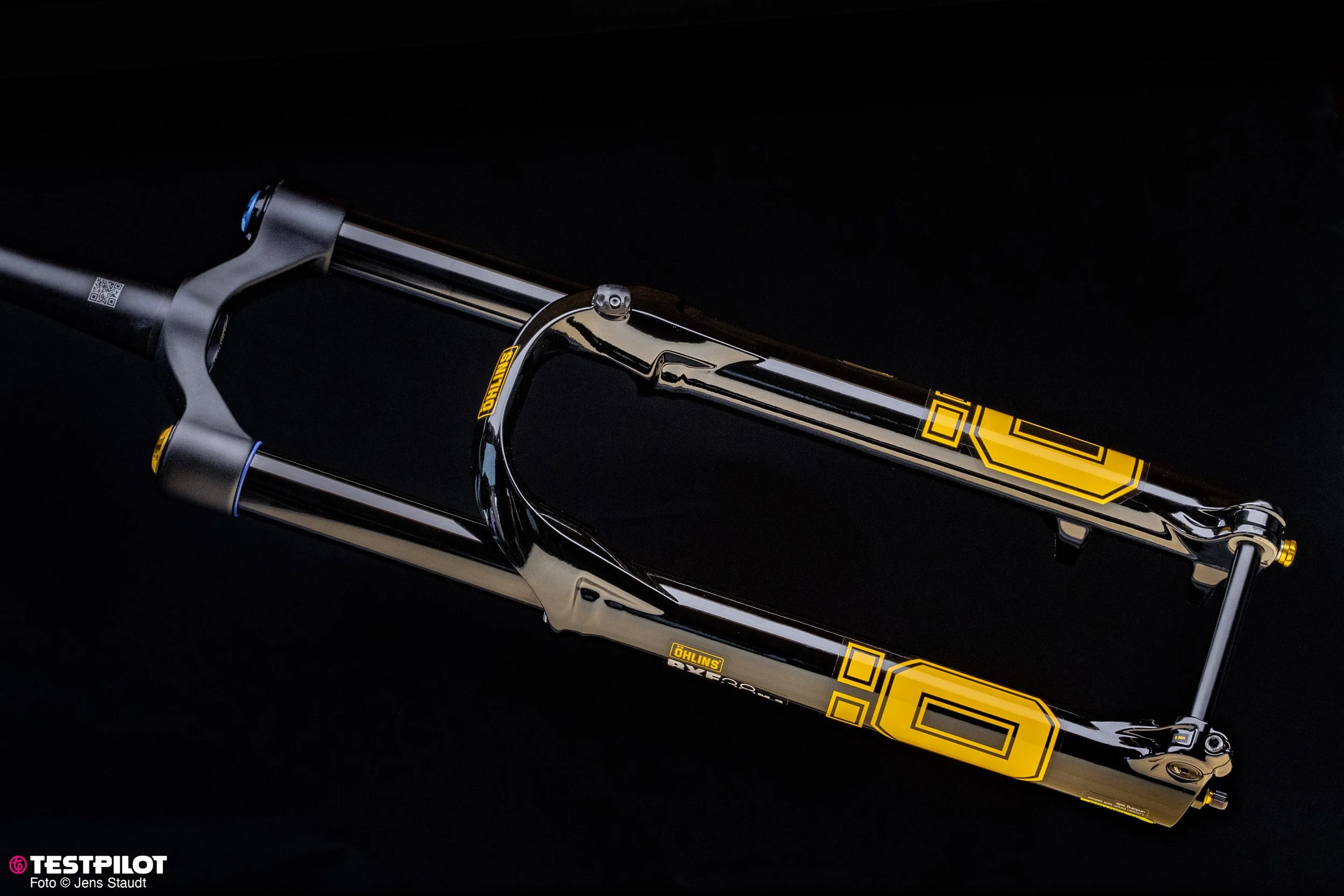
The foundation of the RXF38 m.3 is a chassis designed for serious stiffness while keeping weight in check. The massive 38mm stanchions are made from a special aluminum alloy and clamped into Öhlins' proven fork crown. The casting is made from lightweight magnesium. This makes it built for hard use in bike parks, on enduro trails, and on e-MTBs, establishing it as Öhlins' most burly single-crown fork.
New on the m.3 chassis is an optimized coating on the bushings and stanchions—additional finishing steps are intended to further reduce friction and make the surface even smoother.
The floating thru-axle comes in the modern 15 x 110 mm Boost standard and is inserted from the right side for a secure fit, tightened, and then secured with an additional screw to compensate for hub tolerances.
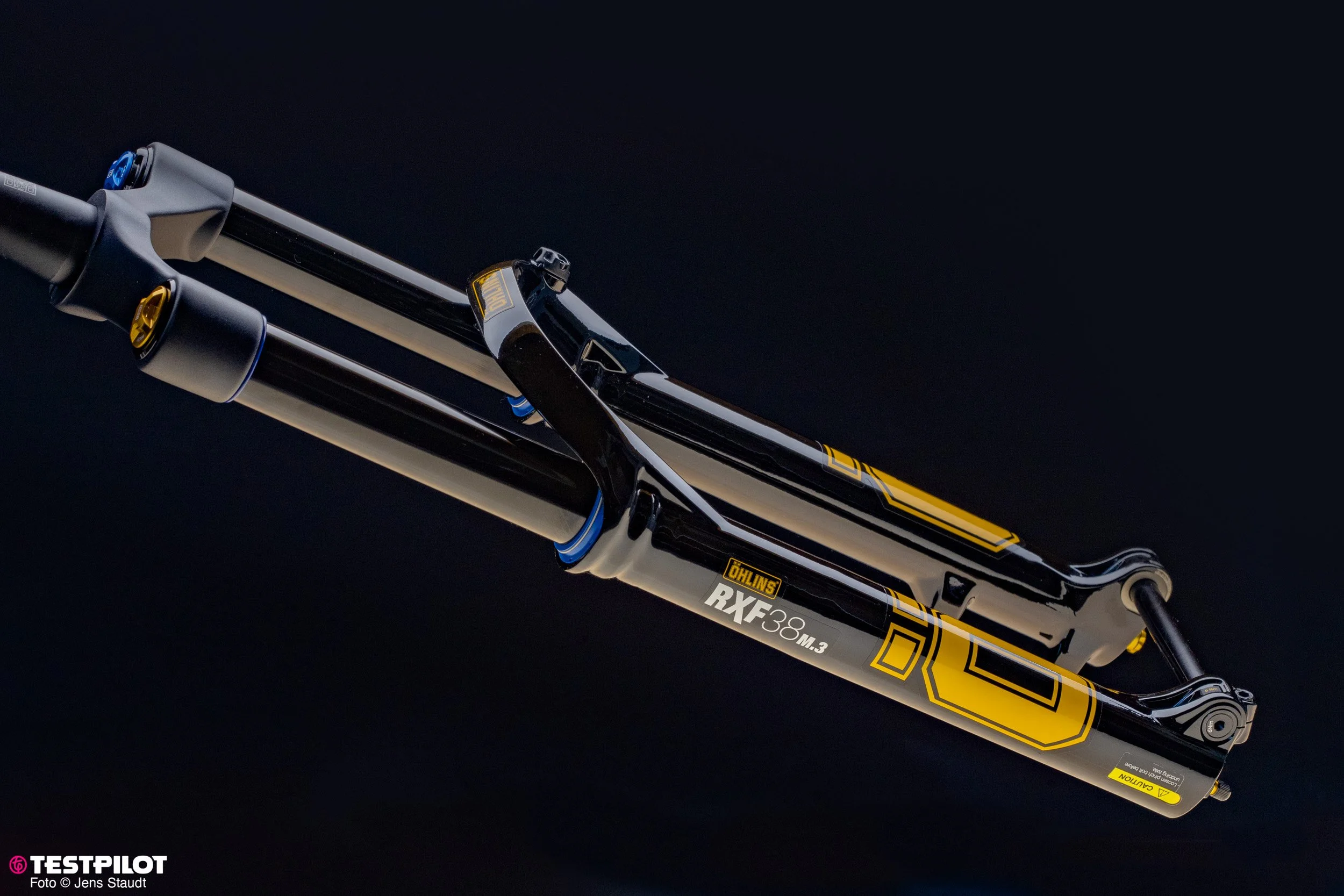
New on the m.3 is the optimized coating on the bushings and stanchions for reduced friction. The casting remains unchanged.
The brake rotor mount is designed for 200 mm rotors. This is too 2015 for you? You can use the regular adapters to bump up braking power. Rotor sizes up to a maximum of 230 mm are permitted.
An optional feature for those who like to run a fender: The RXF38 m.3 has threaded holes on the back of the arch. However, the selection here is limited to third-party solutions, as Öhlins itself does not offer a fender. Mudhugger, for example, offers a suitable adapter for their offerings.
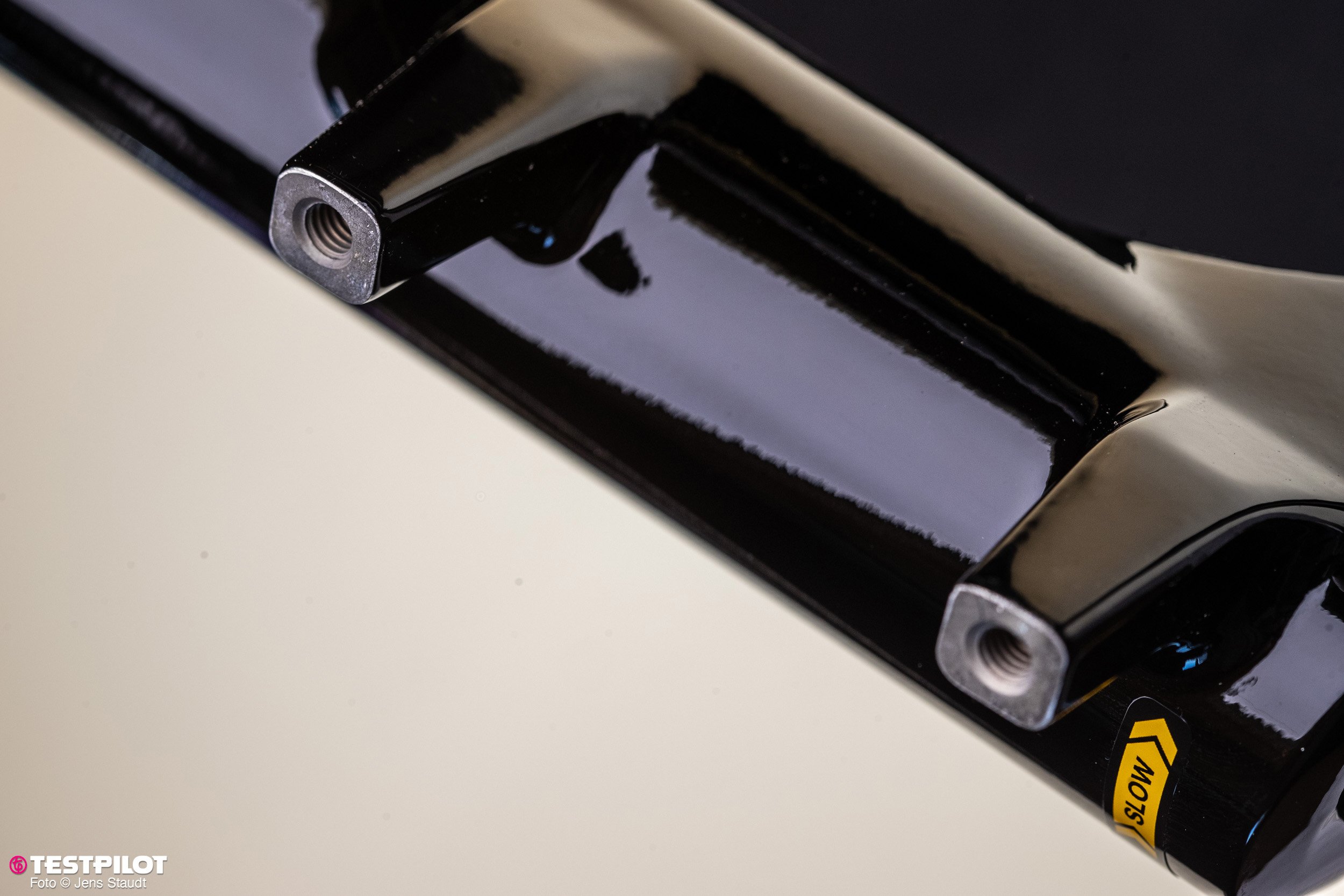
The mount is designed for directly getting your caliper ready for 200 mm rotors. Maximum allowance for disc size is 230 mm.
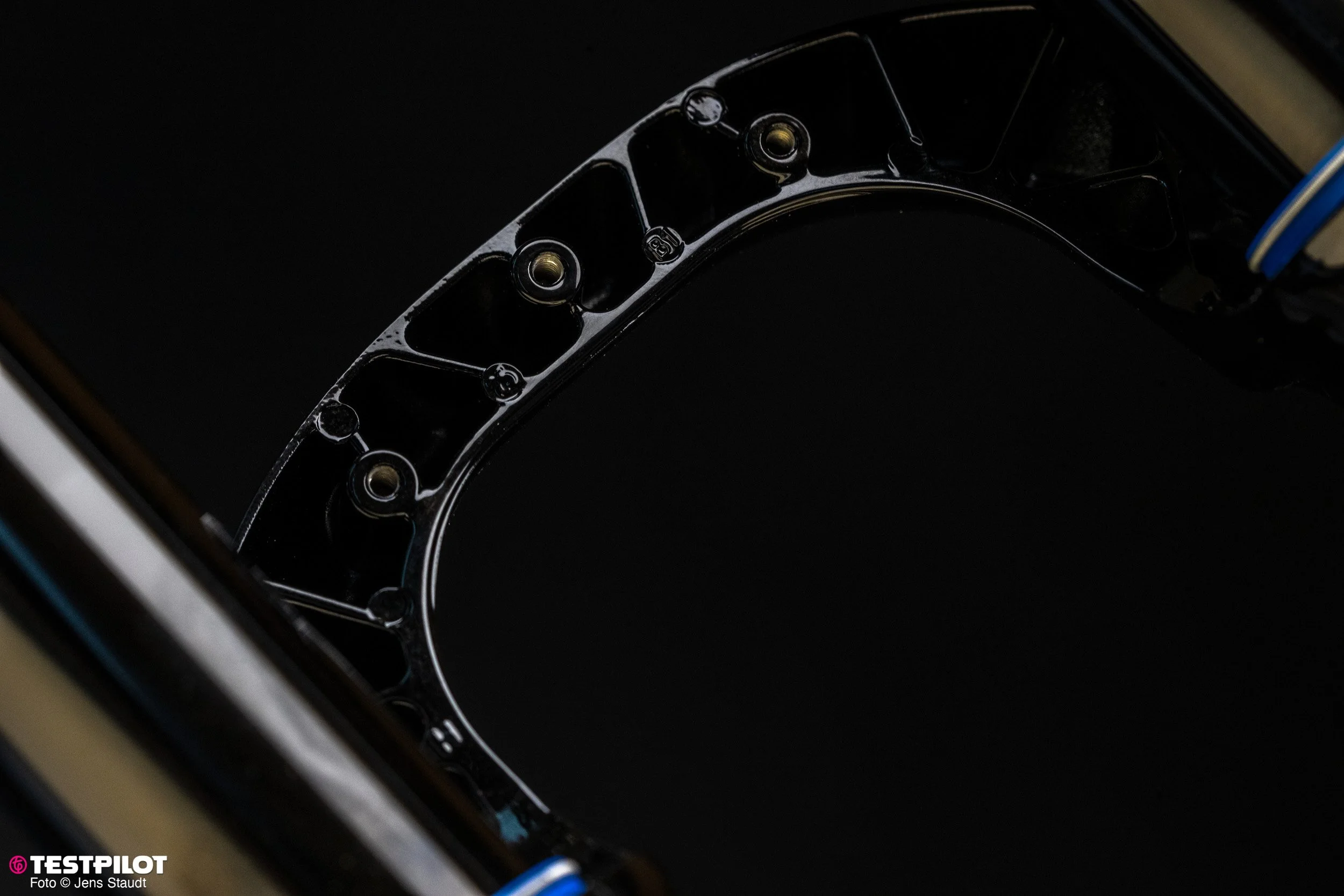
Third-party fenders can be retrofitted using three screws.

Öhlins RXF38 m.3 Air – Airspring
The Öhlins RXF38 m.3 is available in both flavors: air and coil. In our test, we are focusing exclusively on the air version. If you're undecided between the two camps, you can later convert your air version of the fork to coil using a conversion kit.
On our test fork, the air spring unit operates on the left side. The heart of this system is a three-chamber air spring design, which sets it apart from the predominantly common two-chamber designs. The entire air unit is a self-contained system, thus operating independently of chassis flex. The main air chamber consists of a positive and a negative chamber, with the ramp-up air chamber serving as the third chamber, through which the complete spring curve and end progression can be adjusted.
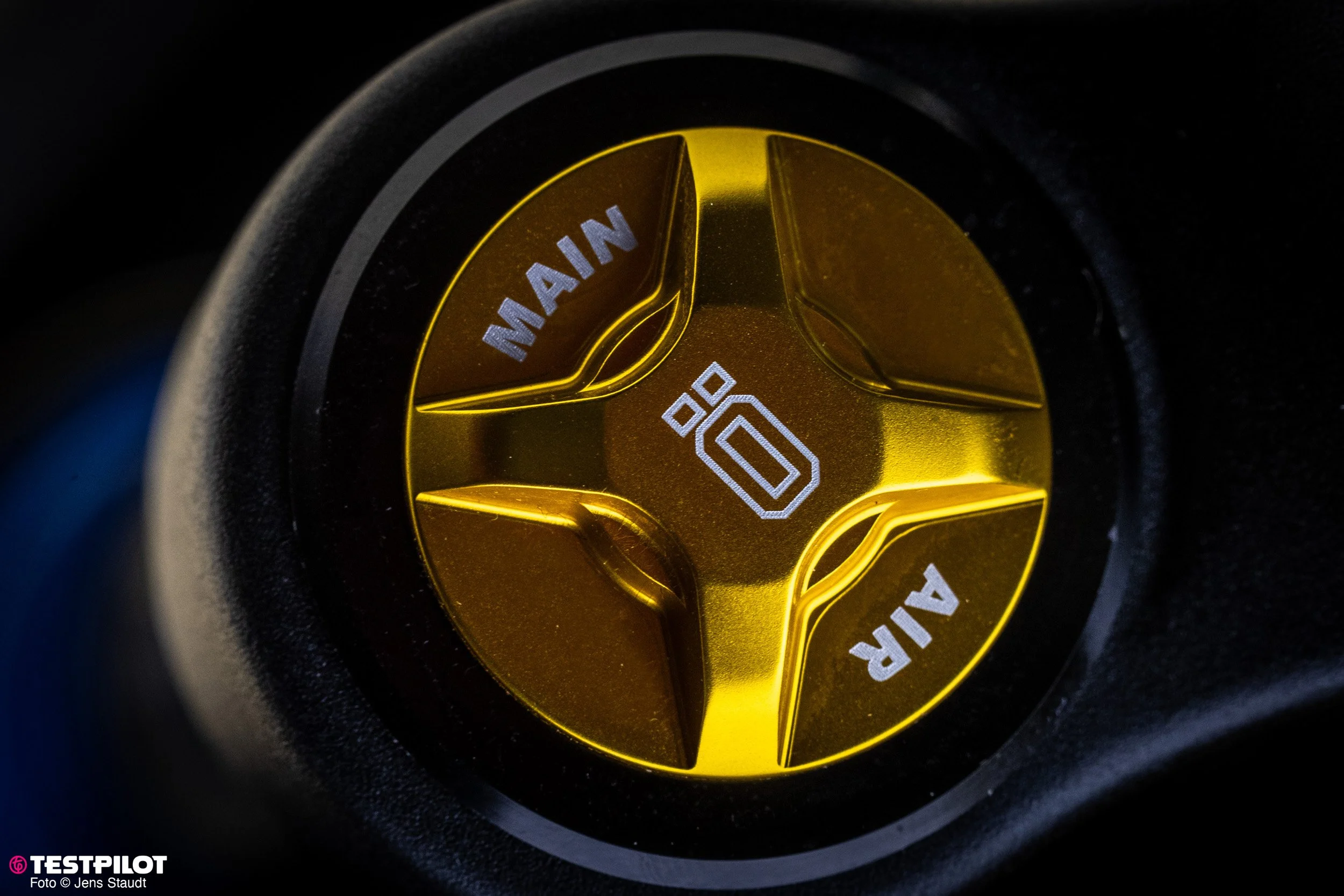
The RXF38 has one valve for the main chamber…
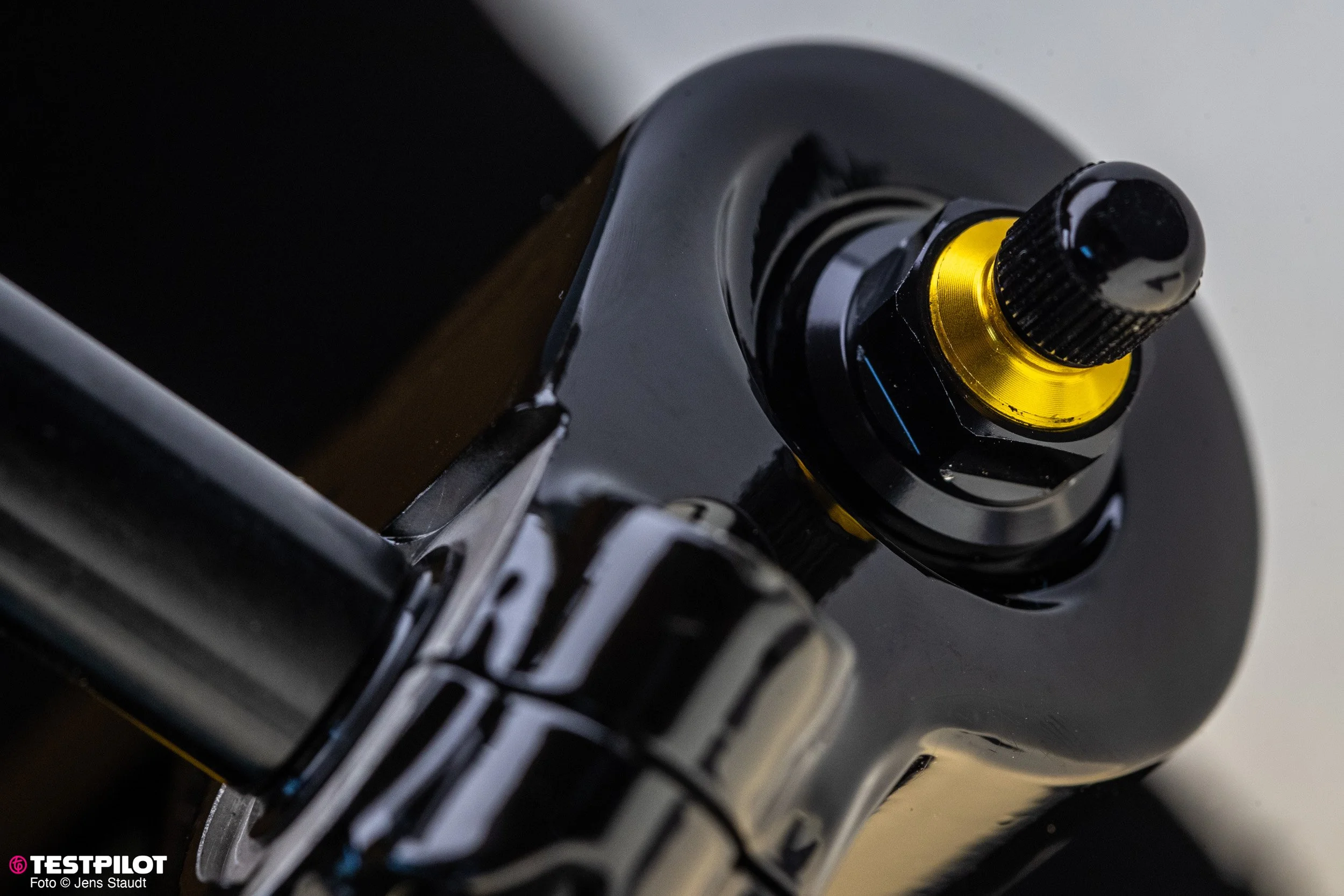
and one valve for the ramp-up chamber.
When you fill the main chamber via the valve on the top right side of the fork, an automatic equalization occurs through a bypass located between the positive and negative air chambers. According to the manufacturer, this ensures an ideally balanced pressure ratio.
The negative air chamber received an update from the m.2 to the m.3. The previous RXF38 was developed with a focus on enduro racing. It had a small spacer in the negative chamber—Öhlins took this out for the m.3 version. With the spacer, the former fork was very sensitive on the first few millimeters of travel but offered significantly more support afterward to suit an aggressive racing style.
Feedback from many riders was that this became too harsh on the hands during long descents—Öhlins responded accordingly. With the enlarged chamber, you now get a more sensitive fork with a more comfortable character.
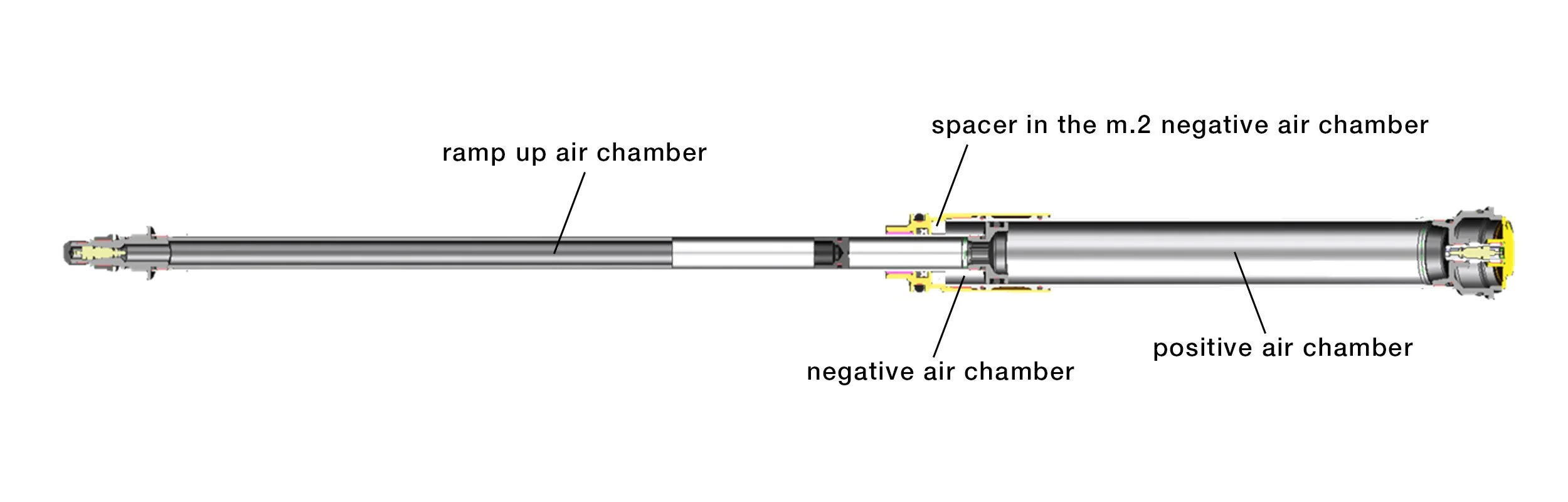
The cross-section shown here is from the m.2 version. The white area in the negative air chamber is the spacer described.
The third chamber, the ramp-up chamber, offers significantly more tuning range compared to other manufacturers who rely solely on plastic spacers to reduce the main chamber volume and increase progression. It has its own valve located on the left underside of the RXF38. The ramp-up chamber operates at a significantly higher pressure than the main chamber. As pressure in the main chamber increases, the ramp-up piston begins to move. The more air you put in here, the stronger the progression becomes throughout the travel.
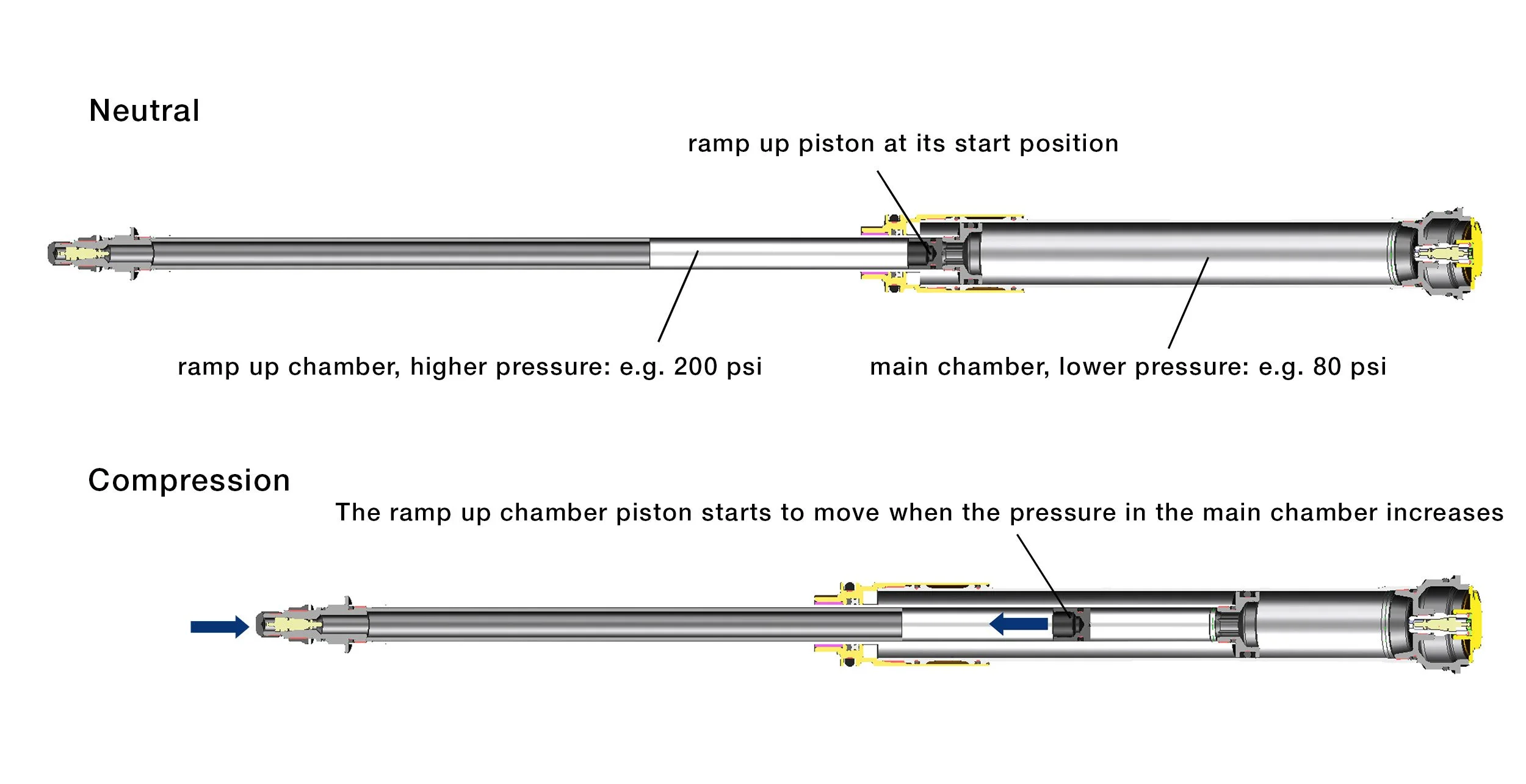
The cross-section shown here is from the m.2 version.
Just as with the negative air chamber, the volume of the ramp-up air chamber was optimized. However, it was reduced at the bottom end using three rubber spacers across a total area of 93 mm, rather than being enlarged. Through this overall revision of the fork, Öhlins adjusted the progression curve.
The following graphic comes from the Blister Review:

Blue = m.3-curve I Yellow = m.2-curve
For those who prefer the firmer race setting of the previous generation on the m.3, it is possible to have the tuning adjusted through the Öhlins service center (in Germany, MRC Trading).
Öhlins RXF38 m.3 Air – Damping
As with the air spring, Öhlins also did not change the fundamental design of the m.3's damping. Hidden on the left side of the fork is the TTX18 damper cartridge. TTX stands for Twin Tube Technology, a heritage from motorsports that Öhlins has consistently developed. In contrast to mono-tube designs, oil here flows through two concentrically arranged tubes. This is intended to ensure consistent damping performance—even under extreme heat buildup during long descents. The goal is to effectively prevent cavitation, the uncontrolled foaming of the oil.
For compression damping, there are two external adjusters on the top left side of the fork. Low-speed compression offers 16 clicks, while high-speed compression comes with 3 positions. There is also a fourth position (fully clockwise) that provides a lockout-like platform for climbing.
Rebound has 16 clicks to adjust the return speed accordingly.
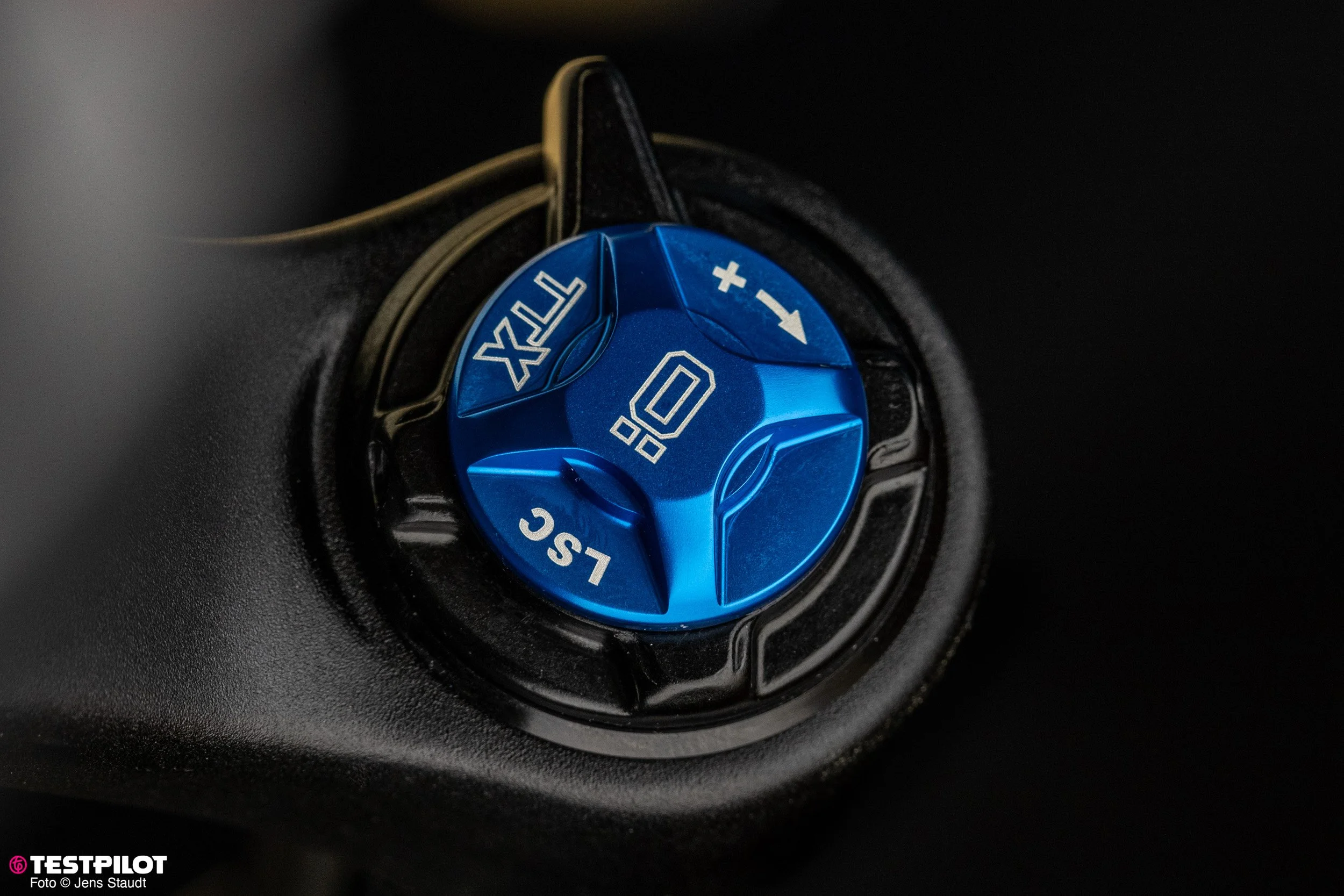
Blue dial = LSC. Black dial = HSC.
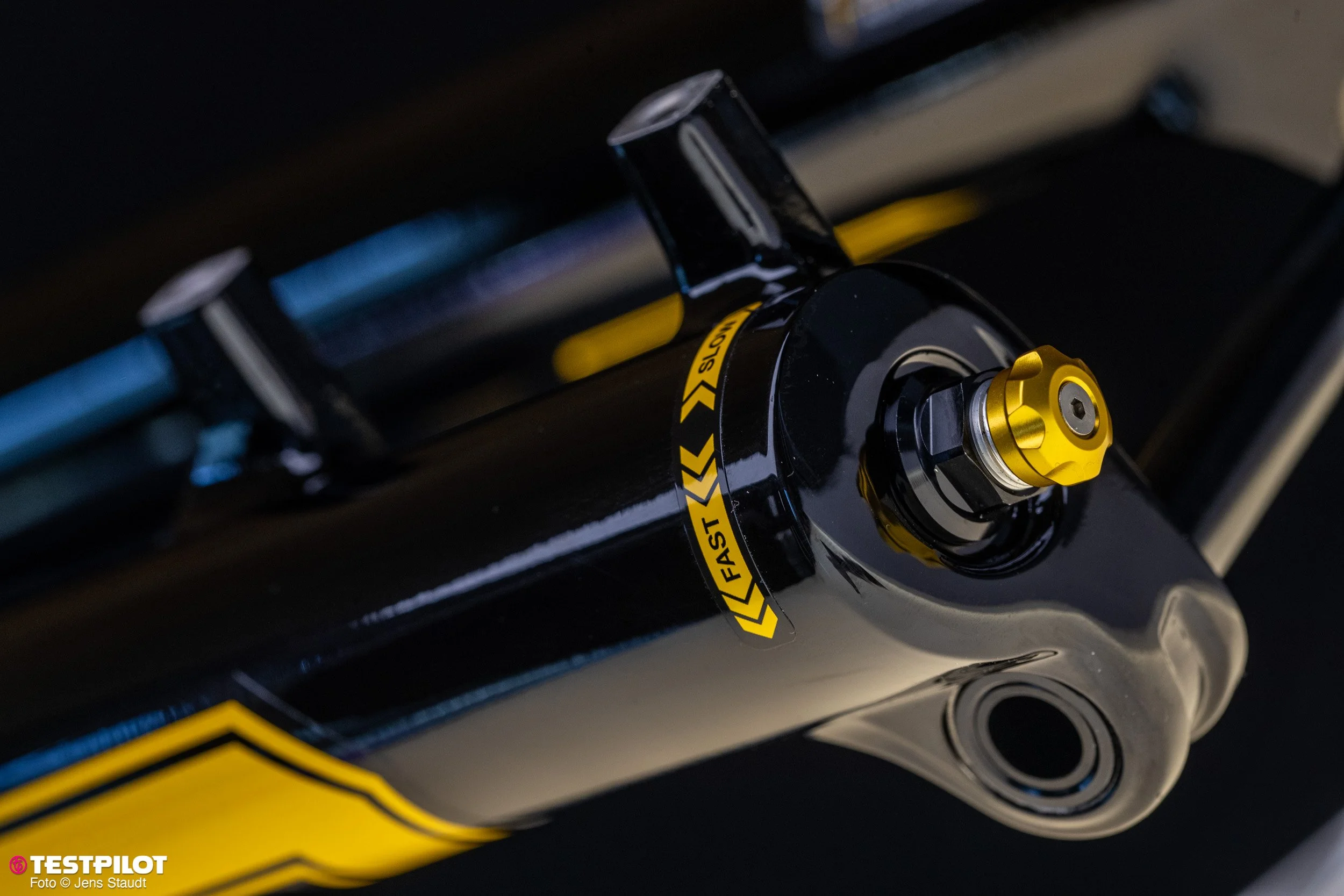
Golden rebound dial at the bottom of the left leg.
What is the actual uipdate on the m.3-cartridge?
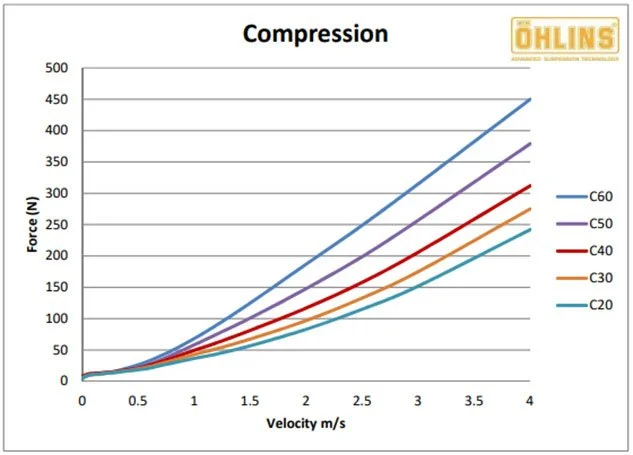
The RXF38 m.3 receives a new shim tune with lighter compression damping. Due to the ability to adjust the curve and end progression via the ramp-up chamber, less damping is required. The fork now uses the C30 variant instead of the C40 version. The information and the accompanying graphic come from the Blister Review:
Setup the Öhlins RXF38 m.3 Air
A setup chart can be found on the back of the right fork leg. According to the manual, the Swedes recommend a sag of 10–15%, but it's best to initially follow the chart on the sticker—this corresponds to approximately 20% sag.
| Rider weight | Main Chamber | Ramp Up Chamber |
|---|---|---|
| 50-60 kg (110-132 lbs) | 70-80 psi | 160-170 psi |
| 60-70 kg (132-154 lbs) | 80-90 psi | 170-180 psi |
| 70-80 kg (154-176 lbs) | 90-100 psi | 180-190 psi |
| 80-90 kg (176-198 lbs) | 100-110 psi | 190-200 psi |
| 90-100 kg (198-220 lbs) | 110-120 psi | 200-210 psi |
| 100-110 kg (220-243 lbs) | 120-130 psi | 210-220 psi |
| 110-120 kg (243-265 lbs) | 130-140 psi | 220-230 psi |
Yannick, at approximately 163 lbs, ended up with 94 psi in the main chamber and 195 psi in the ramp-up chamber. This puts him exactly at the manufacturer's recommendation for main air pressure, but he increased the ramp-up pressure slightly for a bit more bottom-out resistance.
Same final close to the manufacturer recommended settings from Jens with 220 lbs. 120 psi in the main chamber and 210 in the ramp-up.
Important for correct function: First, fill the ramp-up chamber using the valve on the right underside of the fork. Then, fill the main chamber using the valve on the top right. No pressure equalization through repeated compression is necessary, as the positive and negative chambers within the main unit automatically balance via the bypass.
If you feel that after filling the chambers the fork hasn't settled to the correct length, or if you simply want to check, you can verify the following values:
| Travel (mm) | Dust whiper to crown (mm) | Axle to crown (mm) |
|---|---|---|
| 160 | 162 | 573 |
| 170 | 172 | 583 |
| 180 | 182 | 593 |
You are not sure if the length isn't correct? You might need to assist manually. To accomplish this, pull up on the handlebars about 10 times while another person holds the front wheel on the ground until the fork has returned to its original length.
If you're getting too much sag, add some air to the main chamber. If you're getting too little sag, release air from there. For large pressure changes of more than 10 psi (in either the main or ramp-up chamber), you should first release all the air from the main chamber and then start again with the pressure adjustment in the ramp-up chamber.
High-speed compression is controlled by a special valve with an Öhlins patent, a design not used by many other manufacturers. Low-speed compression remains effective across its adjustment range between the three HSC positions. In practice, you can roughly say that turning out LSC by five clicks is comparable to turning in HSC by one click. For most riders, starting with HSC at one click (clockwise) is a good baseline. Due to the large steps of the high-speed compression adjuster, finding a good balance with the rear suspension is easy.
However, because of the twin-tube design and how the fork feels on the trail, matching an Öhlins fork to a non-Öhlins shock sometimes can become challenging. If having a consistent feel between front and rear is important to you, you should consider getting your entire suspension setup from Öhlins.
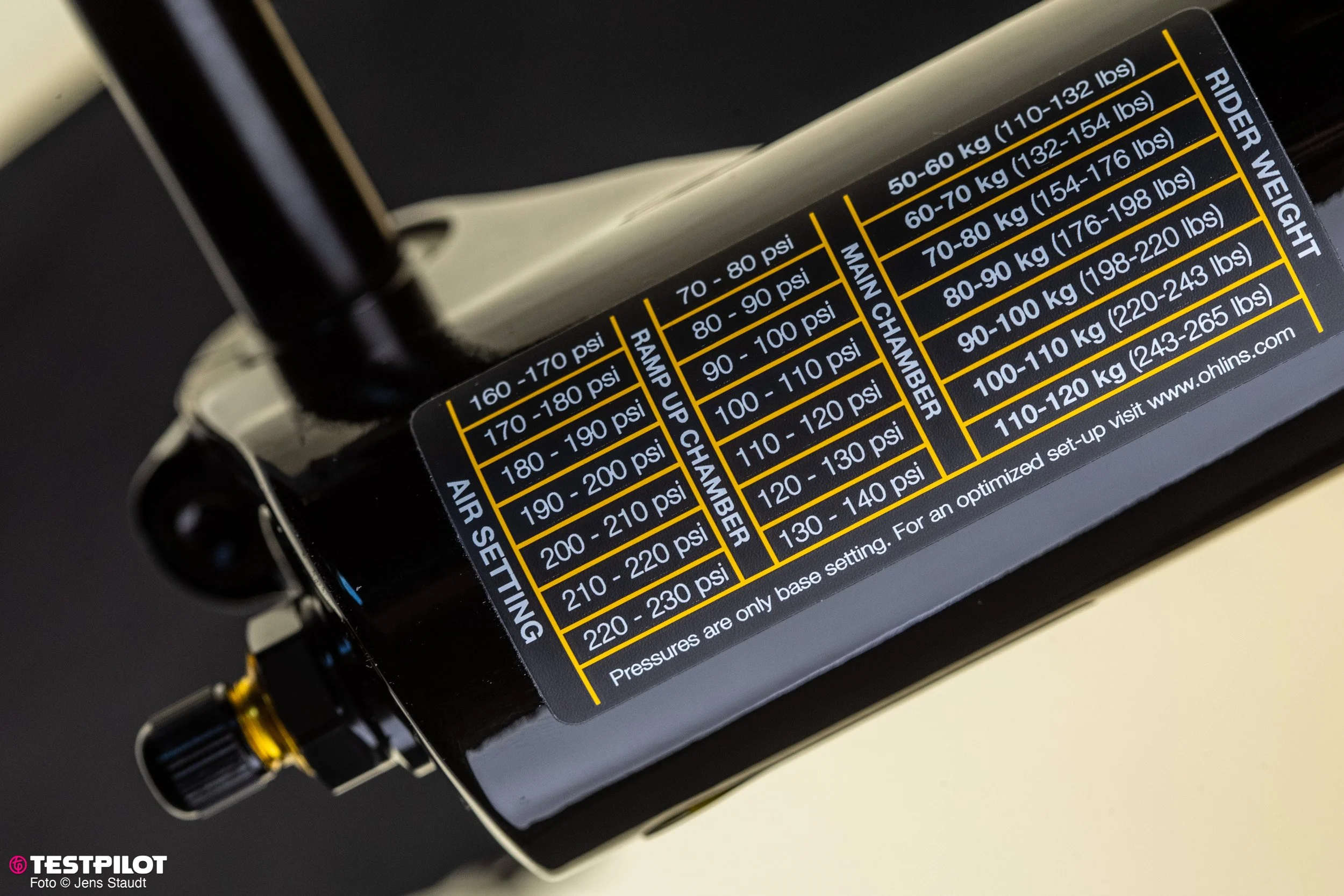
Recommended air pressure based on rider weight can be found on the back of the casting. The main chamber pressure suited us quite well. Yannick ended up increasing the ramp-up pressure slightly.
Ramp Up Chamber vs. Volume spacer
With the ramp-up chamber, Öhlins foregoes the classic plastic volume spacers. The ramp-up function was already present on the m.2 version and is therefore not a new technology. On the m.3, the Swedes reduced the volume of this chamber to increase progression slightly, but it can still be adjusted separately from the main air chamber.
The ability to adjust the ramp-up air pressure independently of the base pressure in the main chamber allows for very fine-tuning of bottom-out resistance—something not possible with conventional volume spacers. This is designed to absorb big hucks safely or deep drops without the fork becoming too harsh in the mid-stroke.
Another new feature is located at the end of the damper cartridge—the so-called "Spring Booster." This additional component uses the air trapped inside the casting below the cartridge to provide a small amount of extra bottom-out protection. The volume of air is fixed and cannot be adjusted or disabled.
Through the optimization of the ramp-up chamber and the addition of the Spring Booster, the progression curve has been tailored to the overall revision of the RXF38 m.3 Air.
Information on the function and characteristic curve can be found in the technical details under the section "Öhlins RXF38 m.3 Air – Air Spring."
Öhlins RXF38 m.3 Air thru axle and how to install the wheel
The floating 15 x 110 mm Boost thru-axle is designed, when used correctly, to prevent the fork from binding during wheel installation and to compensate for hub tolerances.
CORRECT INSTALLATION OF THE 15 x 110 MM BOOST THRU-AXLE
Insert the front wheel into the dropouts and slide the axle through the right dropout and the hub.
Tighten the thru-axle using a 5 mm hex key (6 Nm).
Compress the fork a few times.
Tighten the clamping screw on the drive side using a 5 mm hex key (6 Nm).
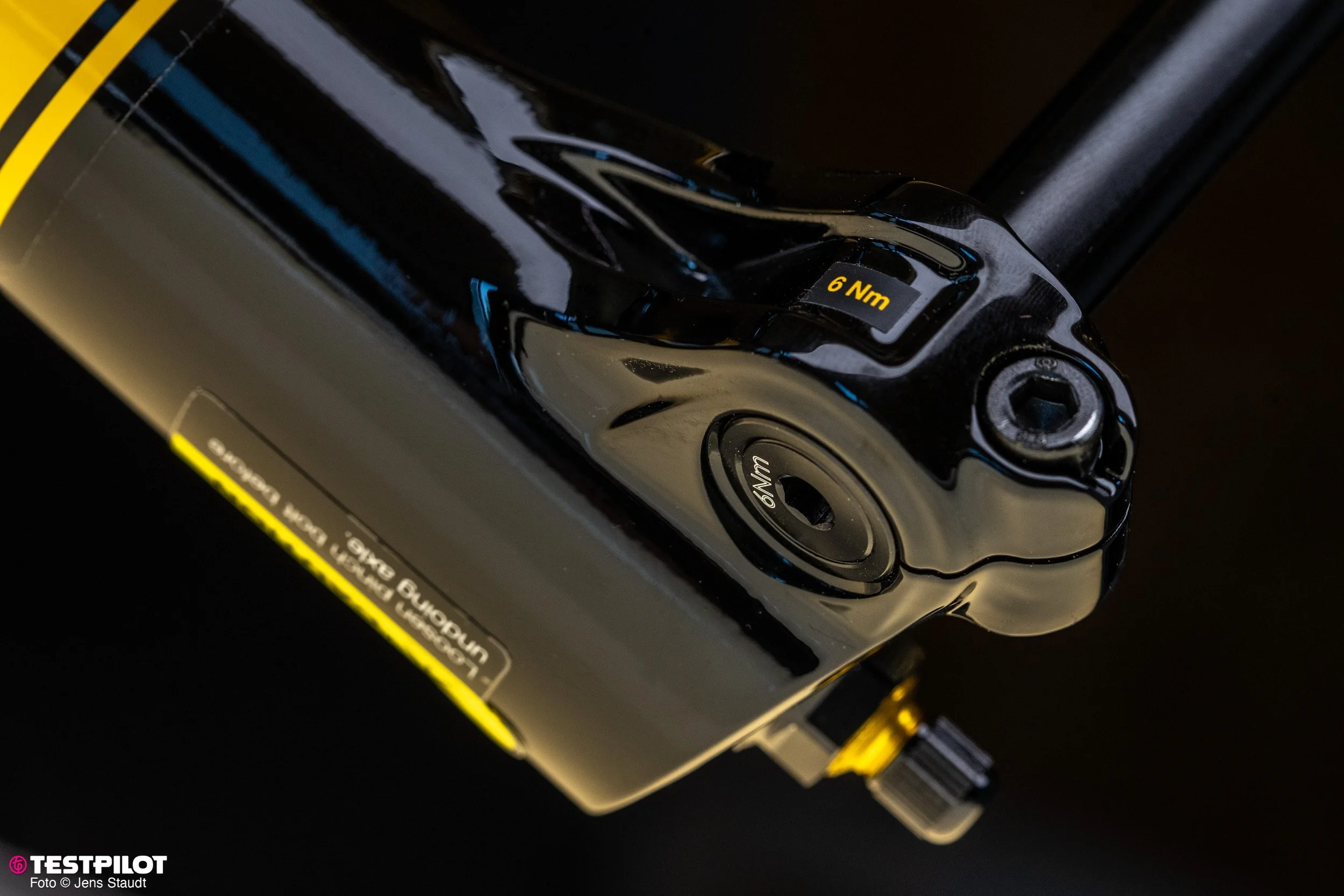
To ensure nothing gets damaged with monkey hands, the torque specifications are shown on the axle and the fork.
On the Trail
To hit the trail—or to really push it on the trail—it might take a bit longer to dial in compared to a simpler fork. Finding the right setup between the main and ramp-up chambers in combination with the compression damping requires time and effort for a few runs (ideally at a bike park). Small pressure changes, especially in the main chamber, have a significant impact on the trail.
However, if you take the necessary time, you are rewarded with a fork finely tuned to your needs. Slightly less pressure in the main chamber for more sensitive response and increased grip on the trail. Slightly more pressure in the main chamber to ride higher in the travel. Tuning the ramp-up chamber works really well, and you can feel how the support increases as the pressure rises, without sacrificing sensitivity in the initial part of the travel.
Overall, after plenty of back and forth, we landed almost exactly on Öhlins' recommendation for main chamber pressure, while we, depending on the trail, gradually increased the pressure in the ramp-up chamber. When you take a big hit—from something like a very blunt drop—and you reach the very end of the travel, you won't just feel it with the Öhlins; you'll hear it too. There's a noticeable, unpleasant metallic "clang." If you're even a millimeter away from that point, the hit is damped smoothly. The challenge lies in finding a good balance for that one percent of cases that matches your personal riding style.

Once you've got the spring curve dialed, you can focus on fine-tuning the compression and rebound. We described it in the technical section: Öhlins has relatively few clicks on the high-speed compression adjuster. The approach here should be to first turn the low-speed compression adjuster in; when you reach the end of its adjustment range, turn the high-speed compression adjuster in by one click and then back the low-speed compression adjuster out again. Still not enough damping? Then simply repeat the process from the beginning. One click more for high-speed and open up the low-speed...
Due to its architecture and unique philosophy, the air side already has the potential to provide a truly solid foundation for a great ride feel on the trail. For most users, the relatively coarse adjustment range compared to other suspension manufacturers will turn out to be a blessing. Absolute nerds, however, might find themselves missing that click in between.

Once you've acclimated to the RXF38, it rewards the time invested with serious grip. This was the most outstanding impression among all testers. The stiff chassis helps transmit steering inputs directly, while the fork keeps the ground under control.
What works well in normal riding and even in fast, rough sections on the ground comes at a cost when popping off lips and jumps. If you're the type of rider who likes to use the suspension to your advantage—actively compressing it before a lip or in a compression to generate "pop" using the rebound—you won't get the same response that other manufacturers offer. It's simply a matter of philosophy—Öhlins' strength and focus here lie in grip and ground connection.
Throughout testing, we caught ourselves preferring to suck up jumps rather than actively popping off them. Öhlins' specific shim tune and the enlarged negative air chamber reduce the ramp-up when pre-loading the fork. This is relevant for more active riders.
On the flip side, the RXF38 m.3 glues itself to the ground and impresses with its grip. On the roughest terrain, it remains composed and holds its line. At the same time, it's stiff enough to stay calm and maintain steering precision at high speeds and through hard hits.

Technical Report
We had a rough start with the RXF38 m.3. Out of nowhere, the fork would release more travel while riding, losing precision and sagging into itself. The cause was a small, sharp burr on the bypass used to equalize the positive and negative air chambers. This burr damaged a rubber seal, causing the issue described.
We sent the fork in, and MRC Trading resolved the problem—since then, the RXF38 has been functioning flawlessly. Following our test, a special tool has now been introduced specifically to prevent this issue in the future.
Here is the official statement from Öhlins:
Thank you for sharing the detailed feedback regarding the incident during your testing of the RXF38 m.3. We take all field feedback very seriously, especially when it relates to rider safety and product performance.After the fork was returned to MRC, our authorized service partner, it was disassembled, honed and checked during an initial inspection. During a subsequent and more detailed assessment, a sharp edge at the transfer port was identified. The sharp edge can damage the seal and lead to a reduction of support, as described.
As part of our continuous quality assurance process, we have:
- issued a service bulletin to all authorized service centers, defining an additional inspection and rework step at the transfer port if a new air spring loses pressure in the main chamber.
- implemented additional quality control measures within our production process to further reduce the likelihood of this issue occurring.
In your case, the air unit was reworked according to the latest specifications and subjected to a full functional and quality check prior to being returned, ensuring full compliance with our standards.
We appreciate your open and professional communication, as well as your technically well-founded approach to product testing. We value technically grounded feedback and constructive dialogue as an important part of our product development process. Should you wish to discuss the topic further or review the measures taken in more detail, we would be happy to arrange a technical exchange.
– Karl Szmechel, Sales & Marketing MTB
How does the perfect rider profile for the Öhlins RXF38 m.3 look like?
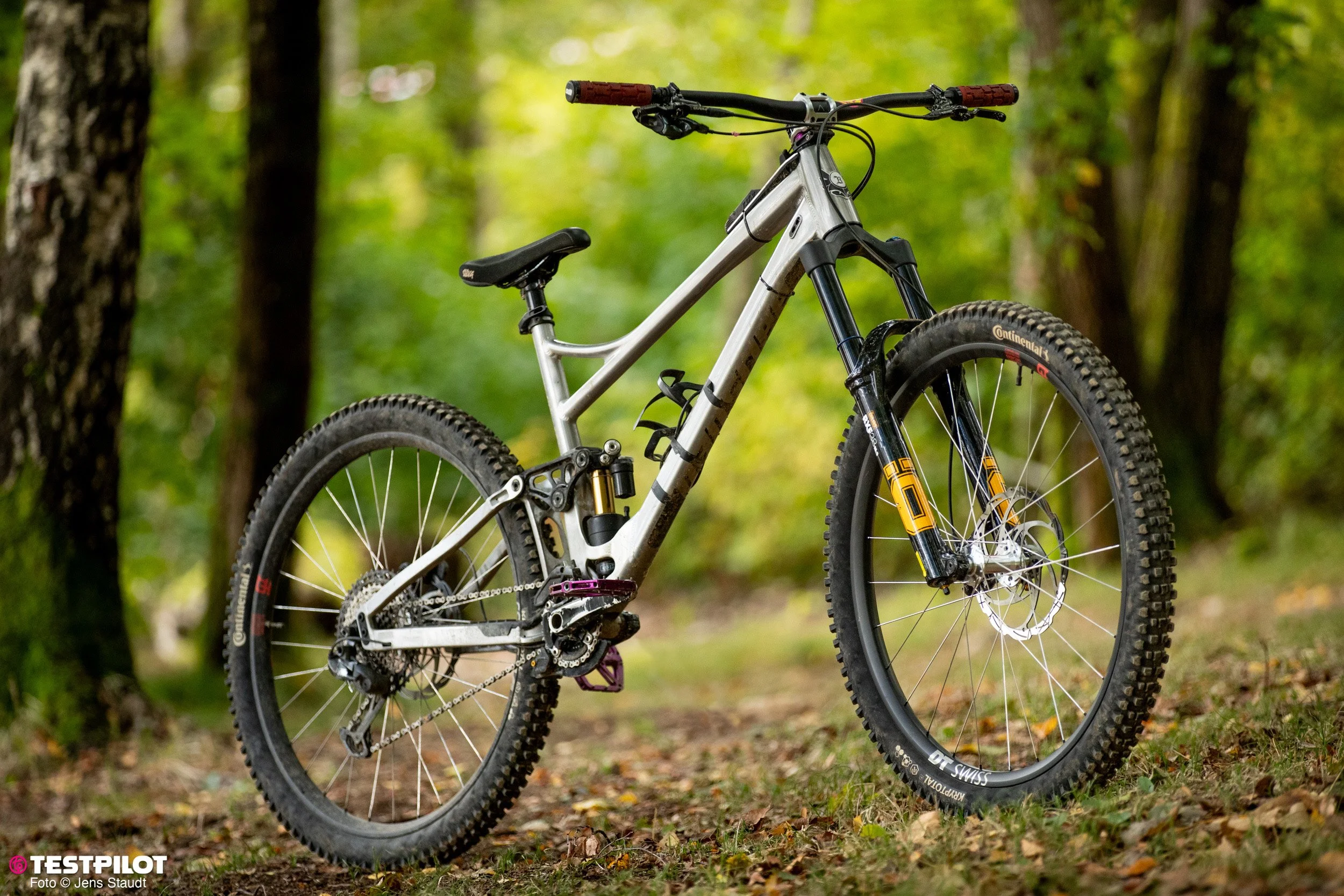
You need to keep in mind that during the setup process, you have to correctly fill two air chambers instead of just one. If you enjoy tinkering with your fork and are willing to invest the time to fine-tune the balance of sensitivity, grip, and support to perfectly match your needs, the Öhlins RXF38 m.3 will be a reliable partner.
With plenty of input when popping off lips, the Öhlins will get airborne, but it will likely make riders happier who prefer to stay on the ground. This is where the RXF38 m.3 feels most at home, delivering joy when charging through rock gardens. Thanks to the adjustment of the negative air chamber, the RXF38 m.3 is more comfortable than its predecessor and appeals to riders who struggled to hold on to the m.2 on long descents.
Conclusion
Öhlins shifts the user profile of the RXF38 m.3 slightly away from targeting pure racers, yet still stays true to its identity. They aim to offer all possibilities for adjusting the spring curve while simultaneously making the damping adjustment range more user-friendly with fewer clicks.
On the air side, this means a corresponding increase in effort for the user. On the damping side, you'll reach your goal more quickly. Those willing to invest the time can find a setup that primarily offers plenty of grip and a strong connection to the ground.
| What is worth mentioning? | Things to consider. |
|---|---|
|
|
What’s next?
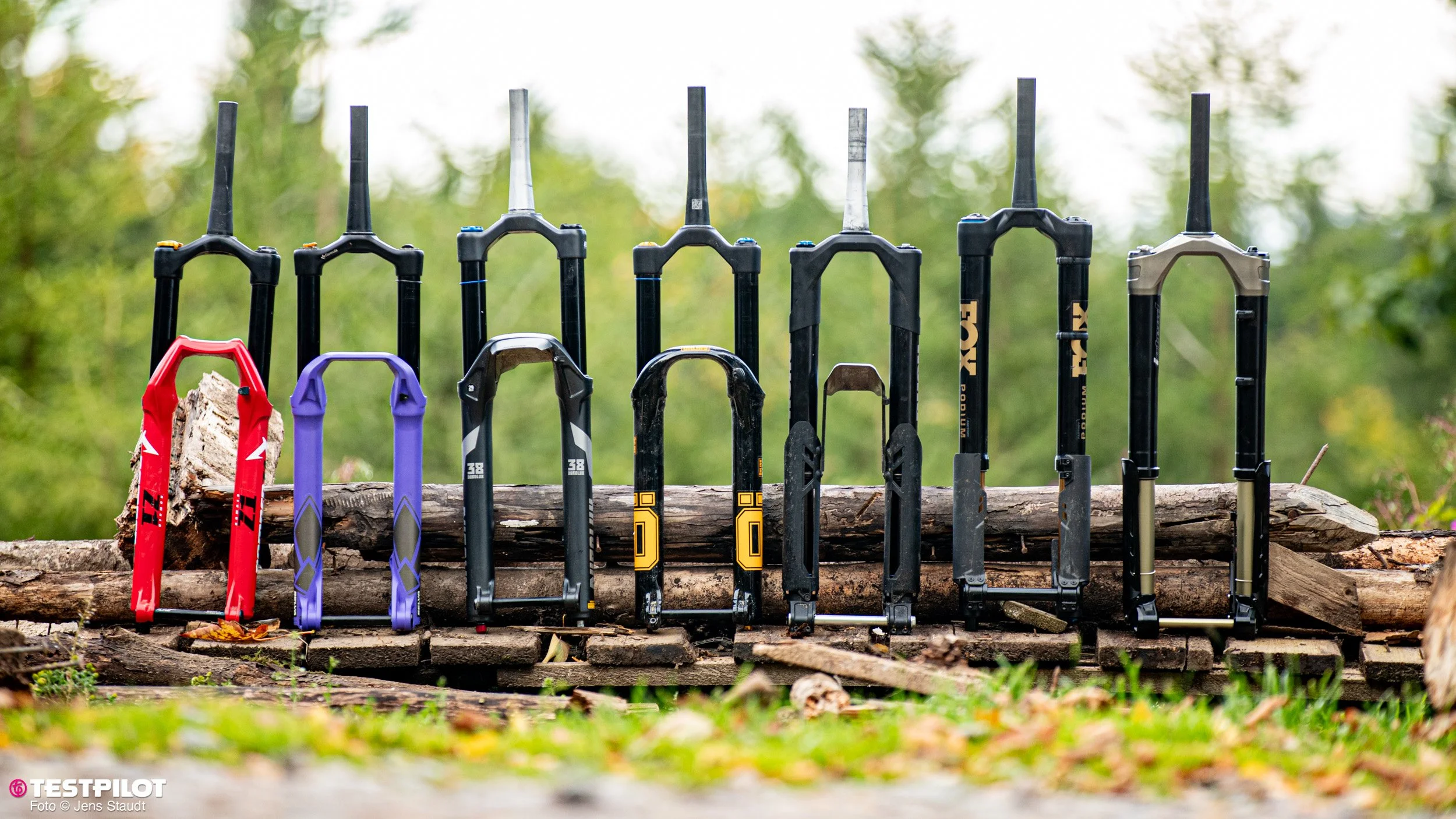
This was the final single review of this field test, but it will not mark the end. We will follow up with an in-depth discussion and compare all forks to each other. So make sure you subscribe to our newsletter to not miss the upcoming articles.
You'd rather get updates via Instagram? You can follow us there.
Here you can find all of our fork tests again: to the articles
You want more tests?


Author – Jens Staudt

Height: 191 cm
Weight: 103 kg
Riding style: With his racing background, the lines are planned, even if there is anything bigger in his way. If possible, sections will be jumped over. You should use the entire width of a trail. Others would say - uncompromising.
Motivation: A product should function carefree and for as long as possible. If you have to screw less, you can ride more. He likes to tinker and see how the bike can be optimized.