

Reading time: 15 minutes | contains paid promotion
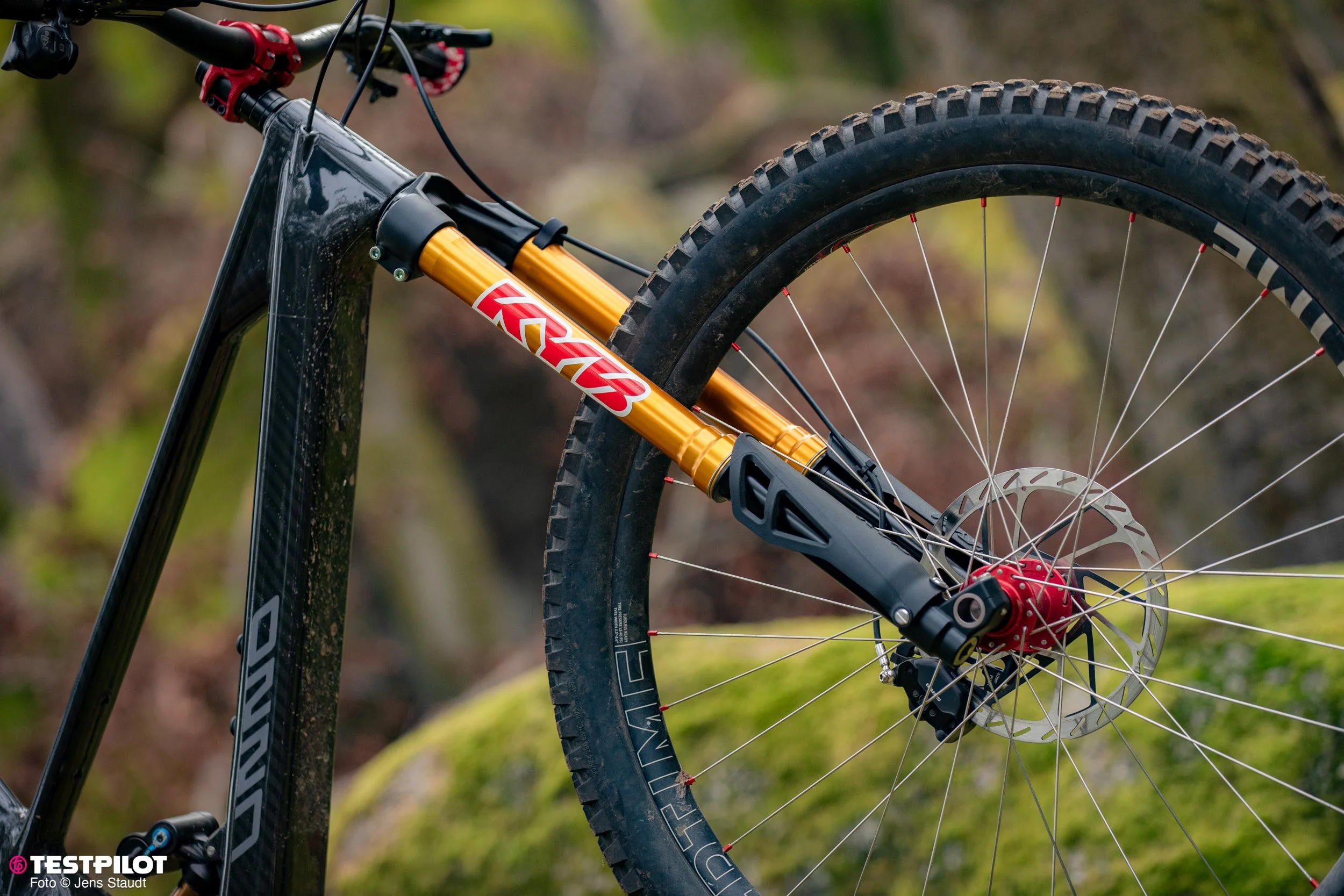
Anyone who couldn't care less about motorsports and has little to no interest in car shock absorbers might never have heard of KYB. However, if you look into the Japanese company even a little, you are virtually bowled over by a history spanning more than a century. They have served the widest variety of sectors: hydraulics for aircraft catapults, technical milestones, and countless racing successes, including two world championship titles in MX2 and MXGP this year alone.
It is not without reason that KYB is one of the global market leaders in hydraulics and suspension. Even though you might have never heard of it. On the other hand, mountain bikers with a motocross background will certainly get starry-eyed at the mention of those three letters right about now, because the giant is finally venturing into MTB. Upside-down, 160 millimeters of travel, and a look that cannot hide where it comes from: a shrunken motocross fork. We were able to exclusively test the suspension fork and are giving you all the details.
The KYB HistorY: From Aircraft Catapult to Motocross Legend
1919 – The Birth of a Giant
On November 19, 1919, inventor Shiro Kayaba founds the Kayaba Research Center in Japan, laying the foundation for today's global corporation. Background: Originally focused on revolutionary hydraulic technologies, the young company develops, among other things, hydraulic launch catapults for naval and aviation use in the 1920s. (Ed. note: A must-watch for tech nerds: https://www.youtube.com/shorts/eHQscu7Eb4I)
1952 – Entry into the Two-Wheel Sector
Kayaba begins developing motorcycle suspension forks, replacing primitive, purely mechanical designs with systems featuring integrated hydraulic damping, a direct technology transfer from shock absorber production.
1988 – The Upside-Down Fork Revolution
Introduction of KYB’s first mass-produced upside-down suspension fork for motorcycles. The goal: maximum torsional stiffness and ultra-supple small-bump sensitivity for hard racing and street use.
2005 – Official Brand Name
Kayaba Manufacturing Co. officially becomes the KYB Corporation internationally. By this point, the company has long been one of the world’s largest original equipment manufacturers (OEMs) for the automotive and motorcycle industries.
Automotive Heavyweight & Toyota OE Partnership
Statistically, one in every four cars worldwide rolls off the assembly line equipped with KYB shock absorbers from the factory.
Background: For decades, KYB has been one of the most important primary OE suppliers for Toyota (as well as Lexus), supplying factory equipment for high-volume models such as the Toyota Corolla, Camry, RAV4, Yaris, and the Toyota Hiace van. Even in the heavy-duty and off-road segments for vans, pickups, and SUVs (with lines like the MonoMax or reinforced Excel-G / Truck-Plus series), KYB enjoys a worldwide reputation for uncompromising durability under extreme loads.
Present Day – Dominance in Motocross (MXGP & MX2)
As the supplier for top factory teams (including Yamaha Star Racing and Triumph Racing), KYB dominates international off-road racing, sweeping the most prestigious world championship titles in motocross and supercross this very year.
Technical info – KYB 160 COIL Fork
Intended Use: E-MTB, Trail, Enduro
Stanchions (upper) ⌀: 41 mm, 7000er-Aluminium
Stanchions (lower) ⌀: 32 mm, 7000er-Aluminium
Travel: 160 mm
Settings: Low-Speed Compression (LSC), Low-Speed Rebound (LSR), Air Pressure
Spring: Coil spring (3 levels for 55–100 kg) + air preload / volume adjustment
Damping: Open-Cartridge with hydraulic bottom-out
Wheel Sizes: 27.5″ and 29″ (adjustable via two clamping positions on the crown)
Max. Tire Clearance: Up to 29″ × 2,6″
Axle Standard: 20 × 110 mm Boost
Brake Mount: Post Mount 160 mm
Offset: 43 mm
Axle-to-Crown: 579 mm
Steerer Tube: 1.5″ tapered
Seals: NOK
Fender: Not available
Color: Gold Eloxal
Weight: 2,850 g (according to the manufacturer)
Warranty: 2 years
Price (MSRP): 1,800 € / 2,000 USD*
Website: https://kyb-europe.com/mtb/
*Includes soft and standard spring, a spring replacement tool, and the Air Assist adapter.
Tech BITS KYB 160 Coil Fork
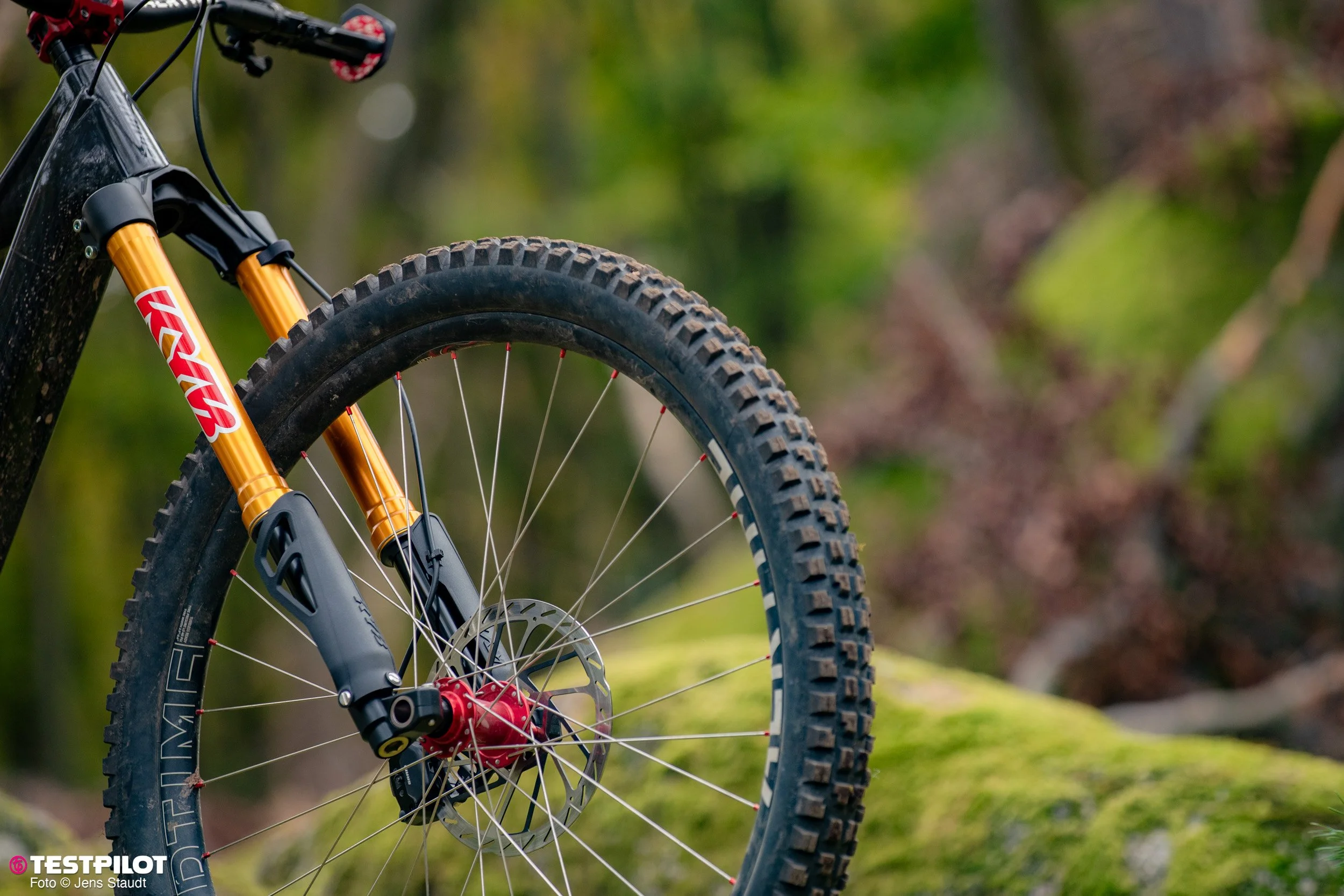
This debut in the MTB segment is only available with 160 mm of travel. Anyone looking at the KYB 160 sees less of a mountain bike fork and more of a scaled-down motocross fork. The principle isn't new. Back in the day Magura took the same approach with the original Gustav M: shrink down what already works. As a result, we aren't looking at finely sculpted adjuster dials with intricate laser-etched logos, but rather a pocket-sized motocross fork.
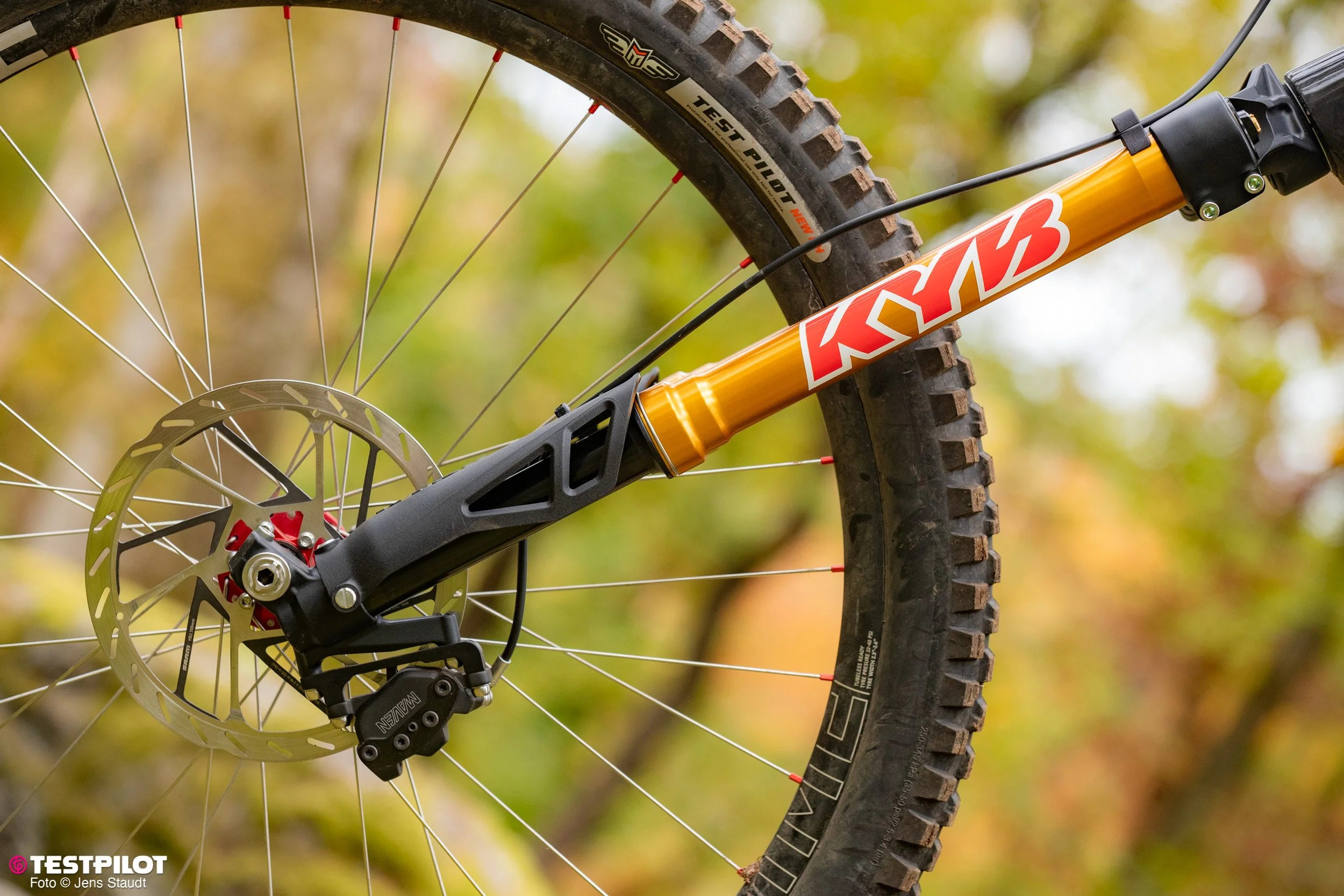
Damping on the KYB Coil Upside-Down
The OG Moto approach has to come with an open cartridge. Therefore: Inside the KYB, an open damping cartridge works alongside a proprietary valve design. The construction is modeled after the damping technology found in the company's own motorcycle and motocross products. This also includes a piston design inspired by KYB motorcycle suspension. Bottom-out control is handled hydraulically via bypass channels.
The valve system is designed to react depending on the shaft speed, enabling sensitive, controlled, and situation-dependent damping behavior. Externally, adjustments are available for low-speed compression and low-speed rebound. Staying true (and OG) to much motorcycle suspension, these adjustments are made using a flathead screwdriver. The compression adjuster features no indexed clicks, instead offering 2.5 stepless turns. The rebound provides 20 subtle clicks.
Want to dial in the fork even more to your preferences and riding style? The open oil bath allows KYB service partners, home mechanics, and racers to tune the damping characteristics by modifying the shim stack and oil volume. KYB specifies 5W oil for this.
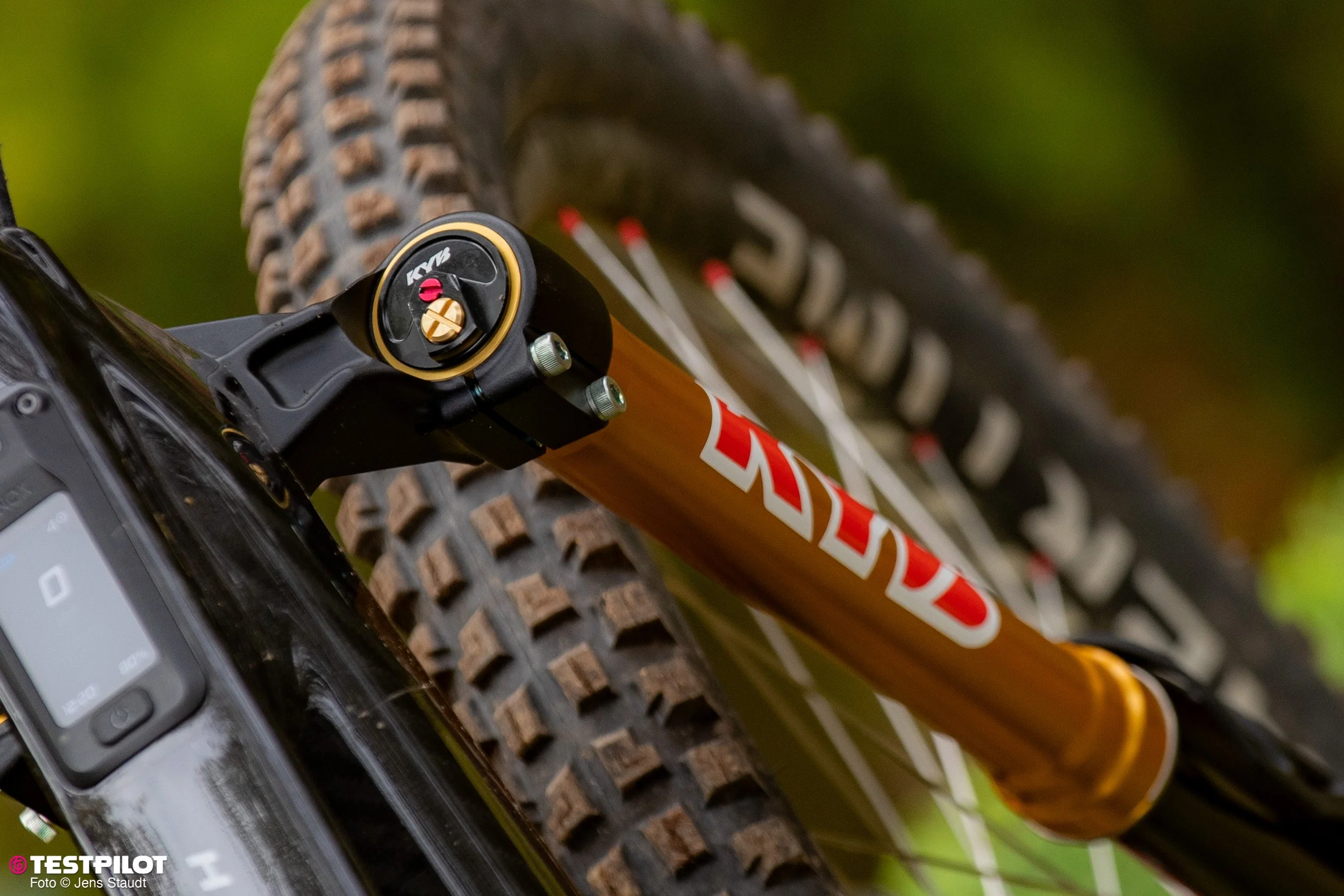
The tiny red dial on the top right of the fork changes your Low-Speed-Rebound.
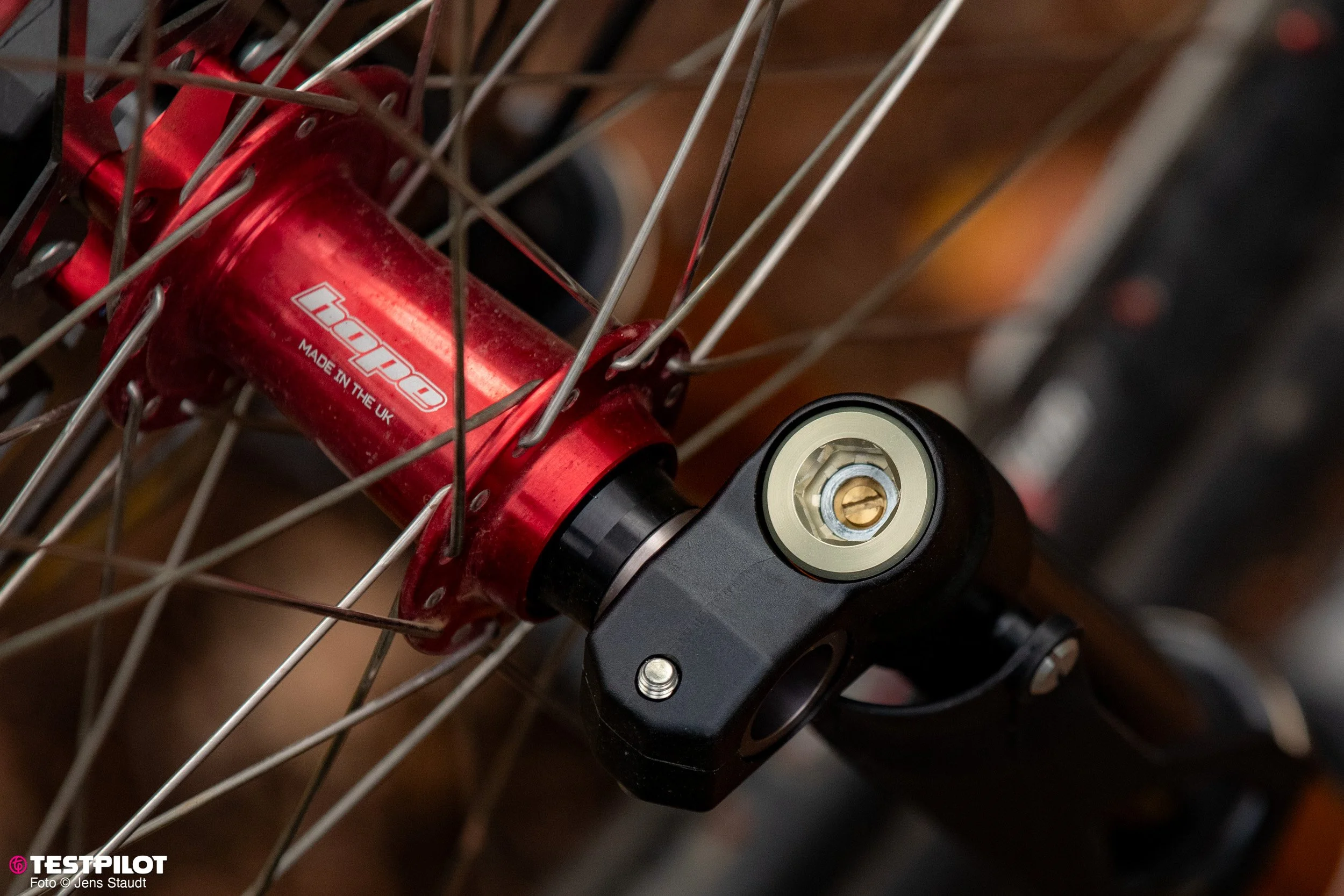
The Low-Speed-Compression is embedded on the bottom.
Coil Spring with Air Assist
On the spring side, there is also air, though only as a supplement. True to its moto roots, actual suspension duties are handled by a classic coil spring, setting the KYB 160 apart from most other enduro forks. This is intended to deliver consistent performance across varying terrain and riding situations.
Three spring rates are available, covering a rider weight range of 55 to 100 kg:
Soft = 55–60 kg
Standard = 60–80 kg
Hard = 80–100 kg
However, spring selection isn't dictated solely by rider weight but also by riding style. The soft spring comes pre-installed from the factory, while the standard spring is included in the box. Should you need the hard spring, it has to be purchased separately for €50.
Another interesting feature is the integrated Air Assist. If ride height or mid-stroke support is lacking, you can add air pressure (which doesn't have to be identical on both sides) via a preload air valve on the top of both the left and right fork legs. This shifts the entire spring curve upward, making the fork feel slightly firmer and providing increased bottom-out resistance. To access the air valves, you have to unscrew the gold caps on top. These valves are also used to bleed trapped air pressure. More background on this you can find in the "Setup" section.
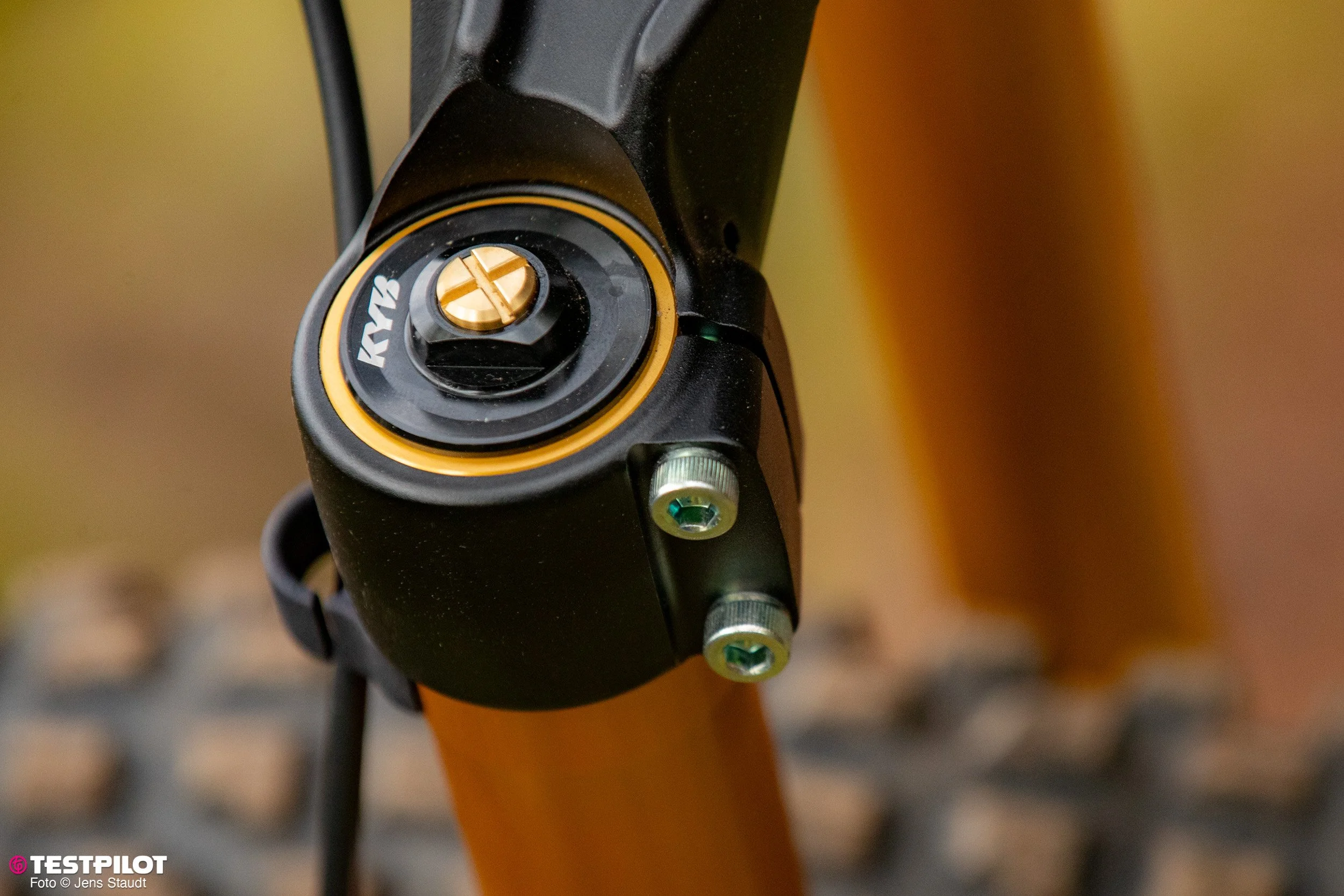
Beneath this gold cap sits the air valve for the air assist. You can choose to pressurize the spring preload feature or leave it empty, depending on how much support you want.
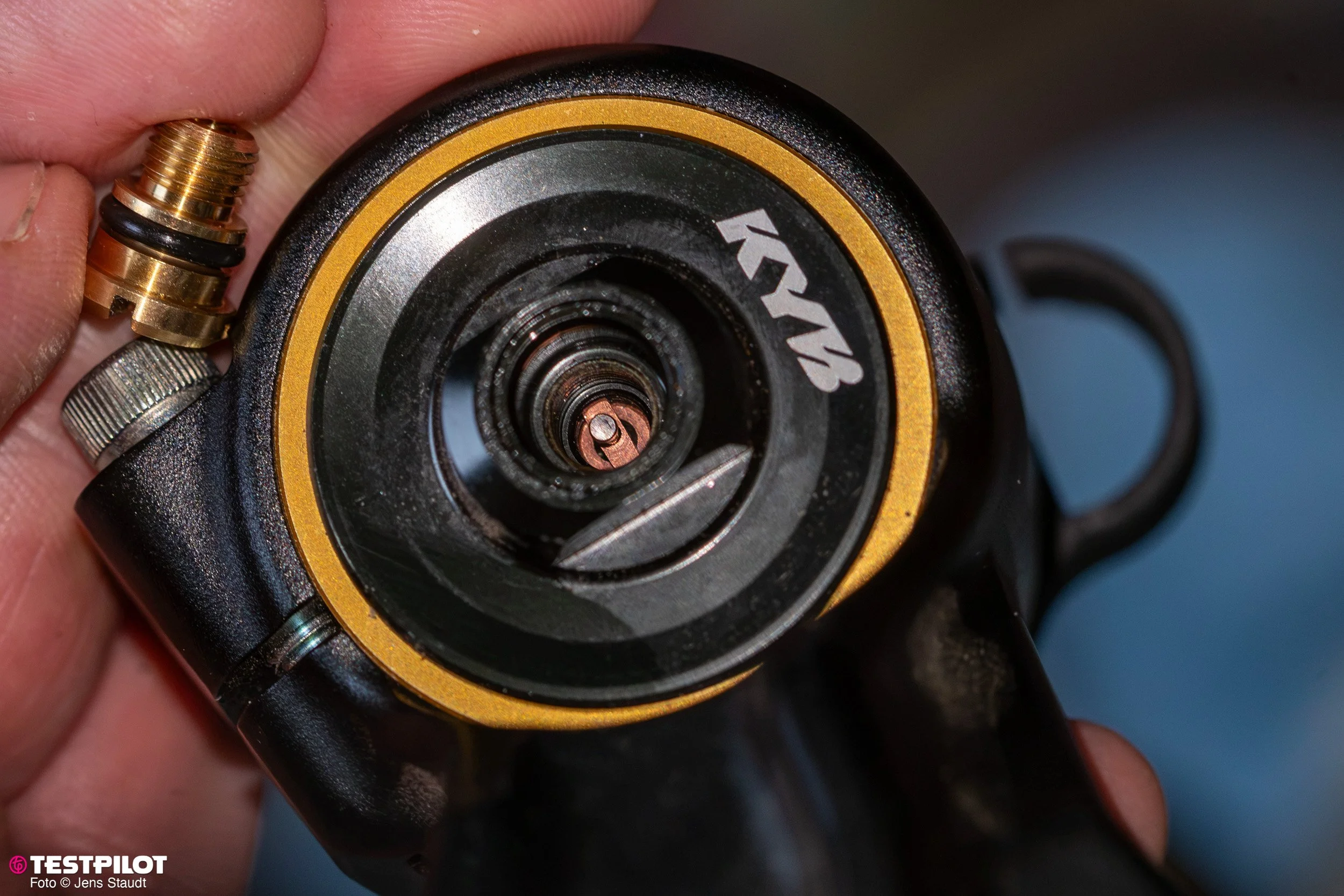
To fill the fork with air, an included adapter connects to a standard shock pump. To bleed built-up air pressure, you simply depress the valve core.
Chassis
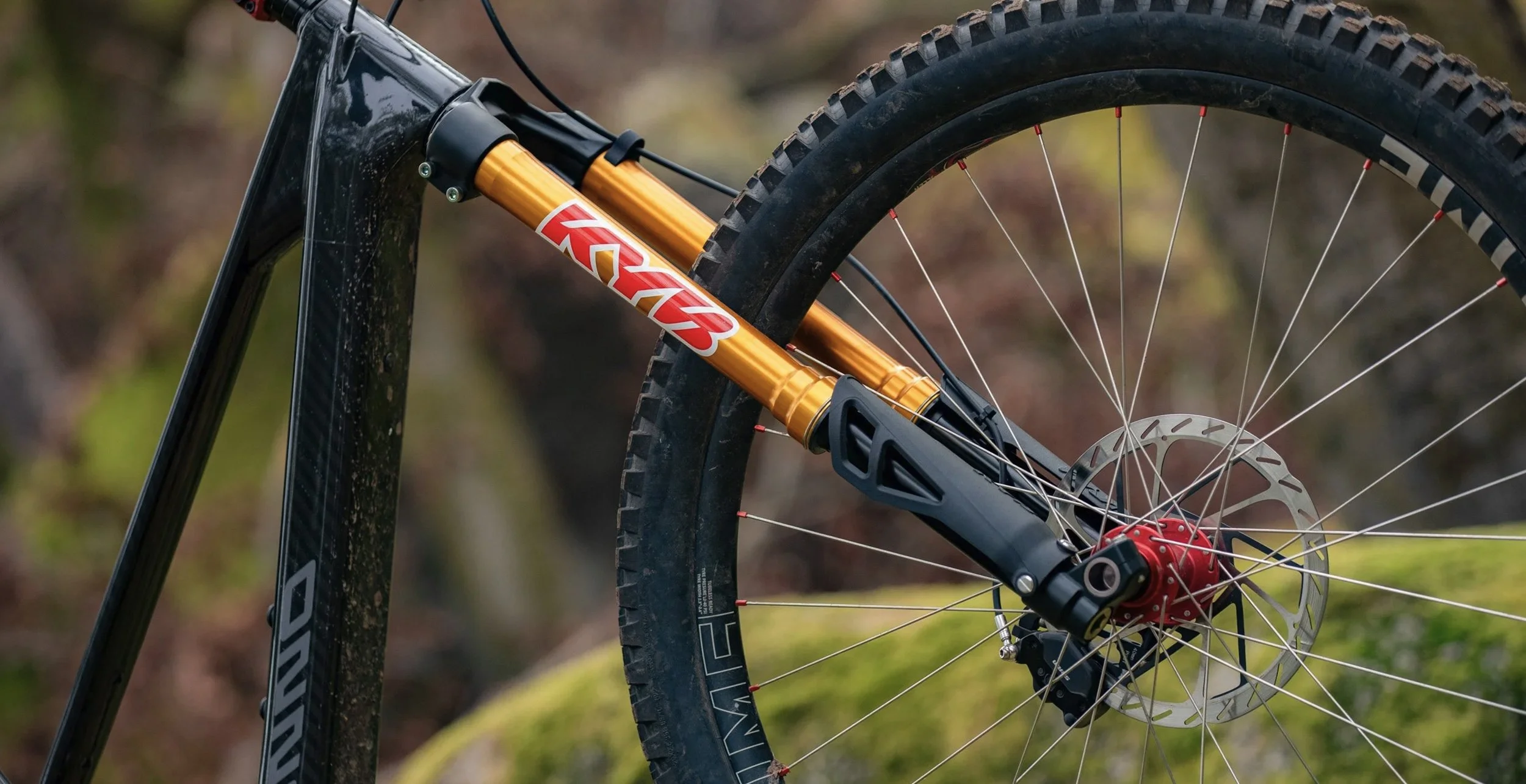
KYB also carries over the upside-down architecture from its motorcycle division. Visually, the KYB looks almost slender compared to offerings from FOX, Push, Intend, Cane Creek, and MRP. 41 mm upper tubes mate with 32 mm lower tubes, both constructed from 7000-series aluminum.
OG motocross-style, the upper tubes are clamped into the crown by two bolts per side. Yet the bolted crown isn't just for moto aesthetics; it serves a functional purpose as well. Machined into the upper tube is a groove where the pinch bolt sits, two grooves, to be exact. If smaller diameter wheels are your cup of tea, you can slide the upper tubes to adjust the ride height and run a 27.5-inch front wheel with the very same fork. More on that in the "Setup" section.
Additionally, the bolted pinch-clamp design allows for easy servicing or replacement of individual fork legs. For maintenance, you don't have to loosen the steerer tube and stem; you can simply slide the fork leg straight out of the crown. In the event of a crash, a damaged leg can be swapped out in no time. And here's an exciting perk for racers: depending on the track, you could keep multiple fork legs with different damping tunes on hand in the pits and swap them out without ever having to crack the fork open. Sounds over the top? Maybe not for everyone. We are curious if KYB onboards some racers next year. Then we might get answers.
As moto as it gets. The smaller diameter of the 41-mm-uppers and 32-mm-lowers are countering concerns for stiffness with wall thickness.
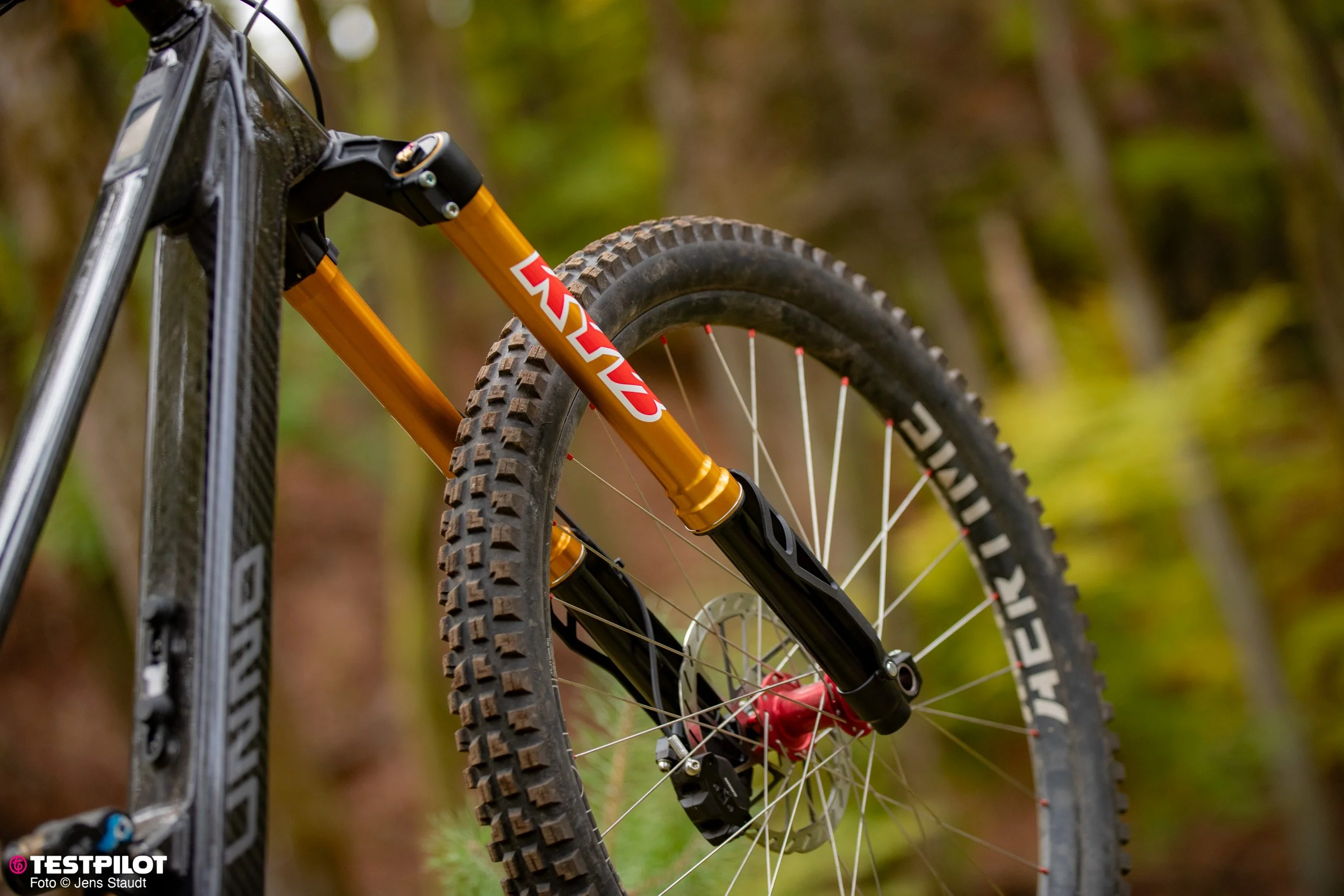
Two sides, two bolts each. You can use two dedicated clamping positions to use different wheel sizes.
The upside-down MTB segment is still undecided: 15 mm or 20 mm axle? Aluminum or steel? When it comes to diameter, KYB has no doubts. Bigger is better, and therefore a 20 mm Boost-spaced axle is the way to go. Currently, it comes in aluminum. If that isn't enough for you, a steel axle will soon be available as an aftermarket upgrade. The aluminum axle weighs 147 grams, while the steel version comes in at 157 grams.
The native 160 mm post-mount brake tab comes up a bit small, and at 2,850 grams, the fork isn't exactly lightweight. However, that puts it squarely in the same weight class as most other USD suspension forks.
There is currently no dedicated mudguard available from KYB, though you can make do with a third-party fender that mounts inside the steerer tube.
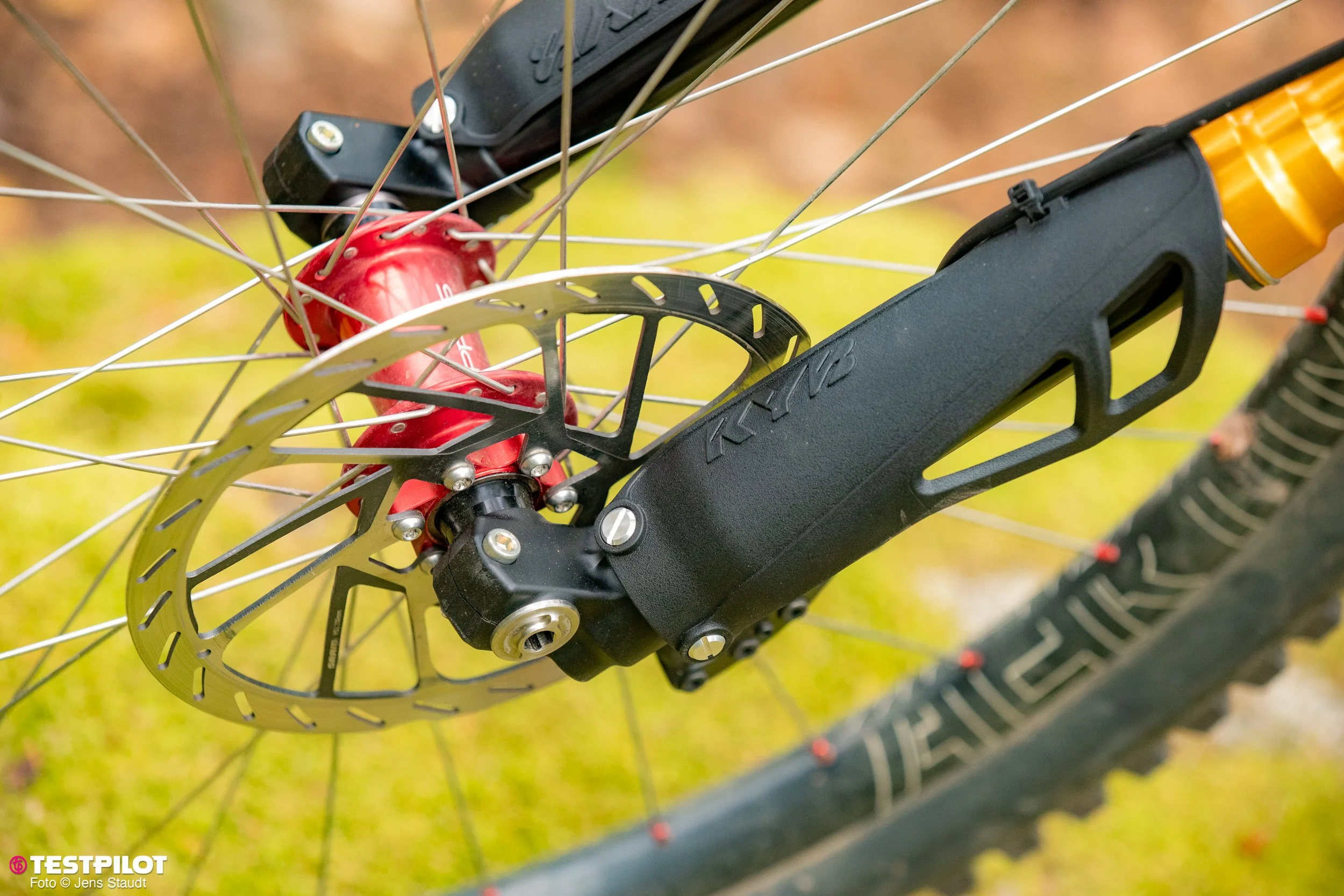
Plastic protection which includes a tab to guide the brake line.
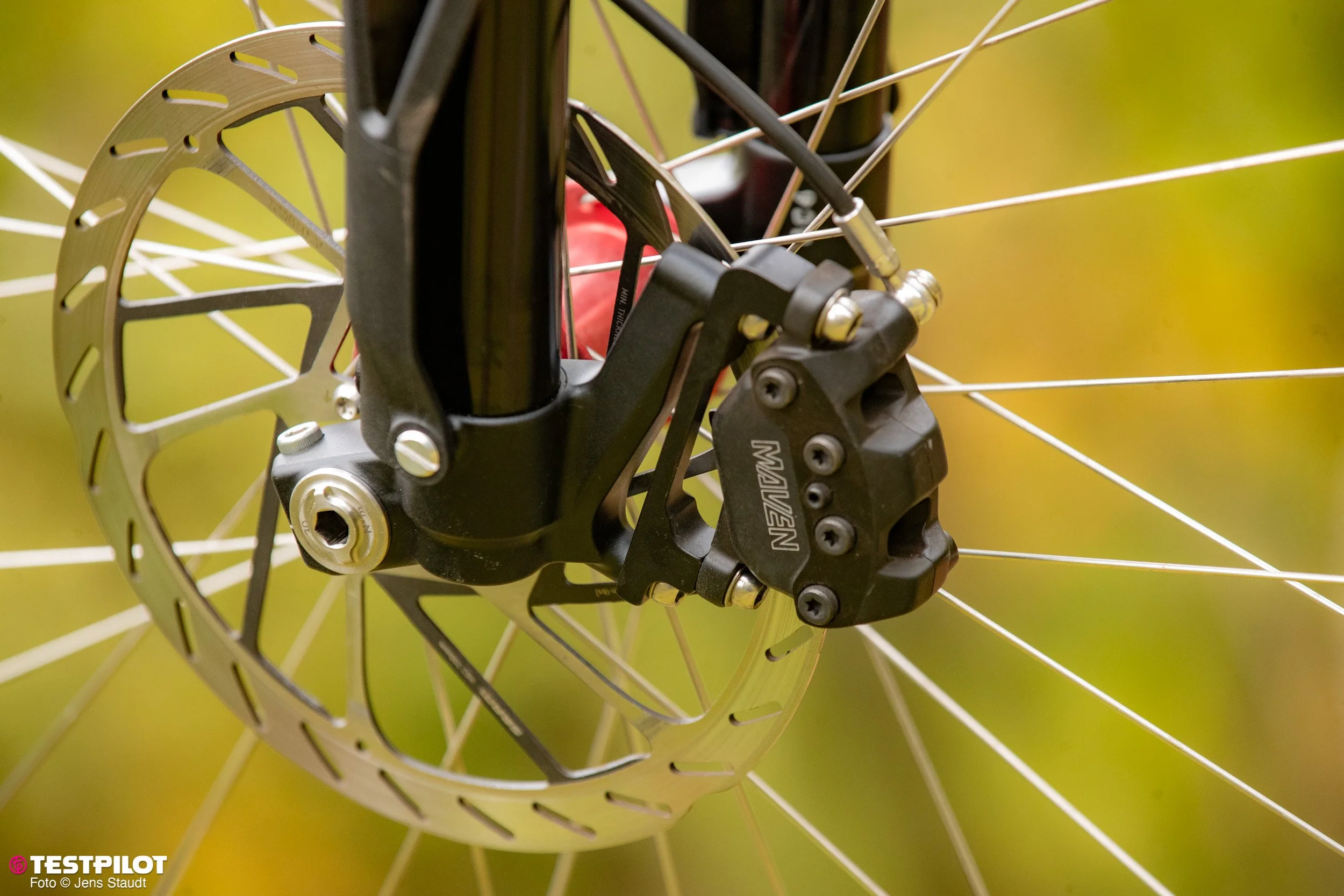
A PM160-brake mount seem a bit uncommon given the category of the fork.
the Philosophy behind the KYB 160 Coil Fork
With this new suspension fork, KYB transfers its decades of experience from motorcycle and motocross development into the mountain bike realm. This is evident not only in the upside-down architecture, but also in the piston guide design and proprietary damping valve.
In doing so, KYB takes a different approach from many established MTB suspension manufacturers: instead of a traditional air spring, it utilizes a coil spring paired with supplementary air assist. This combination is designed to unite a consistent spring feel with a customizable spring curve.
According to KYB, the upside-down construction is specifically engineered to reduce impacts and vibrations on rough terrain and at high speeds, aiming to increase riding comfort and reduce rider fatigue.
Setup the KYB 160 Coil Fork
There isn't much to fiddle with before your first ride. Once the appropriate spring rate (soft, standard, or hard) is installed, all that's left is dialing in the low-speed rebound and low-speed compression. And true to the motto "never touch a running system," KYB's engineers stick firmly to the moto world when it comes to setup as well; to make adjustments, you reach for the flathead screwdriver on your multitool.
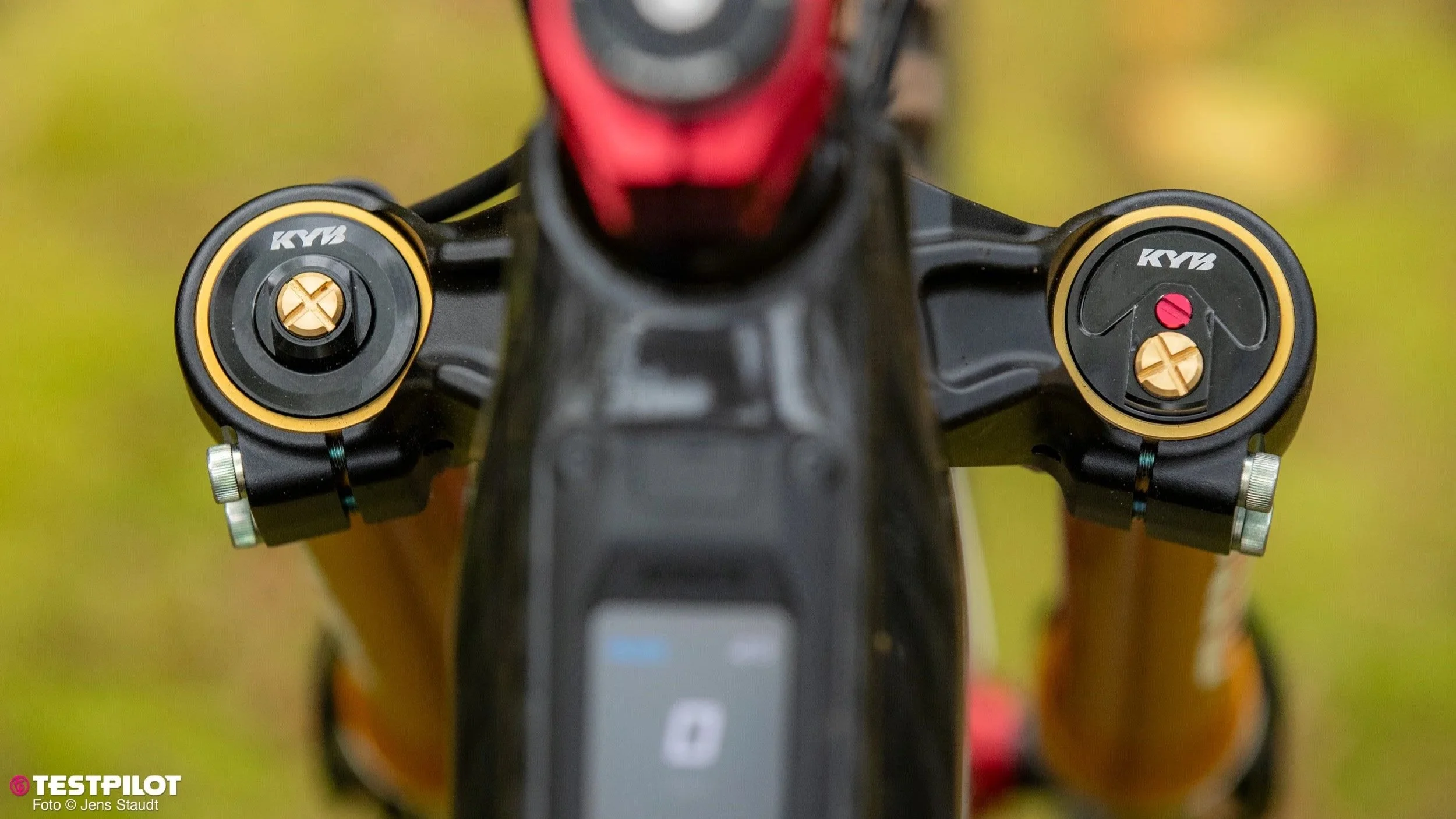
Left side: Air Assist valve (under golden cap) | Right side: Rebound (red), Air Assist valve (under golden cap)
The damping cartridge is housed in the right fork leg. On top sits a red rebound adjuster offering 2.5 stepless turns. On the underside of the right fork leg, tucked safely inside a shallow recess, is the gold compression adjuster with 20 subtle clicks. As is standard on most forks, you close (increase) both compression and rebound damping by turning clockwise.
KYB recommends starting with 5 clicks of compression (counting out from the fully closed position).
The rebound recommendation depends on the spring rate, also counted out from the fully closed position:
Soft = 1 ½ turns
Standard = 1 ¼ turns
Hard = 1 turn
KYB Setup Video
The left fork leg houses the coil spring and the Air Assist. Using a separate tool, the damper rod sitting above the spring can be unscrewed and simply pulled out. You then swap the spring and reassemble everything in the same order.
Spring Change Video
Beneath the gold cap on both the left and right fork tops sits an air valve. Anyone looking to add air volume via the valve to adjust ride height or mid-stroke support will need the included adapter and a shock pump. KYB recommends 0 to 8 psi, which raises the entire spring curve. Logically, both air valves function independently of one another and do not need to be inflated to the same pressure.
KYB told us to start with the valve on the spring side and, if needed, pressurize the damping side as well. For Red Bull Rampage contenders: a maximum of 15 psi is possible, though at that point the fork won't move much anymore.
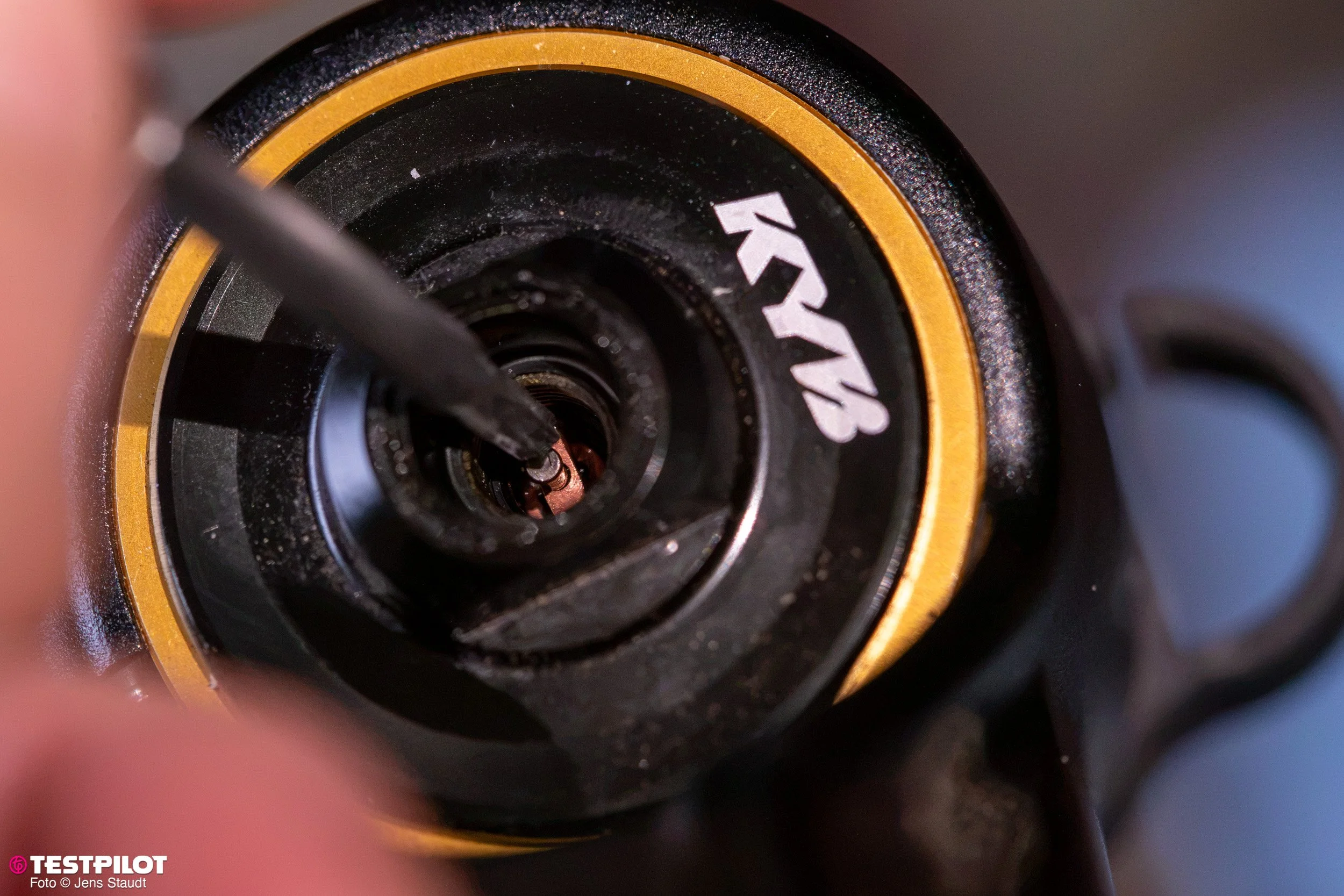
Both the left and right air valves also serve to equalize internal pressure. Anyone prioritizing the ultimate small-bump sensitivity and maximum coil feel should briefly bleed the fork before every ride—comparable to the push-button or pull-tab bleeders found on FOX, RockShox, and Push Industries forks. To achieve this, take an Allen key or a similarly thin tool and press the valve core. The adapter does not need to be screwed on for this. After bleeding the pressure, you simply re-establish your desired Air Assist pressure.
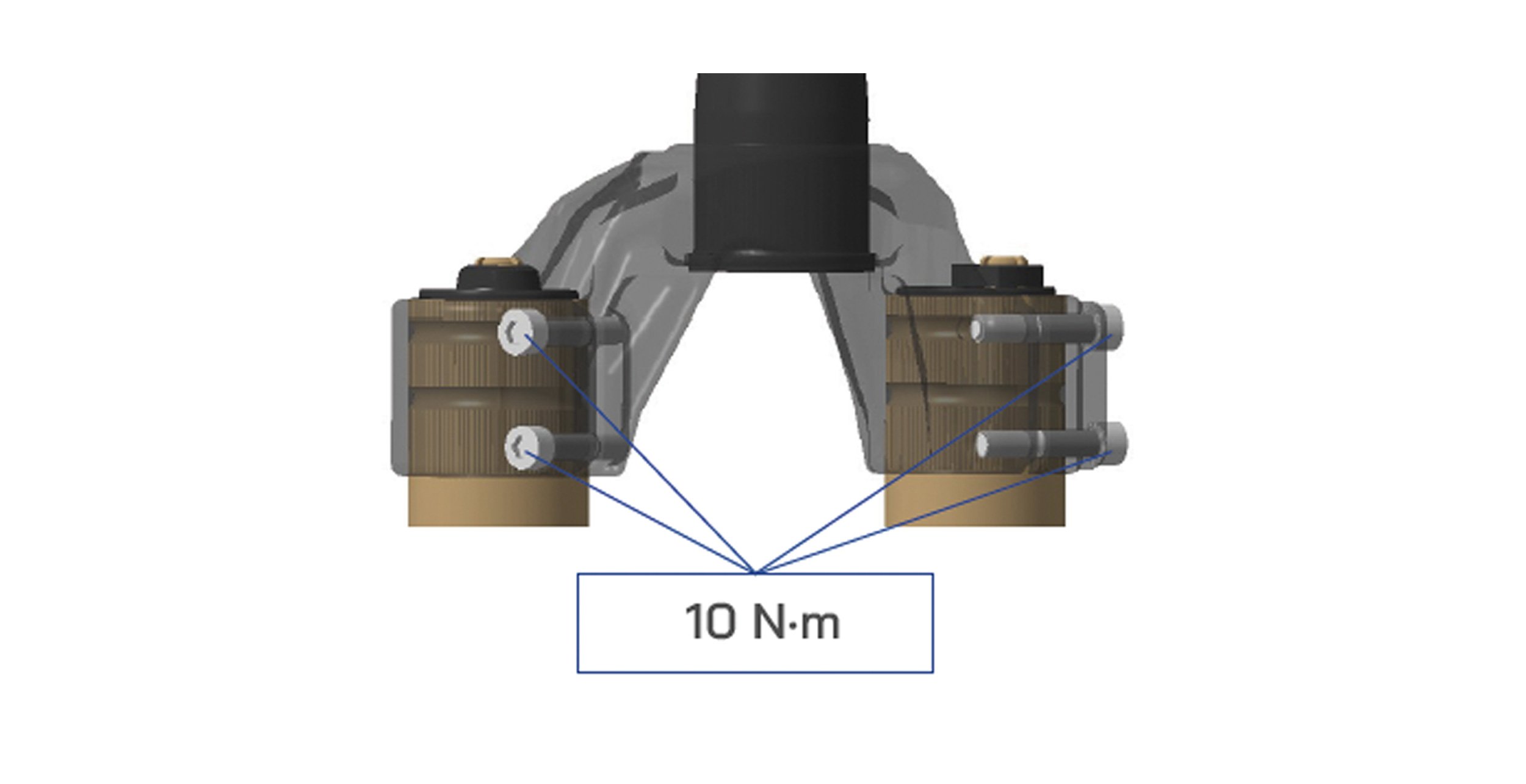
As mentioned at the outset, the fork can be run with either a 29-inch or a 27.5-inch front wheel. To accommodate this, the upper tubes feature a dedicated groove for each setup: upper groove = 29-inch; lower groove = 27.5-inch. To adjust the upper tube's position, loosen the pinch bolts on the crown and completely remove the top bolt. You can then slide the upper tubes into position, aligning the top bolt with the desired groove. Tightening the top bolt locks the upper tube in place. Both bolts are torqued to 10 Nm.
The axle calls for a hefty 30 Nm when installing the front wheel. Using an 8 mm hex key here helps prolong the lifespan of the axle interface. The two small pinch bolts that clamp the axle from above are torqued to 10 Nm. Even so, wheel installation and removal are a bit fiddly, as is typical for USD forks. Anyone who regularly disassembles their bike, travels with it, or wrenches on it frequently should keep this in mind and have an appropriate torque wrench on hand.
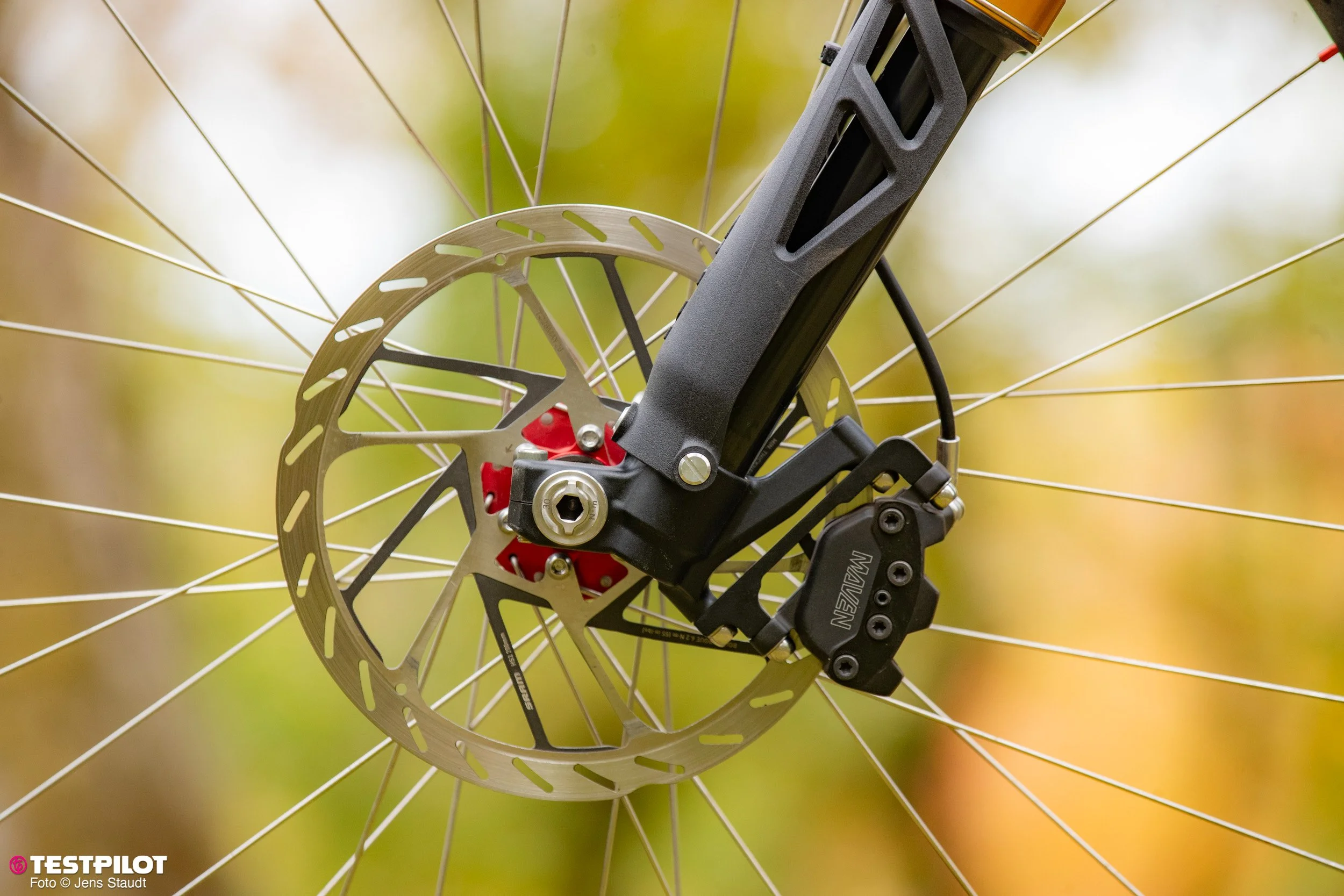
30 Nm and an 8 mm hex key. Using an appropriate torque wrench can help ensure a long service life.
On the Trail
For our initial real-world impressions, we tested the KYB across various mountain bikes and eMTB, running different spring rates and utilizing the aluminum version of the axle. The steel version needs to retested due to a later availability. To broaden our testing perspective, we teamed up with Jordan Hugo, who has a motocross background himself and tips the scales at 70 kg. Combined with Jens' 100 kg, we were able to gauge where the KYB stands in terms of stiffness and how the fork's weight interacts with rider weight to affect handling.
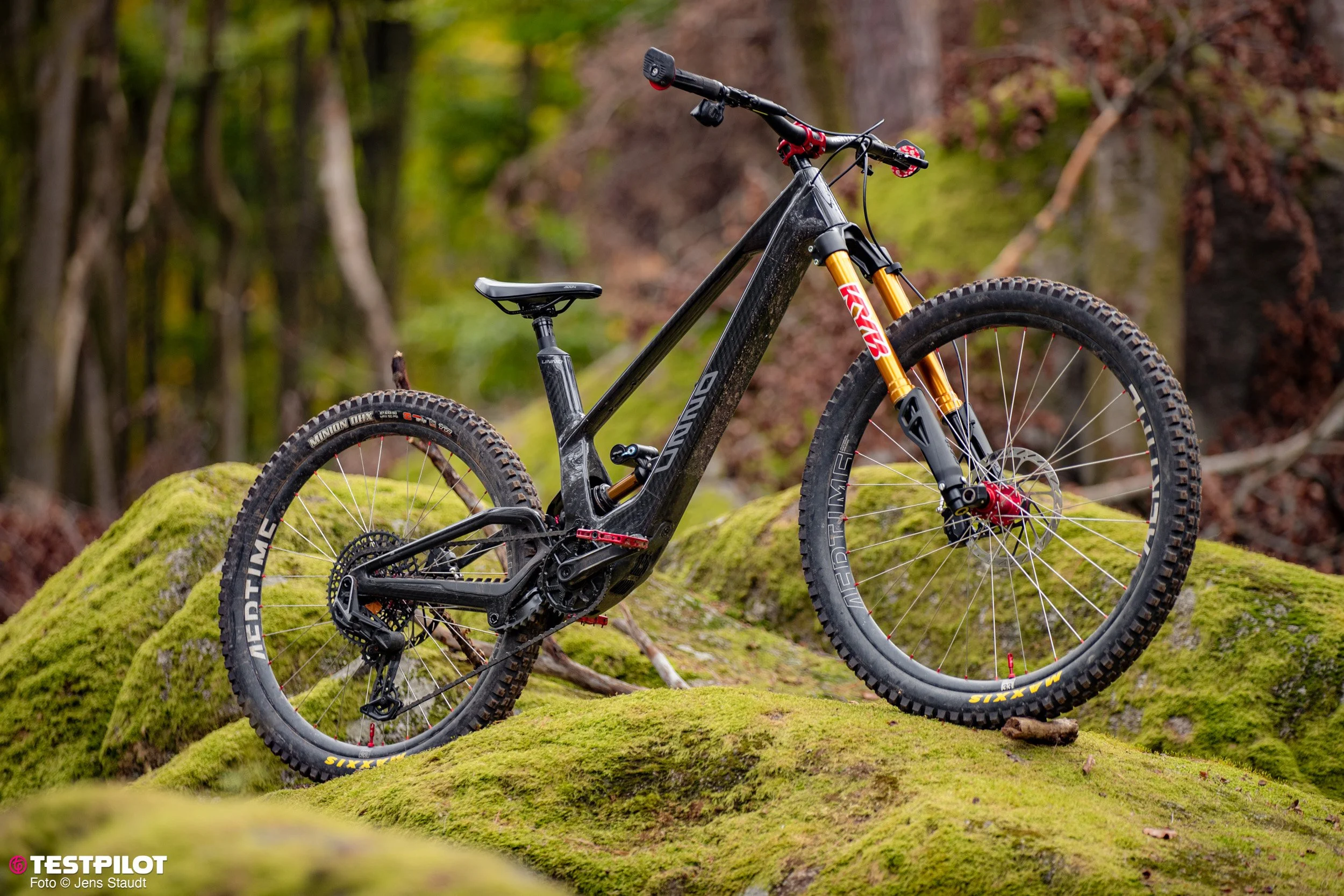
Die KYB 160 Federgabel testeten wir unter anderem in einem Unno Mith E-MTB. Wie wir finden, ein guter Match mit diesem schicken und filigranen Rahmen.
Small-Bump Sensitivity & Traction
Let's be frank: most suspension forks already operate at a very high level. Air springs allow for significant weight savings, bringing down the overall weight of your (mountain) bike. Nevertheless, coil springs command a die-hard following, not just in rear shocks, but in forks as well.
While air forks do exist in motocross, they are the exception; after a brief boom in the mid-2010s, they play virtually no role in racing today. Even KTM is returning to coil springs for next year's factory editions.
That extra edge in sensitivity is immediately noticeable on the KYB, too. Pairing a coil spring with an upside-down architecture naturally takes this to the extreme. On the trail, KYB’s debut offering turned out to be a traction monster in every riding situation and not just on initial bump absorption.
By design, the bushing overlap increases as the fork compresses, minimizing unwanted binding from flex. At the same time, the thicker upper tubes sit at the top, right where leverage forces are greatest, which brings us straight to our next point.

The upside-down construction paired with a coil spring delivers ultra-supple sensitivity and abundant traction.
Stiffness & Steering Precision
Upside-down mountain bike forks are often plagued by a reputation for lacking torsional stiffness. While they place more material (diameter) in the right spot, they lack a secondary brace in the middle. Visually, KYB’s debut looks well-proportioned on analog mountain bikes, especially if they aren't bulky carbon frames. On voluminous frames or eMTB, however, the scaling of the motorcycle fork looks dialed way back. Yet as is so often the case, anyone judging ride characteristics by looks alone has it all wrong.
41 mm upper tubes up top and 32 mm lower tubes down below, combined with the 20 mm thru-axle, the KYB rides differently than its appearance would suggest. Where the FOX Podium flexes its muscles with 47 mm uppers, 36 mm lowers, and a massive crown, KYB manages to deliver more than enough stiffness and tracking precision with less bulk.
Jordan’s speed was on full display during testing and in the video, and the stiffness was completely sufficient for him. Even during Jens' test rides, carrying 30 kg more (100 kg kitted up), the KYB remained completely composed, whether under hard braking, quick direction changes, or over off-camber roots.
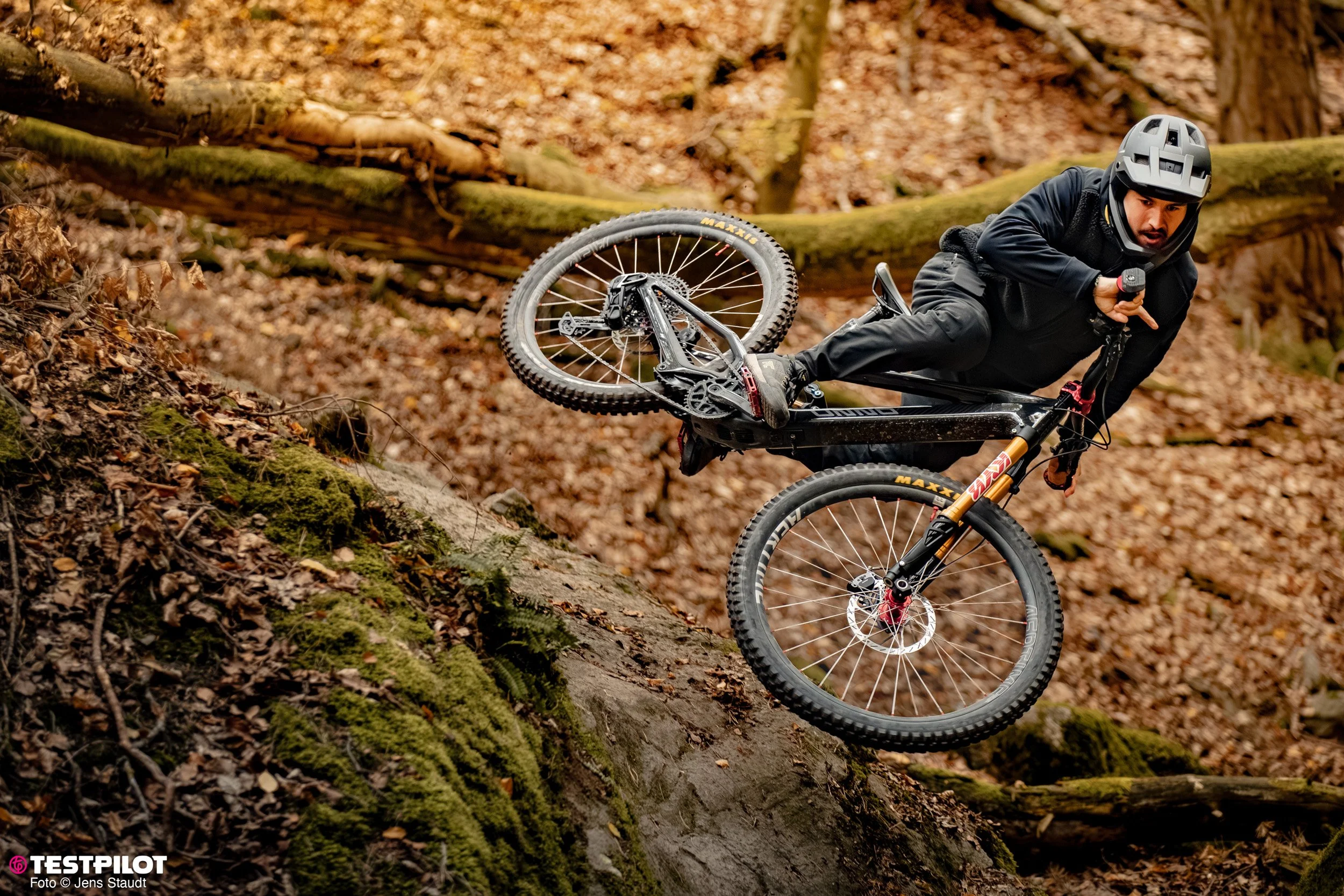
Jordan hammered the KYB with serious forces in every direction. Despite looking slimmer than its USD rivals, the KYB 160 suspension fork has nothing to hide when it comes to stiffness, a sentiment echoed by Jens even with his weight of 0.1 t.
Damping & Bottom-Out Resistance
On heavy compressions and high-speed hits, the open-cartridge damper shows off its MX pedigree. The rebound adjustment is stepless, much like on a Marzocchi Z1 Coil. We like to compare it to a volume knob: dial in more ("...but this one goes to eleven") and you get more rebound damping whenever you need it. Compression offers a 20-click adjustment range, allowing for fine-tuning in small increments.
What impressed us most was how uncomplicated the fork was to set up, offering a wide usable adjustment window. If you prefer a plush, soft ride where rocks and roots simply disappear, back off the compression damping and let the fork smooth out the trail. One turn clockwise, and the exact same hit uses less travel without sacrificing small-bump sensitivity.
During testing, we also got to ride an earlier prototype on the trails. On the final production version, the hydraulic bottom-out was well-tuned for our needs—and if you want more, you can simply bump up the pressure in the Air Assist.
Particularly exciting is the ability to firm up the fork's baseline spring rate. Testing different spring rates showed that even a heavier rider can comfortably run a spring one rate softer than KYB’s recommendation, provided enough air is added to the Air Assist. This feature proved especially helpful when swapping the fork between an analog MTB and an e-MTB, making it easy to adapt to the e-bike's extra heft. Anyone tackling the notoriously steep descents of the French Alps can also use the Air Assist ahead of a ride to compensate for the increased weight transfer onto the bars.
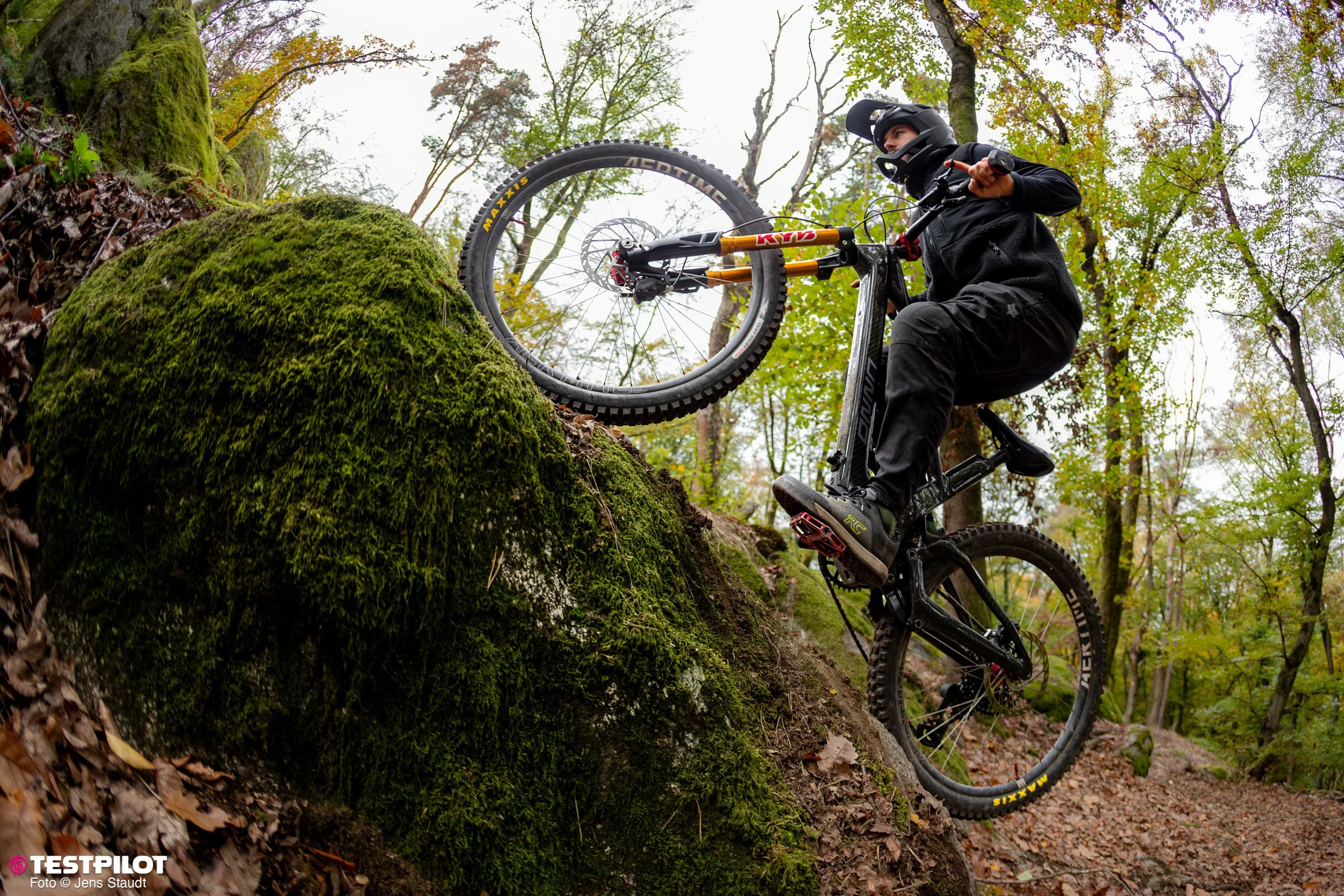
Need more (or less) support up front? Thanks to the Air Assist, the fork's baseline spring curve can be tailored with air.
Things to consider
The Air Assist is a great way to dial in your ideal ride height and active travel window. However, keep in mind that every suspension fork builds up internal pressure over time due to riding heat or elevation/temperature changes. Since the air valves also act as pressure bleeders, riders running zero air pressure (purely on the coil spring) should bleed the fork before every ride.
The same applies when running supplementary air support: as internal pressure rises during a ride, the amount of support creeps upward. Just like on any other fork, you need to equalize that pressure, and if you're using the Air Assist, simply top it back up to your target psi afterward.
The cycling world has slowly come around to the realization that ever-stiffer frames and components aren't the ultimate answer. USD newcomers are often harsh critics when it comes to increased flex, yet the benefits are obvious and worth embracing: more grip and less fatigue. Some manufacturers opt for 15 mm axles, Torque Caps, or 20 mm axles. KYB sticks with the latter—and if the KYB's handling still doesn't feel direct enough for you, you'll soon be able to upgrade to a steel axle, which adds a manageable 10 grams.
Conclusion
The selection of upside-down suspension forks is growing! KYB might be the new kid on the block but is backed by a deep background and serious know-how in motocross. And that pedigree is immediately noticeable in both its looks and its ride feel. The engineering team scaled down a dirt bike fork, and that is precisely how it rides: noticeably stiffer than you would expect given its dimensions, going about its business on the trail with total composure and zero fuss.
The KYB 160 suspension fork pairs genuine coil-spring feel with a solid damping adjustment range that literally takes the sting out of rough line choices and heavy hits. Anyone looking to simply charge hard and do it on an upside-down fork, should definitely take a closer look at the KYB.
You want more Reviews?

Author – Jens Staudt

Height: 191 cm
Weight: 103 kg
Riding style: With his racing background, the lines are planned, even if there is anything bigger in his way. If possible, sections will be jumped over. You should use the entire width of a trail. Others would say - uncompromising.
Motivation: A product should function carefree and for as long as possible. If you have to screw less, you can ride more. He likes to tinker and see how the bike can be optimized.